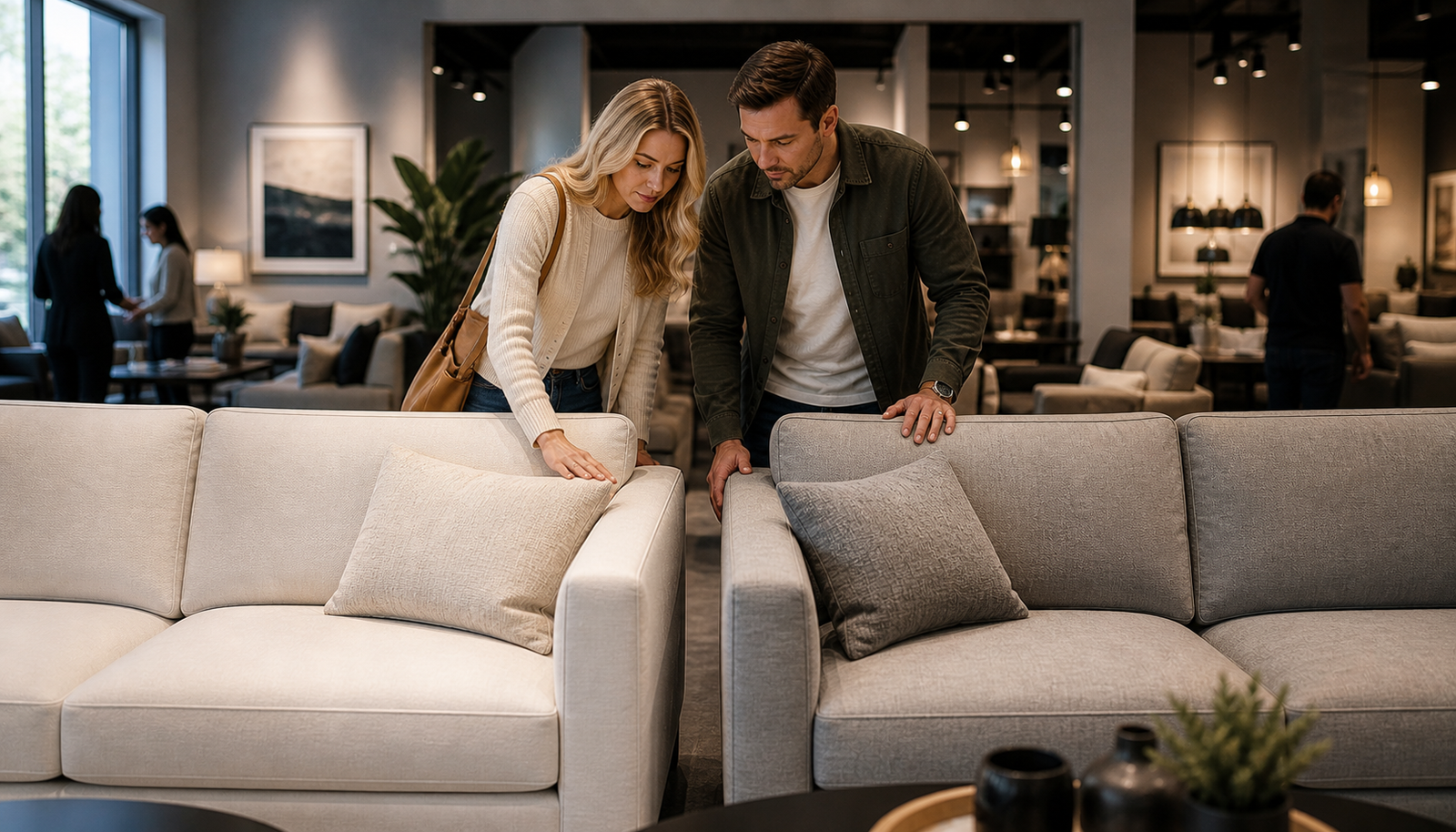
Floor Sample vs. Open-Box vs. Overstock: What’s the Difference?
Learn the difference between floor samples, open-box items, and overstock. Compare condition, warranties, pricing, and risks to shop smarter on FLRPL.

FLRPL Editorial Team
Author
Published in the FLRPL Journal | Buyer's Guide Series
TL;DR
- Floor sample, open-box, and overstock are not interchangeable — each reflects a different product history, pricing logic, and risk level.
- Floor samples carry the deepest discounts but come with visible wear and limited remaining warranty.
- Open-box condition varies widely; the return reason matters as much as the price.
- Overstock is new, unused inventory — lower risk, smaller discounts, full warranty.
- The label alone does not tell you whether a deal is good. Understanding what the label actually means is what does.
- Knowing these distinctions before you shop protects you from overpaying — and helps you recognize genuine value when it appears.
Three Sofas. Same Brand. Very Different Deals.
You are browsing local furniture listings and find three sectional sofas from the same manufacturer, all discounted from the same $2,800 retail price. One is labeled floor sample at $1,400. Another is marked open-box at $1,650. A third says overstock clearance at $1,750.
Which one is the best deal?
Most shoppers instinctively choose the lowest number. But the honest answer is: it depends entirely on what those labels mean — and most buyers have only a vague sense of that (see “How to Spot a Real Deal in 30 Seconds”)..
These three inventory categories represent genuinely different products. They have different condition profiles, different warranty implications, different risk levels, and different reasons for being discounted in the first place. Treating them as interchangeable versions of "discounted stuff" leads to predictable mistakes: paying too much for something in worse condition than expected, or passing on real value because the label triggered the wrong instinct.
Here is what each one actually means.
Floor Sample: The Showroom Veteran
A floor sample is exactly what it sounds like — a piece that has been living on a retailer's showroom floor, often for anywhere from three months to over a year. Shoppers have sat on it, opened it, tested it, and walked past it thousands of times. Sales staff have used it to demonstrate the product. It has been cleaned, possibly touched up, and eventually reached the point where it no longer earns its space at full price.
As explored in "Why Stores Want You to Buy That Deal," retailers are not discounting floor samples out of generosity — they are recovering floor space and converting a depreciating asset back into cash. The item's economic value to the store has dropped. Its value to you as a buyer may not have dropped nearly as much.
What to expect on condition: Upholstered furniture will likely show cushion compression, minor fabric wear on high-contact areas, and possibly some fading near windows. Wood and metal pieces may have surface scratches, scuffs on legs, or slight wear on hardware. Appliances typically show fingerprints, smudging on stainless steel, and door-seal compression from repeated opening. None of this is catastrophic — but it is real, and it is worth inspecting carefully before you commit (see “How to Tell If a Local Home Deal Is Actually Worth It”).
What to expect on pricing: Floor samples typically run 30 to 60 percent below retail, with the discount reflecting both condition and how long the item was on display. A recent floor sample in excellent shape from a premium brand might sit at 30 to 35 percent off. An item that has been on the floor for nearly a year in a high-traffic showroom should be closer to 50 to 60 percent off to justify the condition trade-off. If a floor sample is only discounted 20 percent, that is usually not enough to compensate for reduced warranty and as-is terms.
Risk level: Moderate — but assessable. Unlike open-box, the wear on a floor sample is visible and in front of you. You can see what you are getting. The main risks are cosmetic imperfection, limited remaining warranty coverage, and final-sale terms that leave you without recourse if something is wrong. Floor samples are almost always sold as-is, so thorough inspection before purchase is non-negotiable.
Floor samples tend to make the most sense when you want premium construction at an accessible price, you can live with cosmetic imperfection, or you need something available today rather than in eight weeks.
Open-Box: The Wildcard Category
Open-box is the most misunderstood label in discounted retail, and that misunderstanding costs buyers money in both directions — sometimes they pay too much assuming it is nearly new, sometimes they walk away from something genuinely pristine.
An open-box item is one that was purchased by a customer and subsequently returned, or a product whose packaging was damaged in transit or warehouse handling even though the contents were never touched. The common thread is that the item cannot be sold as new — but beyond that, the category spans an enormous range of actual condition.
A returned refrigerator that sat in someone's kitchen for three months is open-box. So is a sofa that was delivered, found to be two inches too wide for the doorway, and returned the same day without ever being assembled. Both carry the same label. Their condition, value, and risk profile are completely different.
What to expect on condition: This is where open-box requires the most buyer diligence. Like-new open-box — items that were simply unboxed or briefly inspected and returned for reasons unrelated to quality — can be virtually indistinguishable from new. Moderately used open-box items, returned after weeks or months of use, may show meaningful wear. The only way to know which you are dealing with is to ask directly: why was this returned, and how long was it with the previous buyer?
A seller who cannot or will not answer that question is a seller worth walking away from. Return history is documented in every legitimate retail system. Vague answers are a red flag, not a bureaucratic inconvenience.
What to expect on pricing: Open-box discounts typically run 20 to 40 percent off retail, calibrated to condition. Like-new open-box with full warranty is reasonably priced at 15 to 25 percent off. Items with visible use and uncertain warranty should be closer to 35 to 45 percent off to compensate for the added risk. Open-box items priced within 10 percent of retail are almost never a good deal. Items priced at floor sample levels — 50-plus percent off — should raise the question of whether something more significant went wrong that has not been disclosed.
Risk level: Moderate to high, depending on what you can verify. The primary risk is not the condition itself — it is the uncertainty about condition, warranty status, and return history. Open-box items can be exceptional finds or expensive surprises. The difference is almost entirely determined by how thoroughly the buyer vets the specific item before purchasing.
Open-box tends to make the most sense when you can inspect the item in person, the return reason is clear and benign, and warranty status has been confirmed — ideally in writing.
Overstock: The Low-Drama Option
Overstock is the most straightforward of the three categories. It refers to new, unused inventory that a retailer ordered in excess of what they could sell at full price. The product is factory-fresh and discounted because the retailer needs to free up capital or space — not because anything is wrong with it.
Common overstock scenarios include seasonal miscalculations (too much outdoor furniture ordered for a summer that underperformed), model-year transitions (the new refrigerator line arrived and last year's version is now surplus), and discontinued SKUs that are being cleared before the retailer reorders from the updated assortment.
The critical distinction: overstock is not old or compromised. It is simply excess. A dining table sitting in a warehouse for fourteen months, never assembled, never touched, is still a new dining table.
What to expect on condition: New. Overstock should arrive in original packaging, with all components, accessories, and documentation included. Minor box wear from warehouse storage is normal and irrelevant to product condition. If a listing describes something as overstock but the photos show visible use, scratches, or missing packaging — that is not overstock. It has been mislabeled, and you should treat it with the scrutiny you would apply to an open-box item.
What to expect on pricing: Overstock discounts are more modest than floor samples — typically 20 to 35 percent off retail for current-season excess, and 35 to 50 percent for discontinued models being cleared entirely. These smaller discounts reflect the lower risk: you are getting a new product with full warranty coverage and, in most cases, standard return terms. If a seller is offering overstock at 60 percent off with no explanation, that warrants the same skepticism you would bring to any deal that seems misaligned with the category.
Risk level: Low. Full manufacturer warranty, new condition, and standard return policies make overstock the most predictable of the three categories. The one nuance worth knowing: discontinued models may have limited parts availability or manufacturer support over time, so it is worth confirming that the brand still services the product line before committing to an appliance you plan to use for a decade.
Overstock tends to make the most sense when warranty coverage matters, you need multiple matching pieces, or you want the lowest-risk path to a meaningful discount.
How to Decide Which Is Right for You
The right category depends less on which sounds best and more on what you actually need from the purchase.
If maximum savings is the priority, floor samples are where the value lives.
A floor sample from a premium manufacturer at 45 percent off often delivers better long-term value than a new item from a budget brand — you are getting superior construction with surface-level wear, not a compromised product.
If you want near-new condition, carefully vetted open-box can be exceptional.
The operative word is carefully. Open-box rewards buyers who ask the right questions; it penalizes buyers who assume.
If warranty and predictability matter most, overstock is the right category.
You are paying a modest premium over floor sample pricing for the assurance that comes with a factory-fresh product and full coverage.
A practical note on availability: floor samples and open-box items are typically one-of-a-kind. If you need two matching nightstands or a full dining set, overstock is more likely to have the quantity. For single-piece purchases — a sofa, a refrigerator, a bed frame — all three categories are viable depending on your priorities (see “How to Find the Best Drops on FLRPL”). The "Will It Fit?" guide is worth reviewing before any of these purchases, because a deal on the wrong dimensions is no deal at all.
Red Flags Worth Knowing
Regardless of category, a few warning signs apply universally.
The label does not match the description. "Overstock" items with visible wear, "open-box" items the seller cannot explain, "floor samples" with no actual showroom location — inconsistency between category and reality is a signal to slow down.
Pricing feels misaligned in either direction. A floor sample at 70 percent off without explanation suggests undisclosed damage. An open-box item at 12 percent off is almost certainly not worth the condition trade-off.
Vague answers to direct questions. Return reason, display duration, warranty status — these are all answerable questions. A seller who deflects, generalizes, or redirects is not someone to buy a $1,400 sofa from without significantly more scrutiny.
Pressure tactics dressed up as urgency. Real inventory scarcity exists — but legitimate retailers do not need to manufacture it. "Why Waiting Costs You the Deal" covers the real version of that dynamic; high-pressure sales tactics are a different thing entirely.
The Label Is Not the Deal
Floor sample, open-box, and overstock are not tiers of quality — they are descriptions of origin. A floor sample in excellent condition with remaining warranty may be better value than an open-box item in fair condition with no coverage, even if the open-box item is priced higher. A discontinued overstock appliance at 40 percent off might represent a better long-term investment than a floor-model version of the same product — or it might not, depending on condition, category, and how you plan to use it.
None of these labels mean anything in isolation. They are the starting point for a conversation, not the end of one.
The buyers who consistently find and act on real value in local retail are not the ones who get lucky. They are the ones who understand what they are looking at. That is exactly the kind of inventory "How to Find the Best Drops on FLRPL" is built to surface — but knowing how to read the label when you get there is what makes the difference between a good find and a good decision.
The label tells you what it is. Understanding it is what makes it a deal.
Related Articles
Your Storefront Starts Before the Front Door
Shoppers often research before visiting a store. See how product-level visibility can help local inventory become discoverable before they reach the front door.

The Inventory Is Already There. The Audience Isn't.
Local retailers already have inventory on the floor. See how product-level discovery can give that merchandise another way to be discovered by nearby shoppers.
The Showroom Can Be Discovered Before the Visit
A physical showroom holds more than its storefront can communicate. See how product-level discovery can make local inventory visible before a shopper visits.
Discover What's Waiting Nearby
Browse inventory from verified local retailers near you.