Why the Best Fitness Equipment Deals Usually Happen Before New Year's
Most buyers shop for fitness equipment in January. Many of the best deals happen before it. Learn how floor samples, retailer inventory pressure, discontinued models, and local pickup shape real fitness equipment pricing.

FLRPL Editorial Team
Author
TL;DR
- Consumer demand peaks in January, but retailer urgency to discount peaks before it — typically in late fall and pre-holiday weeks.
- Bulky fitness equipment (treadmills, rowers, spin bikes, home gyms) creates compounding storage pressure that pushes retailers toward sharper markdowns before the resolution rush begins.
- Floor samples, discontinued models, and open-box returns reach their highest negotiation potential when stores are clearing display space ahead of new seasonal assortments.
- January shoppers often pay more for the same products than buyers who acted in November or December, because demand expansion gives retailers less incentive to discount.
- Local pickup fundamentally changes the math on large fitness equipment — freight costs on heavy items can easily erase any national e-commerce "sale" advantage.
- Experienced buyers follow retailer pressure, not personal motivation — the best deal appears when the store needs the unit gone, not when the buyer's resolution is sharpest.
The Illusion of the January Sale
Every year, without fail, the first week of January produces a predictable consumer behavior pattern: millions of people who spent December eating, celebrating, and quietly feeling guilty about it suddenly decide this is the year. The treadmill, the rowing machine, the bike that's been in a vague mental cart for eighteen months — January is finally the moment.
The fitness industry knows this. Retailers know this. And if you're paying attention, that's precisely the problem.
The conventional wisdom is that January brings deals because stores are clearing holiday excess and motivating resolution shoppers. There's a kernel of truth in that story, but it misses a more interesting structural reality: by the time you've resolved to buy a piece of fitness equipment in January, you've already missed the window where retailers had the most reason to move it at a discount.
This isn't a counterintuitive trick or a contrarian take for its own sake. It's simply what happens when you understand how inventory pressure actually accumulates in a physical retail environment — and why oversized, expensive-to-store equipment operates by different rules than a sweater or a phone case.
How Seasonal Inventory Pressure Really Works
Retail inventory strategy is fundamentally a space problem. A sweater can fold flat. A 250-pound treadmill cannot. And that distinction — which seems obvious when stated directly — shapes the entire discount trajectory of fitness equipment in ways that most consumers never think to consider.
Fitness retailers, sporting goods chains, and specialty showrooms typically receive their largest equipment assortments in late summer and early fall, positioning inventory for the Q4 gifting season and the anticipated January demand surge. By October and November, showroom floors are stocked, display models are set, and backroom inventory is beginning to accumulate. The clock is already ticking.
Here's where the math gets interesting. A floor sample treadmill sitting in a 40-square-foot showroom footprint is not a passive asset — it's an ongoing cost. Every day it remains unsold represents occupied premium retail real estate, staff time spent managing it, and opportunity cost against newer models arriving for spring assortments. When a retailer shifts from one seasonal line to the next, that display unit doesn't quietly disappear. It becomes a problem that needs a practical solution.
The global home fitness equipment market was valued at approximately $12.88 billion in 2025, according to Fortune Business Insights, with offline retail channels still commanding roughly 65% of sales volume. That means local showrooms and specialty retailers — not e-commerce — remain the dominant venue for fitness equipment transactions. And in physical retail, space is the constraint that creates pricing opportunity.
"The best purchase moment is not when the buyer's wish is strongest, but when the seller is under the most pressure to move inventory."
That pressure doesn't peak in January. It builds toward it.
What Gets Discounted, and Why
Not all fitness equipment is created equal from an inventory management standpoint. The categories with the most negotiating potential tend to share three characteristics: they're large, awkward to store, and expensive to transport. In practical terms, this means treadmills, rowing machines, spin bikes, cable machines, and multi-station home gym systems.
These are the products that, once a store is done displaying them, become immediate storage problems. A discontinued treadmill model that's been on the showroom floor for eight months occupies the same square footage as its replacement will — but it no longer commands the same consumer interest or retail margin. The calculus for a local retailer becomes straightforward: move the old unit at a reduced price and reclaim the floor space, or carry it into the peak January season and compete against yourself.
This is where discontinued models offer a particularly strong value proposition for informed buyers. Once a manufacturer releases an updated version, the previous model loses its reference point. Consumers comparing it to the newer unit naturally perceive it as inferior, regardless of whether the actual functionality gap justifies the price difference. Retailers lose pricing power almost immediately, which means motivated sellers and motivated discounts tend to appear on the same timeline — before the new model officially takes center stage.
Open-box and returned units follow a similar trajectory. A treadmill returned after 30 days may be functionally indistinguishable from new, but it's been removed from its original packaging, which means it can no longer be sold at full retail without customer skepticism. It needs to move, which means it will move cheaper — and the timing of that repricing is driven by internal inventory cycles, not the consumer calendar.
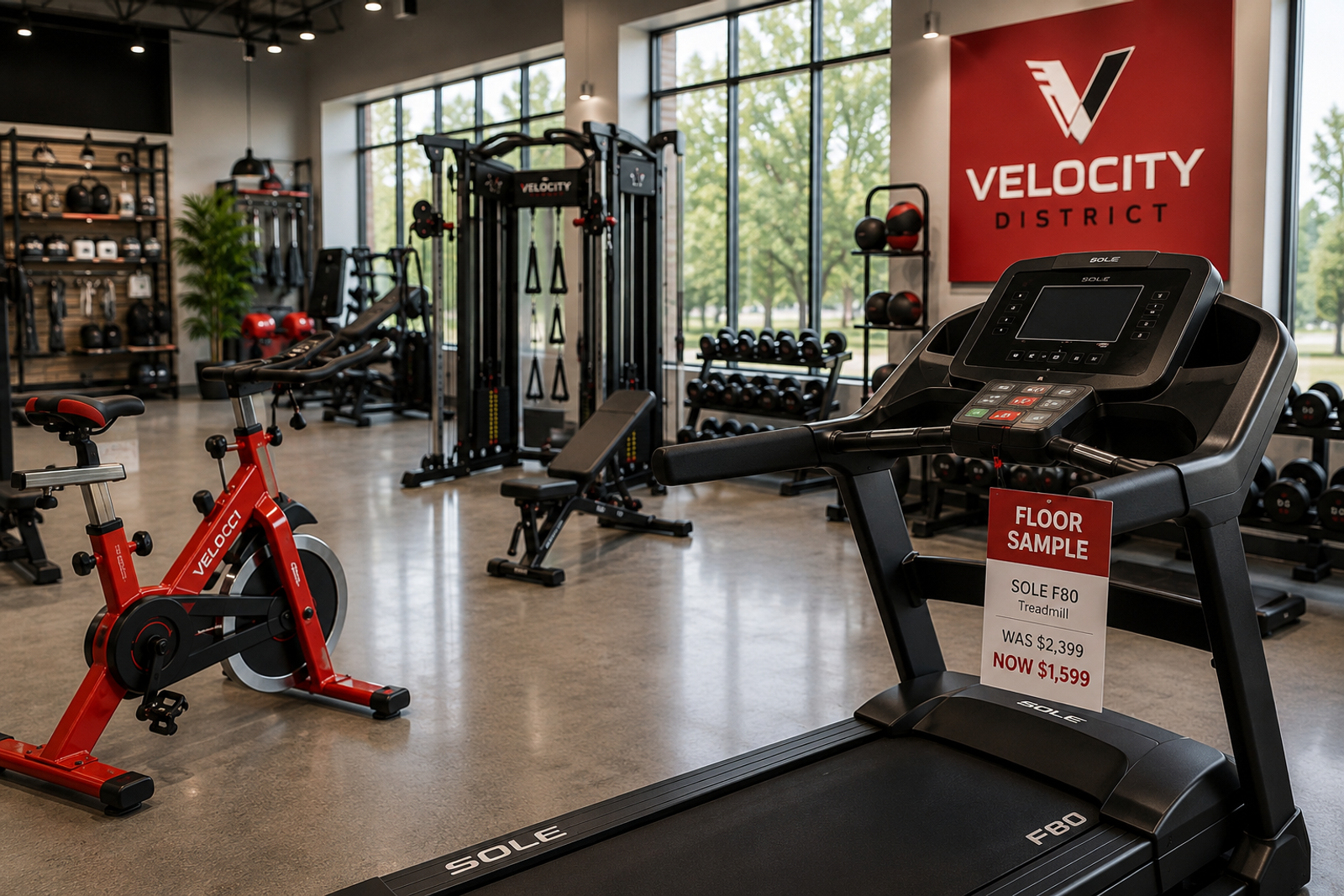
Floor samples exist in their own category. A showroom machine that's been demonstration-ready for a selling season has genuine wear, but it's also been maintained, assembled by professionals, and is often available for immediate local pickup. When a store refreshes its display floor, former samples don't get returned to manufacturers — they get repriced, often aggressively, because the alternative is a storage problem.
The New Year's Resolution Trap
A 2026 consumer survey found that "exercising more" ranked as the top New Year's resolution, with approximately 25% of adults citing it as a priority. That's a significant demand signal, and it's one that retailers have understood for decades.
What that demand signal actually does to pricing is more nuanced than most shoppers expect.
When a large pool of motivated, slightly impulsive buyers enters a retail category simultaneously, sellers don't need to discount to generate sales — they need to stay in stock. The January fitness rush rarely creates a buyer's market; it creates a seller's market, particularly for in-demand, readily available equipment. Stores can hold price, bundle accessories, and move product at firmer margins precisely because the consumer is now motivated enough to pay.
The buyer who arrives in January believing the "New Year's sale" represents the year's best value is often experiencing a very human cognitive error: confusing the peak of personal motivation with the peak of market opportunity. These two things almost never align in the same direction.
Research on consumer price psychology reinforces this dynamic. Heightened motivation tends to increase a buyer's willingness to pay, not decrease it. The person who needs a treadmill right now for their resolution is statistically more likely to accept a weak discount than the person who bought the same unit in November for reasons that had nothing to do with the calendar.
When the Real Windows Open
The practical question, then, is when to buy — and the answer isn't a single date but a set of retailer-driven conditions worth learning to recognize.
Late fall (October through mid-November) is often the first window. Retailers are managing fall inventory, refreshing showroom assortments for the holiday season, and already anticipating the January demand spike. Display models from the current year begin to age, and the window between "this is our current assortment" and "this needs to clear" starts to open.
Pre-holiday weeks (late November through December) can be particularly strong for large, bulky items that retailers don't want carrying into a busy showroom floor when January foot traffic peaks. A local retailer who is already thinking about January doesn't want a floor clogged with stale inventory when motivated New Year's shoppers arrive. That's a meaningful incentive to price aggressively and move product.
Late January and early February offer a secondary window that many consumers miss entirely. Once the resolution rush subsides — typically within two to three weeks — unsold inventory that wasn't cleared in December becomes a problem again. Retailers who overestimated the January demand surge are left with units that now need to compete against a buyer pool that has largely moved on.
Spring transitions bring a third round of repricing as retailers make space for outdoor, recreational, and seasonal categories. This window is particularly interesting for anyone who can be patient.
"The buyer who watches local inventory continuously often wins over the buyer who shops only when motivation peaks."
Local Retail Changes the Equation Entirely
One factor that national retail coverage almost never addresses: freight costs on heavy fitness equipment are not marginal. They're often deal-breaking.
A treadmill that's being discounted 20% on a national e-commerce platform may cost $200–$400 to ship, require scheduling a delivery window, arrive in pieces requiring professional assembly, and come with a return policy that's effectively unusable given the logistics involved. The net price after friction can easily match or exceed the local retail price for a comparable floor sample.
Local and regional retailers understand this, and the best of them use it strategically. A local pickup sale on a floor sample or discontinued model removes the freight variable entirely. The buyer inspects the unit in person, understands its condition, and takes possession on their own schedule. For heavy equipment specifically, this is a fundamentally different transaction than clicking "buy now" on a logistics-dependent national listing.
The floor sample category exists precisely at this intersection. A machine that's been on display is already assembled, already local, and already priced to reflect its display history rather than its functional quality. For buyers who take the time to inspect it properly — checking mechanical condition, testing key functions, understanding any cosmetic wear — the floor sample can represent the single best value in the category.
This is the retail channel where inventory pressure, local geography, and buyer diligence converge into the kind of deal that doesn't show up in national sale roundups. It is also where many of the best deals actually hide. It requires some patience and a willingness to engage with the actual product rather than a product photo. But the economics, for informed buyers, are consistently stronger than what January advertising cycles produce.
How Experienced Buyers Think
The fundamental difference between a reactive buyer and a strategic one isn't access to information — it's the question they're asking. This is often what separates experienced buyers from reactive ones.
A reactive buyer asks: Is this the right time of year to buy fitness equipment?
A strategic buyer asks: Which specific retailer, in my specific market, has a specific unit they need to move — and why?
The second question is harder but answerable. Local inventory changes constantly. Display floors get refreshed. New model introductions create instant obsolescence for predecessors. Returns accumulate. Overstock from a buying miscalculation needs to clear. These conditions don't follow a national promotional calendar; they follow the internal operations of individual retailers who are solving for cash flow, floor space, and inventory efficiency.
This is why the best fitness equipment deals tend to be local, specific, and time-sensitive in a way that has nothing to do with January 1st. A store in your market might be clearing a showroom's worth of demo equipment in November because a major brand refresh is coming. Another might be sitting on six returned rowers in January that nobody claimed. These aren't national deals — they're local conditions that create local opportunity.
The home fitness category has demonstrated genuine staying power. The share of consumers doing home workouts rose from 24% in 2019 to 34% in 2020, peaked at 36% in 2021, and stabilized at 33% in 2022 — suggesting that home fitness has become a normalized behavior, not a pandemic artifact. That normalization means the inventory cycles are more predictable than they were in the volatile 2020–2021 period, and the buyer who understands those cycles has a consistent, repeatable advantage.
The Informed Buy: Bringing It Together
Fitness equipment is an unusual retail category because it sits at the intersection of emotional purchasing and spatial logistics. It's expensive, identity-adjacent, and purchased by people whose motivation is often at its most sincere when the market conditions are least favorable to them.
The resolution shopper who walks into a store in January is experiencing real motivation, and that motivation is worth something. But motivation isn't market timing. The retailer on the other side of that transaction knows the difference between a buyer who's there because of the calendar and a buyer who's there because they've identified a specific unit with a specific carrying cost problem.
The latter buyer wins more often. They win because they've separated the emotional moment — "I want to get in shape" — from the transactional moment — "this store needs this machine gone before Thursday."
That's the simple insight that most fitness equipment buying guides miss: the deal is driven by the retailer's clock, not the consumer's. And the retailer's clock — shaped by inventory cycles, storage pressure, display refreshes, and model discontinuation timelines — tends to run fastest in the weeks before the resolution rush, not during it.
The floor sample, the discontinued model, the open-box return, the showroom pull — these are categories where a retailer's need to solve an inventory problem and a buyer's opportunity to capture value can genuinely overlap. That overlap is most likely to produce the best outcome when the buyer is paying attention to the right signals, shopping local channels where freight complexity doesn't dilute the discount, and measuring the deal against the retailer's urgency rather than their own.
January is a fine time to want a treadmill. The timing is not always as generous to the wallet as the season suggests. The months immediately before it, and the weeks immediately after the surge subsides, are where the more interesting math tends to live.
Related Articles

Your Store. Your Merchandise. Your Digital Outlet.
Give your store a digital outlet. See how FLRPL helps local retailers showcase products, share their branded storefront, and connect with nearby shoppers.


You Don't Need Everyone to See It
Local merchandise doesn't need everyone to see it. Explore why proximity, availability, timing, and relevance all matter in local retail discovery.

Not Every Drop Has to Be a Deal
A Drop doesn't require a markdown. See how retailers can use FLRPL to feature new arrivals, seasonal merchandise, distinctive products, deals and more.
Discover What's Waiting Nearby
Browse inventory from verified local retailers near you.