
Why Great Local Inventory Often Goes Unseen
Many local retailers already hold exactly what shoppers are looking for — floor samples, overstock, discontinued pieces at real prices. The problem isn't the inventory. It's that the right buyer never knew it existed. FLRPL Journal explores the discovery gap in local retail.

FLRPL Editorial Team
Author
The merchandise is already there. The price is already right. The problem is that the right buyer has never seen it.
TL;DR
- Valuable local inventory — floor samples, overstock, discontinued models, clearance goods — frequently goes unsold not because it is overpriced or unwanted, but because the right buyer never encounters it.
- A clearance tag only reaches shoppers who are already inside the store. Most potential buyers are never inside.
- Modern consumers discover products through search, marketplaces, and digital comparison — channels where local store inventory is largely absent.
- Owning inventory and having visibility in the market for that inventory are two entirely different things. Many independent retailers hold one without the other.
- When the discovery gap closes, both sides benefit: shoppers find genuine value, and retailers recover capital from inventory that was already sitting there.
The Credenza in the Back of the Store
There is a furniture showroom in a mid-sized city. Near the back, partly obscured by a newer display, sits a solid-wood credenza — a floor sample from a discontinued line. It is in excellent condition. It has been meaningfully reduced from its original price. By almost any measure, it is a legitimate find.
It has been sitting there for four months.
The store owner knows it is there. The sales staff knows it is there. A small handwritten tag communicates the markdown. And yet the credenza remains — patient, quiet, and invisible to everyone who has not physically walked into that specific store on one of those specific days.
This is not a story about a flawed piece of furniture. It is not a story about a struggling retailer or a slow market. It is a story about visibility — about the wide, largely unexamined gap between inventory that exists and inventory that gets discovered.
That gap is the subject of this article.
What Inventory Visibility Actually Means
Inventory visibility, in its clearest form, means knowing what is in stock, where it is, and whether it is genuinely available to a buyer at any given moment. In a well-run retail operation, that knowledge exists internally — the store knows what it has, what is priced to move, and what has been sitting too long.
But internal knowledge is not the same as market visibility. A retailer can have complete awareness of everything on their floor and still have zero presence in the channels where shoppers are actively looking for exactly those items.
There is a specific category of inventory that is uniquely prone to this problem. Floor samples, display pieces, overstock, discontinued models, end-of-season goods, one-off items that came in as part of a larger purchase — these share a common characteristic. They are not replenishable. They are not standardized. They often represent genuine value, sometimes exceptional value. And they are, almost by definition, harder to surface than ordinary catalog merchandise.
A regular in-stock product has a product page, a search listing, a category entry on a national platform, possibly a manufacturer's website driving traffic toward it. A floor sample has a tag on its leg. An overstock piece has a shelf position. A discontinued item has, at best, a handwritten sign and whatever foot traffic happens to pass it.
For a deeper look at what floor samples specifically represent — and why they are often among the most attractive items in a showroom — the article What Is a Floor Sample? covers the mechanics in useful detail. The broader point stands regardless of category: non-replenishable, irregular inventory is structurally harder to discover than standard product lines, and the discovery systems most shoppers rely on were not designed for it.
A Clearance Tag Is a Communication Tool With a Hard Ceiling
Walk through any furniture showroom, appliance retailer, lighting gallery, or outdoor living store and you will find some version of the same scenario. A compelling piece — reduced, available, ready — sitting in plain sight for anyone standing in front of it.
That last phrase is the entire problem.
A clearance tag is a communication tool, but it has an absolute ceiling on its audience. That ceiling is the number of people who physically enter the store during the window the item is available. In a typical independent retailer, that is a finite and relatively predictable group: the existing customer base, occasional foot traffic from passersby, and whoever happens to be in the market at that moment.
It does not reach the couple who just moved and are shopping for their new home from their couch at 10pm. It does not reach the interior designer looking for a specific piece to complete a project. It does not reach the shopper who would drive across the city for the right find but has no particular reason to know that this store, in this location, has exactly what they are looking for.
Consider a few real-world variations of this pattern.
In a lighting showroom, clearance tags are placed throughout the floor — pendants, sconces, flush mounts, discontinued fixtures that have been genuinely reduced. The store is well-organized and the tags are visible. For anyone who walks in, the deals are apparent. But the audience for those deals is limited entirely to walk-ins, and walk-ins on any given day represent a narrow slice of the broader pool of shoppers who might genuinely want those fixtures if they knew they existed.
In an appliance store, discontinued floor models sit alongside current inventory. These are working appliances, often with full warranties, priced well below their original retail. The value is real. But the shopper researching refrigerators online — comparing models, reading reviews, checking availability — will not encounter those floor models in their search. The store's floor inventory does not appear in product feeds, comparison engines, or the shopping results that now define how most appliance purchases begin.
In a furniture retailer, a heavily discounted sectional sits toward the back of the showroom floor. It has been marked down twice. The retailer genuinely needs to move it before a new delivery arrives. The motivation to sell is high, the price is competitive, and the quality is exactly what a range of buyers would want. It sits quietly for two more months before finally selling to a customer who happened to come in looking for something else entirely.
In every case, the markdown was real. The motivation was genuine. The obstacle was not the price or the merchandise. The obstacle was that the right buyer never appeared, because the right buyer had no way to know the item existed.
After visiting furniture stores, appliance showrooms, lighting galleries, and kitchen-and-bath retailers, the pattern becomes difficult to ignore: valuable inventory is often available today, but only to the people who already know where to look.
How Shoppers Actually Find Things Now
Understanding why local inventory goes unseen requires being honest about how modern shoppers actually behave — not how retailers might hope they behave, but the real mechanics of how people find products to buy.
The answer, in most categories, is that they search. They browse marketplaces. They compare. They use platforms built specifically to surface options, filter by criteria, and present ranked choices efficiently. Over roughly two decades of e-commerce habit formation, the majority of shoppers have been trained to expect that what they need will appear digitally before they ever need to visit a physical location.
This is not laziness or indifference to local commerce. It is genuine efficiency. A shopper looking for a dining table in a specific size, finish, and price range can, in a few minutes, survey dozens of options across national retailers, resale platforms, and marketplace listings. They can filter, compare, save, and return to their research later. This is meaningfully better than driving to stores with no guarantee of finding what they want.
The challenge is what gets left out of those digital paths. Local inventory — particularly the kind that is irregular, non-replenishable, or simply not listed online anywhere — is largely absent from these searches. The shopper who is actively in the market for a mid-century credenza may never know there is one available twelve minutes away, already marked down, already available today. Their search surfaces national platforms, resale listings, and in-stock catalog items. The floor sample at the local retailer does not appear because it is not in the feed.
This is the core of the discovery gap. The problem is not that shoppers are unwilling to buy locally or prefer national platforms on principle. Many shoppers actively want to buy local — the service, the ability to see something in person, the relationships that good independent retailers build over time. The problem is that local inventory is often not visible in the channels where discovery now happens. If it cannot be found, it cannot be considered. If it cannot be considered, the sale does not occur.
Where Deals Actually Hide and Why You Don't See Them Online examines some of the specific mechanisms behind this gap. The structural point, however, is consistent across categories: digital discovery paths are powerful, but they surface what has been prepared for digital visibility. Irregular local inventory has rarely been prepared for anything.
Owning Inventory and Owning Visibility Are Two Different Things
"The problem isn't always the inventory. Sometimes the problem is that the right buyer never knew it existed."
This distinction is underexamined in most conversations about local retail, and it matters more than it might appear.
A retailer who owns a floor sample owns the object. They own the right to sell it, they set the price, they manage the floor space it occupies, and they carry the cost of keeping it until it finds a buyer. In the most literal sense, the item is theirs to sell.
What they do not automatically own is visibility into the market for that item. Visibility belongs to whoever controls the channel where the relevant buyer is actively searching. In most product categories today, that channel is somewhere other than the physical showroom. It is a search engine results page. It is a marketplace feed. It is a comparison platform that a shopper is browsing from their home.
This reframing changes how we understand why inventory sits unsold. The conventional explanation defaults to pricing: if something is not selling, it needs to come down in price. Reduce the tag. Put it on clearance. Mark it down again. This logic treats the problem as a valuation issue — the item is not moving because the price has not yet found the right buyer.
Visibility-based thinking asks a different question: has the right buyer actually been reached?
If an item exists in a showroom that a shopper has never visited, in a building they have never passed, listed on no platform they have ever browsed, then the price is almost beside the point. Not because the buyer would not pay it. Because the buyer does not know the item exists.
A markdown does not create awareness. It creates value for buyers who were already going to find the item. But for the buyer who never encounters the listing — who never knew to look — no amount of price reduction closes the gap. Only visibility does that.
Why Independent Retailers Face a Discovery Challenge
None of this is a criticism of independent retailers. It is worth saying that plainly, because discussions about digital visibility and local retail can carry an unspoken implication: that stores with visibility gaps are simply behind, under-resourced versions of businesses that should be doing more.
That reading misunderstands what it actually means to operate an independent retail store.
A local furniture dealer, lighting showroom, or appliance retailer is not a media company. It is not a technology company. It is a business organized around a showroom floor, a service team, a vendor network, a delivery operation, and a customer relationship built over years — and in some cases, generations. On any given day, the owner or manager is coordinating installations, managing staff, receiving deliveries, handling vendor changes, resolving customer service issues, and responding to the immediate needs of people who are physically present in the store.
Creating and maintaining a searchable, digitally visible inventory — the kind that surfaces in the channels where modern shoppers discover products — is a separate discipline entirely, and it is a demanding one. It requires platform familiarity, consistent effort, content creation, and ongoing maintenance. For a team already stretched across the genuine demands of operating a retail business, this is not simply a matter of choosing to prioritize it. It is a capacity question.
The visibility gap is not incompetence. It is the predictable outcome of a discovery environment that increasingly demands digital presence, in a sector built — and continuing to operate — primarily as a physical environment. The store is structured to do what stores do. The digital discovery channels are structured for something different. The gap between those two realities is structural, and it affects excellent retailers with valuable inventory as reliably as it affects anyone else.
What Shoppers Miss When They Only Look Where They Always Look
"A markdown does not create awareness. It only delivers value to shoppers who were already going to find the item."
There is a category of inventory that national platforms structurally cannot serve: the genuinely local, the genuinely irregular, the item that exists in one quantity in one location and will not be replenished once it is gone.
Floor samples are almost definitionally in this category. So are display pieces being retired from a showroom refresh. So are overstock items from a vendor order that ran long, discontinued lines a retailer purchased in quantity, and seasonal goods that did not move before the calendar shifted. These items do not have manufacturer pages. They do not have comparison listings across sellers. They exist in one place, in one condition, at one price, for a finite window of time.
National platforms excel at standardized, replenishable inventory. They are exceptional for finding a specific model across multiple sellers, comparing prices on an in-production item, or shopping brands that distribute through multiple channels. For that kind of purchase, they are genuinely superior discovery tools, and shoppers are right to use them.
But a shopper who conducts all of their research on national platforms is also, by definition, operating without visibility into local availability. They are not seeing the credenza in the back of the furniture showroom. They are not seeing the floor-model appliance priced to move before a new shipment arrives. They are not seeing the discontinued outdoor dining set marked down meaningfully because the season is changing and the floor space is needed.
These items are not inferior to what the national platforms carry. Often they represent the opposite: the opportunity to inspect a piece in person before buying, the certainty of exactly what you are receiving, access to staff who can answer real questions about construction and materials and service history, and the possibility of delivery within days rather than weeks. The genuine advantages of local retail are real, and they are covered in some depth in Why Buying From Local Retailers Near You Beats Big Box and Online Stores. The catch is that those advantages are available only to shoppers who discover that the inventory exists in the first place.
For shoppers who have learned to look beyond the familiar default paths — who understand how local retail actually works and what it typically holds — there is a consistent and ongoing opportunity to find excellent merchandise at genuine prices, from retailers who are motivated to move it and capable of delivering a far better purchase experience than a shipping label and a doorstep delivery can provide.
An Educated Buyer Is a Better Buyer explores how that kind of informed approach changes the shopping experience — and why buyers who understand the mechanics of local retail consistently find what others miss.
When Visibility Closes the Gap
When local inventory becomes discoverable — when the right buyer finally encounters the right item at the right time — the dynamics for both sides of the transaction improve materially.
For shoppers, it means access to a category of merchandise that has always existed but has rarely been easy to find: unusual, non-replenishable, locally available pieces at prices that reflect a retailer's genuine interest in moving them, sold by people who have direct knowledge of the product and direct accountability for the sale. These are not consolation prizes. These are often the best version of an item available, offered by someone who stands behind it.
For retailers, visibility means that the investment already made in floor samples and display inventory can be recovered more efficiently. Carrying costs on unsold floor inventory are real — capital tied up in pieces that are not moving is capital unavailable for other purposes. When a buyer finds a piece that has been waiting months for the right person to discover it, the sale is not just a transaction. It is the completion of a match that the market had already made possible, waiting only for the moment of awareness that would bring buyer and item together.
The shopper who finally finds the credenza in the back of the showroom is not experiencing luck. They are accessing value the market had available all along. The only thing that had separated a sale from continued invisibility was whether the right buyer happened to walk through the right door at the right time.
When that moment finally arrives — when a genuine find surfaces and presents itself — knowing how to act on it matters. What To Do When You Find a Real Deal Before It Disappears covers that practical side of the equation.
Closing Thoughts
The credenza in the back of the showroom is not a story about a retailer who failed to execute or a shopper who failed to look hard enough. It is a story about a structural gap that exists in the space between where inventory lives and where discovery happens — and about the real opportunity on both sides of that gap when it finally closes.
Independent retailers carry inventory that deserves more attention than it receives. Floor samples, overstock, discontinued lines, seasonal clearance — this is merchandise with genuine character, genuine value, and real advantages over comparable items on national platforms. The obstacle is rarely quality. The obstacle is rarely price. The obstacle is awareness.
Shoppers who learn to look beyond the familiar paths — who understand how local retail actually works and what it tends to hold — consistently find what others miss. Not because they are unusually skilled, but because they understand a simple reality: the best items are often the ones the algorithm never surfaced.
And the retailers who find ways to make their floor inventory visible to the buyers who are actively looking — without any additional work, without any additional cost, simply by closing the gap between ownership and discoverability — are not solving a marketing problem. They are completing a transaction that was already possible. The merchandise was there. The buyer existed. All that was missing was the moment of awareness that turned potential into a sale.
The inventory was never the problem.
The visibility was.
The Opportunity
Every day, independent retailers already have inventory waiting to be discovered.
Floor samples.
Open-box merchandise.
Clearance inventory.
Overstock.
Discontinued products.
One-of-a-kind finds.
Inventory already sitting on showroom floors.
FLRPL gives verified local retailers a dedicated digital outlet to create visibility for inventory they already have, helping nearby shoppers discover what’s available before they ever visit the store.
Visibility creates discovery.
Discovery creates opportunity.
FLRPL.
Your Digital Outlet.
Get Goods Gone.
Related Articles

Different Channels. Different Jobs.
Discover how FLRPL complements your website, Facebook, Instagram, and TikTok by helping local shoppers find merchandise available in nearby retail stores.

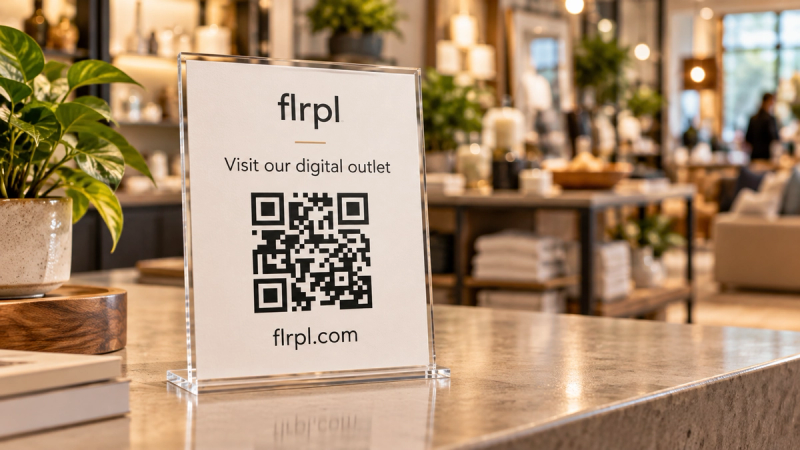
Your Store. Your Merchandise. Your Digital Outlet.
Give your store a digital outlet. See how FLRPL helps local retailers showcase products, share their branded storefront, and connect with nearby shoppers.

You Don't Need Everyone to See It
Local merchandise doesn't need everyone to see it. Explore why proximity, availability, timing, and relevance all matter in local retail discovery.
Discover What's Waiting Nearby
Browse inventory from verified local retailers near you.