
The Sale Doesn’t Start in the Showroom
Modern retail discovery begins long before a shopper walks through the door. Learn how the shift from newspapers and foot traffic to search, maps, and AI has changed what it means for local inventory to compete — and why visibility is now an operational condition for independent retail.

FLRPL Editorial Team
Author
TL;DR
- Many retail sales no longer begin at the point of purchase—they begin when a shopper opens a search bar, browses a map, reads a review, or asks an AI assistant for a recommendation.
- Discovery has always been part of retail, but the channels that control it have changed dramatically — from newspapers and circulars to Google, social platforms, and AI-generated shortlists.
- Inventory, visibility, discovery, consideration, and transaction form a chain. That chain breaks most often at the visibility stage — before a shopper ever considers a product.
- Independent retailers often carry valuable inventory—including floor samples, overstock, and discontinued merchandise—that often goes unseen because it has no representation where modern product discovery happens.
- Visibility does not guarantee a sale, but invisibility can prevent one before demand ever has a chance to form.
The Showroom Is Ready. Nobody Knows.
Picture the kind of independent showroom that makes you slow down when you walk past it. The lighting is warm and deliberate. The floor is merchandised with the kind of care that takes years to develop — furniture arranged into rooms that feel lived-in, lighting that flatters the pieces beneath it, textures and finishes that reward a closer look. Near the back wall, a sectional carries a floor sample tag. Along one aisle, a discontinued dining collection has been marked down to a price that would make an interior designer pause. A clearance rack of outdoor furniture sits near the window, each piece tagged and ready to leave.
Everything about this showroom signals competence, taste, and value.
And yet the showroom is quiet.
Not because the merchandise is wrong. Not because the prices are too high. Not because the store has failed at its craft. But because the shoppers who would want exactly what is on that floor — the ones who spent last weekend measuring their living room, or who have been saving for a new dining set for six months, or who are renovating a guest room on a realistic budget — those shoppers have no idea this inventory exists.
That is the central tension of modern retail.
The question is no longer only: do we have the right merchandise?
The question that sits upstream of it — and that often determines whether the first question even gets a chance to matter — is simpler and more uncomfortable:
If the inventory is already here, who knows it exists?
How Discovery Used to Work
For most of the twentieth century, that question had a straightforward answer. Retailers competed for awareness through a small number of high-reach local channels, and those channels were well understood.
Newspaper advertising and weekly circulars put merchandise in front of households directly. Radio built name recognition in a market. The Yellow Pages served as a structured local directory — a place where a shopper with a need could find a store with a solution. Storefronts themselves were discovery tools: a well-positioned sign, a dressed window, a prominent location on a busy street could generate meaningful foot traffic without any additional effort. And referrals — a neighbor mentioning a furniture store, a colleague recommending an appliance dealer — added a layer of social proof that no advertisement could fully replicate.
This system had obvious limitations. Reach was geographically bounded. Advertising was expensive relative to its precision. And the shopper's journey was largely invisible to the retailer: you ran the ad, you hoped people came in, you counted what sold.
But the system also had a kind of structural fairness. A local independent retailer could participate in most of these channels on roughly similar terms to a larger competitor. A well-placed ad in the local paper, a distinctive storefront, a reputation built over decades — these were accessible advantages. The playing field was not level, but it was legible. You knew what the channels were, and you knew what it cost to use them.
That world has not disappeared. Storefronts still matter. Referrals still carry weight. Foot traffic still drives sales. But something significant has been layered on top of all of it — and that something now shapes whether any of the traditional channels get a chance to work at all.
Where Shoppers Go Before They Visit
Modern retail discovery does not begin at the store. It begins, for many shoppers, in a search bar.
A shopper may never realize they’re shopping when the process actually begins. It might start with a casual Google search after dinner. A saved Instagram post. A conversation with a neighbor who recommends a local store. A quick map search while driving through town. Increasingly, it may even begin with an AI-generated recommendation. Long before anyone parks outside a showroom, the shortlist is already forming. Retailers aren’t just competing inside their four walls anymore—they’re competing in those early moments of attention.
A shopper looking for a sectional sofa today is more likely to start with Google than with a drive around town. They will search, scroll through results, consult maps, read reviews, scan social feeds, and compare across platforms before they commit to visiting anywhere in person. By the time they walk into a showroom, many of them have already formed a shortlist. Some have already made a tentative decision.
This shift matters because the channels that now mediate discovery are not neutral. They reward stores and products that are well represented within them — with structured data, consistent listings, strong review profiles, updated photos, accurate inventory signals, and the kind of metadata that makes a product findable when someone searches for it specifically or stumbles onto it while browsing adjacent categories.
Google Search and Google Maps have become, for many independent categories, the functional equivalent of what the Yellow Pages and the newspaper circular used to be — except that ranking within them is significantly more complex, more competitive, and more dependent on digital infrastructure that many independent retailers have not built. Social platforms like Instagram and Facebook create discovery through feeds and interest-based targeting, but they require consistent content, platform-specific knowledge, and ongoing investment to reach an audience beyond a store's existing followers. Marketplaces like Amazon and Wayfair have trained a generation of shoppers to expect searchable, filterable, photographed, and categorized product listings — a standard that raises the bar for any retailer that wants to compete for attention online.
And increasingly, AI-assisted discovery is entering the picture. When a shopper asks a voice assistant or an AI tool to help them find a leather sofa under two thousand dollars near them, the answer depends entirely on what information has been made available to that system. Stores and products that are not represented in the underlying data are simply absent from the answer.
This is not a criticism of any single platform. It is a description of how discovery now works — and why visibility has become part of the sales process, not merely a marketing preference. As we explored in Why Most Shoppers Search the Wrong Places, the channels shoppers use to find products are not always the channels where independent retailers have invested.
The Chain That Can Break Early
It is worth slowing down to trace the sequence clearly, because the breakdown is not always obvious to retailers who are focused on operations and merchandise.
Think of it as a chain of dependent stages.
Inventory is what exists on the showroom floor. The sectional with the floor sample tag. The dining collection that has been discontinued. The clearance appliances near the back. These items exist. They are real, priced, and available today.
But inventory is not the same as visibility. Visibility is whether that inventory is represented somewhere that shoppers are likely to encounter it — in search results, in maps, in feeds, in structured listings, in any channel that surfaces products to shoppers who are actively or passively looking.
Visibility, in turn, is not the same as discovery. Discovery is the moment a specific shopper becomes aware that a specific product exists. It requires not just that the product is represented somewhere, but that the right person encounters that representation at a moment when it is relevant to them.
Discovery then enables consideration — the stage at which a shopper evaluates the product against their needs, their budget, and their alternatives. And consideration, finally, creates the conditions for a transaction.
Each stage depends on the previous one. Inventory without visibility cannot be discovered. Discovery without consideration produces no transaction. And the stage where independent retailers most often lose ground is not the last one — it is the first transition, from inventory to visibility. A shopper cannot consider merchandise they have never encountered.
“Great inventory cannot compete if nobody knows it exists.”
The Best Deals Never Make the Shortlist explores exactly this problem: strong products at competitive prices that never enter consideration because they were not visible when the shopper was forming their list.
The Structural Gap
Part of what makes this dynamic difficult for independent retailers is that the disadvantage is structural, not personal. It is not that independent retailers are less skilled at retail. In many cases, they are more skilled — their curation is sharper, their service is more attentive, their product knowledge is deeper, and their inventory in categories like furniture, appliances, flooring, and home décor often reflects better taste and more deliberate selection than what a national chain can offer at scale.
The gap is in digital infrastructure.
And it compounds quietly.
National chains maintain SEO teams. They run Google Shopping feeds with thousands of structured product listings. They participate in Local Inventory Ads that surface real-time in-store availability in search results. They have data teams managing categorization, photography standards, and metadata at scale. Their products are indexed thoroughly, represented consistently, and discoverable across the channels where modern shoppers look.
Independent retailers, even excellent ones, often have a website that functions primarily as a business card, a social media presence that requires constant attention to produce modest reach, and physical inventory that is tagged beautifully in-store but represented nowhere online. For many independent retailers, the challenge isn’t the quality of their inventory. It’s that much of that inventory never enters the shopper’s field of view in the first place.
As we examined in Why Great Local Inventory Often Goes Unseen, this gap between inventory quality and inventory discoverability is one of the defining challenges for independent retail today.
This matters most for inventory that benefits from discovery: floor samples, open-box merchandise, overstock, discontinued models, and clearance inventory. These are products retailers are not trying to hold indefinitely. They need to move. And they move fastest when the shoppers most likely to want them know they exist. Understanding the differences between floor samples, open-box items, overstock, and clearance inventory matters because each has its own discovery challenge and its own ideal buyer.
What Visibility Does and Does Not Do
It is worth being clear about what this argument is and is not.
Visibility is not a substitute for good merchandise, fair pricing, skilled merchandising, or sound retail operations. A poorly priced product that becomes more visible will receive more rejection, not more sales. A store with genuine service failures will surface those failures to a larger audience when its visibility increases. Discovery is a prerequisite for consideration — it is not a replacement for the things that convert consideration into purchase.
There are also retail categories where the in-store experience remains essential. Buying a mattress, selecting tile, or evaluating furniture often requires shoppers to see, touch, or experience the product in person. Digital discovery doesn't replace the showroom—it determines whether many shoppers ever visit it.
The strongest claim is a more modest one: invisibility can suppress demand before it has a chance to form. A product that goes undiscovered is not failing because shoppers considered it and declined. It is failing because shoppers never reached the consideration stage. And that is a different problem with a different solution.
Improving visibility does not change what the product is. It changes the number and quality of shoppers who enter the funnel with awareness of it. That alone can move inventory — not by altering price or quality, but by reducing the search friction that keeps the right buyer from finding the right product at the right moment.
What Local Retail Actually Competes For Now
There is a tendency, in conversations about the challenges facing independent retail, to frame the problem as one of competition — as though the primary threat is always a bigger competitor with lower prices or a broader selection.
That framing misses something important.
The more immediate competition is often not another store. It is attention. Modern shoppers are navigating an enormous amount of information before they make a purchase decision, and the discovery systems they use to manage that information are selective by design. They surface what is indexed, categorized, reviewed, and represented. What is absent from those systems is not penalized — it is simply invisible.
This is why where deals actually hide and why you don't see them online has become one of the most practically important questions in local retail. The answer, in most cases, is not that deals are being deliberately concealed. It is that they have no representation in the places where modern discovery happens. The inventory exists. The price is right. The product is available today. But the shopper looking for exactly that product, searching from a few miles away, will not find it — because the discovery systems they are using have no record of its existence.
An informed shopper is a more effective shopper, as we explored in An Educated Buyer Is a Better Buyer. But an educated buyer still depends on having accurate information available to them. The obligation runs in both directions: retailers need to make inventory legible to the systems where shoppers search, and shoppers need access to channels where local inventory is actually represented.
The Showroom, Revisited
Return to the showroom at the beginning of this piece. The lighting is still on. The floor still looks excellent. The floor sample sectional is still there, tagged and priced. The discontinued dining collection is still at a compelling number. The clearance outdoor furniture is still near the window.
Nothing about that picture has changed.
But the context around it has.
The shopper who would have found this store through a newspaper ad in 1995 is now starting her search on Google. The shopper who would have driven past the storefront and come in on impulse is now filtering results on a map. The shopper who would have heard about this store through a neighbor's recommendation is now reading reviews and comparing options across platforms before she decides which stores are worth visiting.
These shoppers exist. The demand is there. The merchandise is right. The prices are compelling.
The missing piece is representation — a signal that reaches the right shopper at the moment she is looking, that tells her this inventory exists, that it is nearby, that it is available today, and that it is worth a visit.
That is what has changed about retail discovery. And it is why the sale, for a growing share of purchase decisions, does not start in the showroom at all.
It starts earlier. Much earlier.
It starts the moment a shopper begins looking — and what she finds in that moment determines where she goes next.
The Opportunity
Every day, independent retailers already have inventory waiting to be discovered.
Floor samples.
Open-box merchandise.
Clearance inventory.
Overstock.
Discontinued products.
One-of-a-kind finds.
Inventory already sitting on showroom floors.
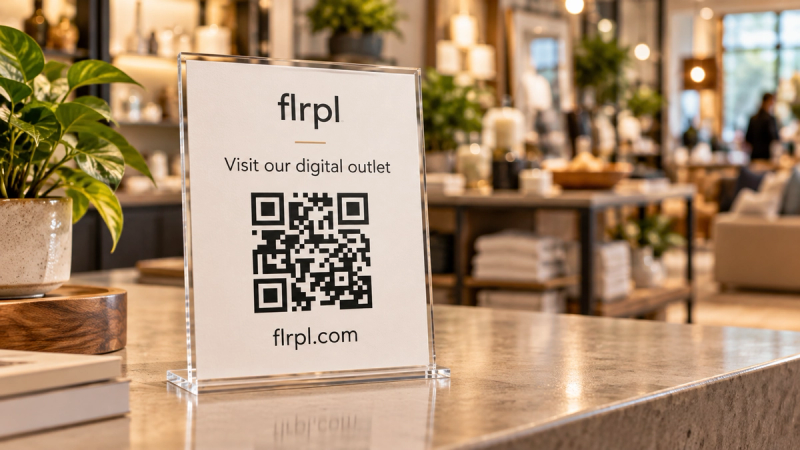
FLRPL gives verified local retailers a dedicated digital outlet to create visibility for inventory they already have, helping nearby shoppers discover what’s available before they ever visit the store.
Visibility creates discovery.
Discovery creates opportunity.
FLRPL.
Your Digital Outlet.
Get Goods Gone.
Related Articles
Your Store. Your Merchandise. Your Digital Outlet.
Give your store a digital outlet. See how FLRPL helps local retailers showcase products, share their branded storefront, and connect with nearby shoppers.


You Don't Need Everyone to See It
Local merchandise doesn't need everyone to see it. Explore why proximity, availability, timing, and relevance all matter in local retail discovery.

Not Every Drop Has to Be a Deal
A Drop doesn't require a markdown. See how retailers can use FLRPL to feature new arrivals, seasonal merchandise, distinctive products, deals and more.
Discover What's Waiting Nearby
Browse inventory from verified local retailers near you.