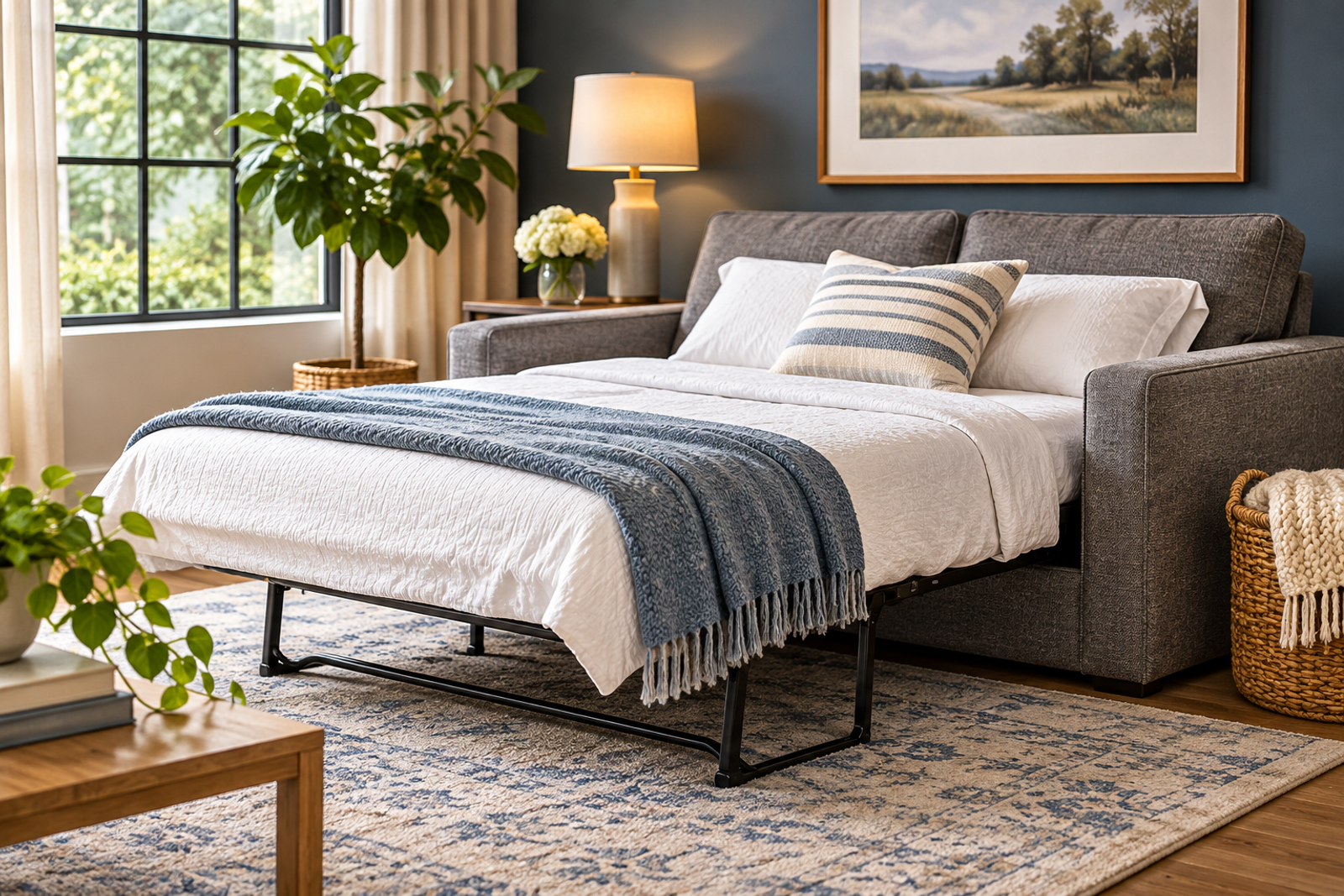
Is a Sleeper Sofa Worth It? What to Know Before You Buy
Learn what to look for when buying a sleeper sofa, from mattress comfort and opening mechanisms to room dimensions, durability, and showroom testing.

FLRPL Editorial Team
Author
TL;DR
- Test it twice. Good seating doesn't guarantee a good bed. Sit on it and lie on it.
- The mechanism matters more than the label. Pull-outs, fold-down convertibles, and sleeper sectionals give you different sleeping surfaces.
- Measure it fully opened. A sofa that fits against the wall can block walkways and doors once it's a bed.
- Check the real mattress size. Some "queen" sleepers measure 60 by 72 inches, eight inches shorter than a standard queen.
- Buy for how you'll use it. A few guest nights a year and nightly sleeping call for different priorities.
- Try it in person when you can. Photos help you narrow the list. Opening it and lying on it confirm the choice.
A Sofa That Has to Do Two Jobs
The spare room is an office most of the year. Then a friend books a flight for a long weekend, and suddenly the house needs one more bed.
A sleeper sofa looks like the obvious answer: a sofa during the day and a bed when you need one.
Then the real questions come up. What if it's comfortable to sit on and miserable to sleep on? What if the mattress is fine but opening it means moving the coffee table, the rug, and a floor lamp every time?
Neither problem is inevitable. They do mean a sleeper sofa has to be judged in both of its forms, as a sofa and as a bed, before you decide whether it suits your household.
Not All Sleeper Sofas Work the Same Way
"Sleeper sofa" covers several designs:
- Traditional pull-outs: you remove the cushions and unfold a frame holding a separate mattress.
- Convertibles: the back folds down, or the cushions fold out, so the upholstery becomes the bed.
- Sleeper sectionals: a platform slides or lifts out, often lined up with the chaise or main seat.
- Futons and daybeds: close relatives that either convert to a flat mattress or work as a twin bed you can sit on.
As Good Housekeeping's sleeper sofa guide notes, these designs operate quite differently. The mechanism decides what you'll actually sleep on: a dedicated mattress, a set of cushions laid flat, or something in between. Look past the label and ask how this particular model opens.
Comfortable to Sit On Doesn't Always Mean Comfortable to Sleep On
Better Homes & Gardens tested sleeper sofas in real homes, some for as long as a year. Its testers found that good seating didn't always translate into a good bed. Some models did well in both positions, and in others the cushion comfort and wear changed over time.
A great sleeper sofa isn't just a sofa with a bed hidden inside. It needs to be comfortable in both forms.
When you sit on it, check cushion support, seat depth, back support, and how easily you can stand up.
When you lie on it, check whether your hips and shoulders are evenly supported, whether you can feel seams, folds, or the frame underneath, and whether the surface is long and wide enough for whoever will sleep there.
Sleeper mattresses come in foam, memory foam, and innerspring versions. None is best for everyone. The right one is the one that feels supportive when you actually lie on it.
Many people know the classic complaint about a metal bar across the middle of your back. It can happen when a thin mattress sits on a frame that isn't well supported, but it isn't universal. Mattress thickness and how the frame is built both make a difference, which is why lying down on the actual mattress is such an important part of evaluating comfort.
Measure the Sofa Twice: Closed and Fully Open
A sleeper can fit perfectly between two end tables and still be impossible to use once it's extended. Before you buy, check:
- Closed width and depth
- Fully opened depth from the wall
- The actual sleeping-surface dimensions
- Walking room around the open bed
- Doors, closets, and drawers the open bed might block
- Furniture that has to move every time you open it
- The delivery route: doorways, hallways, stairs, and elevators, which Consumer Reports lists among the details buyers most often forget
The closed dimensions tell you whether it fits the room. The open dimensions tell you whether it works there.
Check the mattress size carefully. Good Housekeeping lists several queen-size sleeper mattresses with estimated dimensions of 60 by 72 inches. A standard queen is 60 by 80, so a taller guest will notice the missing eight inches.
Sizes vary in other directions too. IKEA lists the FRIHETEN sleeper sectional with a sleeping surface of about 55⅛ by 80⅜ inches in one configuration. That's narrower than a queen and slightly longer than a standard one. Neither number is good or bad on its own. Just read the actual sleeping-surface measurement instead of relying on the size name.
For a step-by-step method, see Will It Fit? The Complete Buyer's Guide to Measuring Before You Bring Home Furniture and Appliances.
The Opening Mechanism Is Part of the Purchase
Some sleepers have you pull off the cushions and lift out a folded mattress. Others fold flat or roll out a platform in one motion. BHG's testers found real differences in how easy each one was to operate, so open and close the actual model yourself when you can.
As you do, ask:
- Can one person do it without a struggle?
- Does it move smoothly or catch partway?
- Where do the cushions go?
- Does nearby furniture have to move?
- Can the bedding stay on when it's closed?
- Are replacement mattresses or mechanism parts available?
- What does the warranty cover: frame, mechanism, mattress, upholstery?
If guests use the bed twice a year, a clunky mechanism is a small annoyance. If someone opens it every night, it becomes part of the daily routine, and serviceability matters far more.
Is It for Occasional Guests or Everyday Sleeping?
For occasional guests, seating comfort usually comes first, because that's how the piece spends most of its life. The bed needs to be comfortable enough for a few nights and easy to set up.
For regular sleeping, mattress support, a full-length surface, a mechanism that holds up to daily use, and available replacement parts become much more important. Some manufacturers design sleepers for frequent use, and some list full 80-inch sleeping lengths, but suitability still comes down to testing. When sleeping is the room's main job, a daybed or a conventional bed may simply fit better.
The right sleeper sofa matches how your household actually lives, not how you imagine using it.
What to Check Before You Buy
- Sit on it for a few minutes.
- Open and close it yourself.
- Lie down on the bed on your back and on your side.
- Measure the actual mattress.
- Confirm the fully opened depth against your room.
- Inspect cushions, seams, and upholstery.
- Ask about the warranty and replacement parts.
- Review delivery, return, and service terms.
For a floor sample or open-box sleeper, inspect that exact unit for wear, missing hardware or mattress, and any stiffness in the mechanism. What Is a Floor Sample? The Smart Shopper's Guide to Showroom Deals covers what to ask.
The Value of Seeing It in Person
Photos and spec sheets are good for building a shortlist. They can't tell you how the mattress feels under your shoulders or whether the mechanism catches halfway.
A showroom visit lets you test the actual piece in both positions and ask about warranty and service directly. A floor sample or another sleeper on display at a local furniture store can be worth considering, as long as the price, condition, warranty, and terms make sense for you.
FLRPL gives verified local retailers a way to feature selected merchandise through Drops, helping nearby shoppers discover what's being offered and connect directly with the retailer. Shoppers can confirm availability, pricing, and purchase details before making a visit.
A sleeper sofa is worth buying when it seats you well, sleeps well enough for the people who'll use it, fits the room when it's open, and opens easily. If it passes all four, you've found a good one.
The Opportunity
Every day, independent retailers already have inventory waiting to be discovered.
Floor samples.
Open-box merchandise.
Clearance inventory.
Overstock.
Discontinued products.
One-of-a-kind finds.
Inventory already sitting on showroom floors.
That's why FLRPL exists.
FLRPL helps verified local retailers create visibility for inventory they already have, making it easier for nearby shoppers to discover what's available before they ever visit the store.
FLRPL.
Your Digital Outlet for Local Inventory.
Visibility creates discovery.
Related Articles

When Do the Best Holiday Deals Actually Start?
Wondering whether to buy now or wait for Black Friday? Learn how to compare holiday deals, evaluate discounts, and find worthwhile local merchandise.


Getting Your Home Ready for the Holidays? Start Here.
Preparing your home for holiday guests? Explore smart tips for furniture, guest rooms, appliances, delivery planning, and finding merchandise at local stores.

Different Channels. Different Jobs.
Discover how FLRPL complements your website, Facebook, Instagram, and TikTok by helping local shoppers find merchandise available in nearby retail stores.
Discover What's Waiting Nearby
Browse inventory from verified local retailers near you.

