
When Do the Best Holiday Deals Actually Start?
Wondering whether to buy now or wait for Black Friday? Learn how to compare holiday deals, evaluate discounts, and find worthwhile local merchandise.

FLRPL Editorial Team
Author
TL;DR
- Holiday promotions now stretch well before Black Friday — but earlier doesn't automatically mean cheaper.
- Black Friday still brings real discounts in specific categories, especially furniture, appliances, and televisions, so waiting can pay off for widely available products.
- A big percentage-off sign doesn't prove you're getting the best price — it depends what the discount is measured against.
- A floor sample, open-box appliance, or one-of-a-kind local find may not follow the national sales calendar and deserves its own evaluation.
- Whether to buy now or wait comes down to your actual timeline, the item's availability, and whether a comparable alternative even exists.
Say you've had your eye on a new sofa. Or maybe it's a refrigerator that's been making an unsettling noise since August. October is winding down, the holiday ads are starting to show up in your inbox, and Black Friday is a few weeks off. Do you buy now, or do you wait?
It's a more complicated question than it used to be. Black Friday isn't really the starting line of holiday shopping anymore — it hasn't been for a while. Adobe's 2026 holiday forecast projects discounts reaching up to 14% off listed prices in early November, climbing to around 21% in the days just before Thanksgiving, before the deepest markdowns of the season — up to 30% — arrive during Cyber Week. Promotions, in other words, build gradually across more than a month, not just on a single Friday.
That's useful context. But it raises a more important question than when the deals start: whether an early deal, a Black Friday deal, or a plain old in-stock item at a local store actually represents the best value for what you need.
Holiday Deals Start Earlier Than You Think
October sales events, early-November promotions, and pre-Thanksgiving markdowns have genuinely expanded what used to be a one-day event into a weeks-long season. If you're the kind of shopper who likes to get ahead of the crowds, there's more opportunity to do that than there used to be.
But timing and value aren't the same thing. An October promotion might be a legitimately good price — or it might just be an early markdown designed to get shoppers buying before the competition starts discounting too. The fact that something is labeled a "holiday deal" in October tells you it's early. It doesn't, by itself, tell you it's the lowest price you'll see all season.
A holiday deal in October tells you when the offer appeared — not whether it's the best price of the season.
When Waiting for Black Friday May Make Sense
National retailers still save some of their strongest discounts for the traditional dates, and the data backs that up. Adobe's 2026 forecast expects especially strong Black Friday discounts for furniture, appliances, and televisions — categories where actual 2025 holiday results showed peak online discounts of 18.8% for furniture and 20.2% for appliances, with electronics peaking even higher. Adobe also found that Black Friday spending grew faster than Cyber Monday spending last season, a sign that shoppers are still treating it as the moment to act.
If you're shopping for a widely available product — a mainstream refrigerator model sold at a dozen retailers, say — and your purchase isn't urgent, waiting and comparing prices as Black Friday approaches is a reasonable strategy. That calculus changes, though, when you're looking at a particular floor sample, open-box unit, or one-of-a-kind piece that may not be available later. Waiting introduces another consideration beyond the possibility of a lower price.
Not Every Piece of Merchandise Follows a Sales Calendar
This is where the national promotional calendar and an individual retailer's merchandise start to diverge. Black Friday and Cyber Week are coordinated, industry-wide events. A floor sample coming down to make room for a new collection, a discontinued appliance line, or a distinctive rug a local retailer wants to move — those follow the retailer's own schedule, not a calendar set by national chains.
Imagine a shopper who, in early November, comes across a floor-sample dining table at a local furniture store — exactly the size and style they've been looking for, priced to reflect its condition as a showroom display. Waiting three weeks for Black Friday wouldn't necessarily get them a better price on that particular table. It might just mean someone else buys it first. The smarter approach is to evaluate that piece on its own terms: its actual price, condition, dimensions, and availability — not whether the calendar happens to say "Black Friday" yet. For a clearer sense of what you might be looking at, it helps to understand the difference between floor samples, open-box merchandise, and overstock before you walk in.
None of this means local, one-off merchandise is automatically cheaper, or that every retailer resets its showroom floor on the same schedule. It simply runs on a different clock than the one in the holiday ads.
A Big Markdown Doesn't Always Mean the Best Deal
Here's the part that trips up even careful shoppers: a large percentage-off sticker doesn't automatically mean you're getting a great price. It depends entirely on what that percentage is measured against.
The FTC's guidance on former-price comparisons draws an important distinction between a retailer's actual former selling price and other reference points used in advertising — and separately, its guidance on manufacturer suggested prices notes that an MSRP isn't necessarily the price an item generally sells for in the first place. A product marked "40% off MSRP" could still be priced right in line with what every other retailer charges for it. A struck-through price isn't proof of an exceptional bargain on its own.
A big percentage-off sign isn't proof of a good deal. The price still has to hold up to comparison.
The more reliable approach: compare the current price against what comparable retailers are charging for the same or a genuinely similar item, right now. Consumer Reports' appliance buying guidance makes a similar point — tracking historical prices and comparing specific models across retailers tells you far more than a single advertised discount ever will.
Should You Buy Now or Wait?
There's no universal answer here, but there is a sensible way to think it through.
Buying now tends to make sense when:
- The current price compares well to similar items elsewhere.
- The item genuinely meets a real need you have today.
- You've inspected it, or its condition is clearly documented.
- You're working against a real deadline — a holiday gathering, a broken appliance, a move-in date.
- It's a one-of-a-kind or limited piece that won't have an identical replacement if it sells.
Waiting tends to make sense when:
- The purchase isn't urgent.
- The product is widely available from multiple retailers.
- You're able to track and compare prices over the coming weeks.
- A relevant seasonal promotion is genuinely approaching.
- There's no delivery or installation deadline forcing your hand.
If you're shopping with a holiday deadline in mind — getting a home ready for guests, for instance — that deadline itself is a legitimate reason to act sooner rather than betting everything on a Black Friday price that may or may not beat what's available today. And if an appliance is part of the plan, it's worth knowing how to evaluate open-box and discounted appliance deals before you commit either way.
The right time to buy depends on the price in front of you, the alternatives you can compare, and how long you're willing to wait.
The Shopping Season Doesn't End on Black Friday
Cyber Monday brings its own round of discounts, particularly for electronics — Adobe's 2026 forecast expects the deepest online discounts for that category on Cyber Monday rather than Black Friday. December brings further promotions, and the days after Christmas can turn up genuine clearance pricing as retailers make room for new inventory in the new year.
None of that guarantees lower prices than what you'd find today. It just means the calendar keeps offering chances, right through the start of the new year, for shoppers willing to keep watching.
The Local Opportunity Worth Checking
Whatever the national ads are promising this week, it's worth checking what a store near you actually has on hand. A local retailer might be sitting on a floor sample, an open-box appliance, or a distinctive piece that never shows up in a Black Friday circular — not because it's hidden, but because it was never part of a national campaign to begin with.
FLRPL is designed to make that kind of merchandise easier to find. Verified local retailers can feature selected items — Drops — giving nearby shoppers another way to discover what's being offered, explore the products that interest them, and contact the retailer to confirm availability and purchase details before deciding whether a particular item represents a worthwhile opportunity.
The Opportunity
Every day, independent retailers already have inventory waiting to be discovered.
Floor samples.
Open-box merchandise.
Clearance inventory.
Overstock.
Discontinued products.
One-of-a-kind finds.
Inventory already sitting on showroom floors.
That's why FLRPL exists.
FLRPL helps verified local retailers create visibility for inventory they already have, making it easier for nearby shoppers to discover what's available before they ever visit the store.
FLRPL.
Your Digital Outlet for Local Inventory.
Visibility creates discovery.
Related Articles

Getting Your Home Ready for the Holidays? Start Here.
Preparing your home for holiday guests? Explore smart tips for furniture, guest rooms, appliances, delivery planning, and finding merchandise at local stores.


Different Channels. Different Jobs.
Discover how FLRPL complements your website, Facebook, Instagram, and TikTok by helping local shoppers find merchandise available in nearby retail stores.
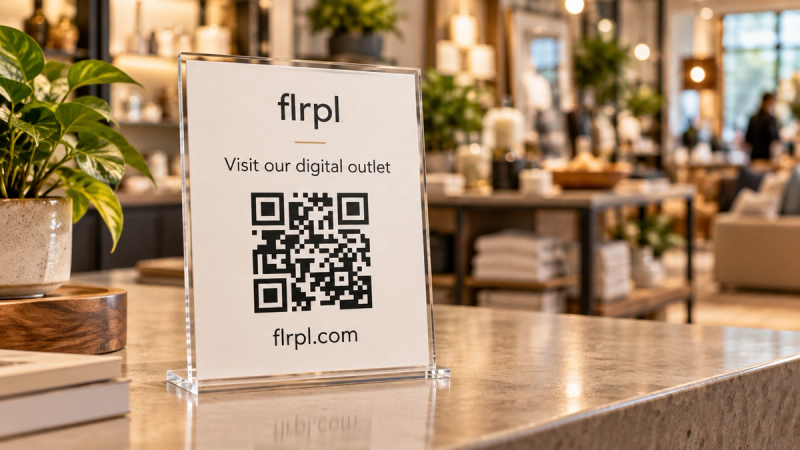
Your Store. Your Merchandise. Your Digital Outlet.
Give your store a digital outlet. See how FLRPL helps local retailers showcase products, share their branded storefront, and connect with nearby shoppers.
Discover What's Waiting Nearby
Browse inventory from verified local retailers near you.

