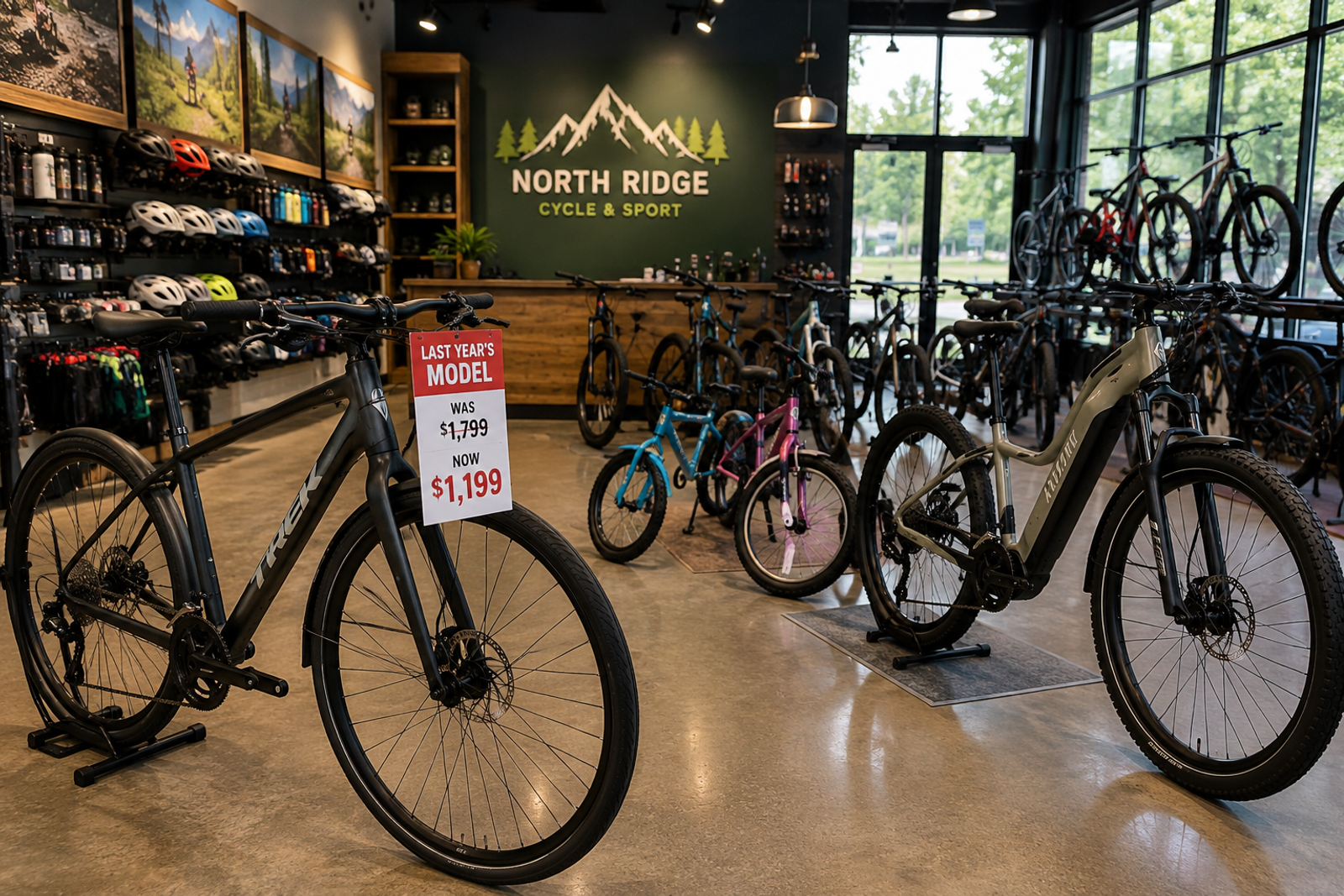
Why the Best Bike Deals Usually Happen After Summer Begins
Spring feels like the right time to buy a bike. Retailers know it. So do their pricing teams. Here's why the most interesting deals — on adult bikes, kids' bikes, e-bikes, and demo units — tend to surface once the seasonal rush has already passed.

FLRPL Editorial Team
Author
TL;DR
- Spring feels like the natural time to buy a bike, but retail pricing often becomes more flexible after summer begins.
- The first wave of demand happens early; the first wave of markdown pressure usually arrives once stores see what has not sold.
- Bikes create unusual inventory pressure because they take up space, need assembly, and come in many size-color combinations.
- Kids' bikes are especially timing-sensitive because children outgrow sizes quickly and retailers are left with awkward, harder-to-move inventory.
- E-bikes carry their own inventory economics — higher capital tied up per unit, steeper depreciation curves on last-year tech, and a buyer profile that responds well to value framing.
- The best opportunities often appear when stores are shifting attention from this season's bikes to next season's floor plans.
Introduction
There is a gap between when consumers want to buy a bike and when retailers want to sell one. Most people have never thought about that gap. Most retailers depend on it.
Spring is when consumer enthusiasm peaks. The weather improves, the trails reopen, and everyone who told themselves "this is the year" in January starts showing up at bike shops. Retailers know this. They stock aggressively, price confidently, and rarely negotiate. They do not need to. The floor is full of motivated buyers, and inventory is fresh.
What changes after summer begins is not the bike. The bike sitting on the floor in July is often the same bike that sat there in April. What changes is the retailer's relationship to it.
The first-wave buyers have come and gone. The remaining inventory is the inventory the store could not sell during its most favorable conditions. And now the calendar is no longer working in the retailer's favor — every week that passes without a sale is a week closer to next year's model cycle, next season's floor plan, and the quiet realization that this unit may have to be marked down significantly or absorbed at a loss.
Consumer urgency peaks before summer. Retailer urgency grows after it begins. Understanding that distinction is the foundation of every good late-season bike deal.
The Seasonal Cycle That Retailers Follow But Rarely Explain
Most shoppers understand seasonal retail in consumer terms: demand rises, prices rise, then discounts appear. That model is directionally correct but too simple to be useful.
Retailers think in layers. The spring buy-in happens months before the product hits the floor. A shop owner deciding how many bikes to stock for the coming season is making that call in the fall or winter prior, based on historical sell-through, brand forecast data, and their read on the local market. By the time April arrives and the floor looks full and fresh, every unit already has a cost basis, a margin expectation, and an implicit deadline baked into it.
The selling season for bikes in most U.S. markets runs roughly from March through August, with peak consumer traffic concentrated in April, May, and early June. Retailers plan for that window. What they cannot fully plan for is which specific models, sizes, and colors will outsell expectations and which will lag.
The models that sell quickly in April and May validate the buyer's instincts. The models still sitting in late June start a different conversation. The store has already committed its capital, paid for assembly labor, and used up prime floor space. The question is no longer whether to sell — it is how much pressure it takes to make that sale happen.
"The retailer's urgency and the consumer's urgency run on opposite schedules. Spring is when buyers are most motivated and stores are least flexible. Summer is when that ratio starts to reverse."
By late July and August, most specialty bike retailers are doing two things simultaneously: trying to move current inventory and beginning to think about what next season's floor looks like. Those two objectives sometimes conflict, and the friction between them is where deals happen.
Why Bikes Are Particularly Difficult Inventory to Hold
Not all slow-moving retail inventory creates equal pressure. A box of apparel can be folded and stacked. A rack of accessories takes minimal floor space. Bikes are different in ways that compound quickly.
A bicycle requires standing room on a retail floor. A well-merchandised shop may display 40 to 80 bikes on the main floor, plus additional stock in a back room or storage area. Each unit occupies vertical and horizontal space, requires a display rack or hook system, and needs to be close enough to high-traffic areas that customers can handle it. When sales slow and inventory doesn't turn, the floor starts to feel crowded. Newer models cannot be staged effectively. Seasonal resets — the kind that keep a shop looking current and curated — cannot happen until older inventory moves.
Assembly is a compounding cost that most buyers never see. Even when bikes arrive boxed from a distributor, a shop technician has to unbox, partially assemble, adjust, and inspect each unit before it is floor-ready. For an adult road bike or hybrid, that process may take 30 to 60 minutes of skilled labor. For an e-bike with electronic components, even longer. That labor is a sunk cost. Once it is spent, it does not come back whether the bike sells quickly or slowly. But a bike that sits for months represents labor that was paid once and is being diluted across more time — quietly lowering the effective return on that investment with every week it goes unsold.
Size and color fragmentation is the third pressure point. A bike manufacturer typically produces a given model in multiple frame sizes and several colorways. A shop may stock, say, a popular hybrid in small, medium, large, and extra-large across two or three color options. If medium gray sells through immediately and large red does not, the retailer is left with a unit that is not defective — it is simply mismatched to the local demand distribution. Unlike clothing, where a rack of unsold small shirts can be shipped back to a regional warehouse relatively easily, bikes are expensive to return and expensive to transfer. The retailer often has to carry that size-color combination until a buyer appears or until the discount becomes compelling enough to absorb it.
The Model-Year Transition Nobody Explains at the Register
Bicycle brands, like automotive brands, operate on model-year cycles. The cadence varies by brand and category — some release updated models annually, others on 18-month or two-year cycles — but the pattern is consistent: new models arrive at the retail level in late summer or fall, just as the current selling season is winding down.
What that means in practice is that a bike purchased in August may technically be a "current-year" model, but the next-year version is already sitting in a distributor's warehouse waiting for its retail window. The retailer knows this. The brand rep knows this. The buyer in the store almost certainly does not.
The implications for pricing are significant. A bike that would have sold at full margin in April becomes harder to justify at that same price once the new model has landed. If the update is cosmetic — a new colorway, a minor component swap, a refreshed graphic kit — the performance difference between last year's version and this year's is negligible. But perception is not negligible. A buyer who asks the salesperson "is this the current model?" and hears "the new version just came in" has already started mentally discounting the unit in front of them, even if the actual ride quality difference is zero.
Shops respond to this dynamic in predictable ways. Some begin reducing prices on current-year stock before the new model officially arrives, to accelerate turnover and avoid the awkward conversation. Others wait for the new model to land and then use the contrast as a closing tool — "the new version retails for $200 more; this one's last year's model but it's identical in terms of what actually matters for riding." Both approaches are legitimate, and both can produce real value for a buyer who understands what is happening.
The category where this matters most is electric bikes. E-bikes carry substantially higher price points than most traditional bikes — often $1,500 to $5,000 or more at the retail level — and technology turnover is faster than in the traditional bike market. A battery management system, motor efficiency rating, or display interface that was considered current in one model year may feel dated twelve months later as the category continues to develop. For a retailer, holding a previous-year e-bike into the fall means carrying significant capital in a product whose perceived technological freshness is declining. That is a meaningful motivation to reduce price.
Demo Bikes: A Category With Its Own Economics
Every floor model that gets used for test rides is undergoing a slow financial transformation the store doesn't advertise.
In most specialty bike shops, demo units are purpose-selected units that do double duty: they display the model at its best and allow prospective buyers to feel the ride before committing. The problem is that a demo bike accumulates cosmetic wear in ways that are difficult to price precisely. Handlebar grip wear, small scuffs on the frame, a slightly scratched saddle, cable housing that has been adjusted multiple times — none of these affect ride performance, but all of them affect perceived value in a retail context.
A thoughtful retailer knows that a demo bike cannot be sold at new price once it has had real use. But pricing it requires judgment calls that not every shop handles the same way. Some apply a fixed percentage reduction. Others negotiate case by case. A few wait until the end of the season and liquidate the entire demo fleet at once to make room for the next year's models.
For buyers who understand the difference between a floor sample, open-box item, and overstock unit, demo bikes are often the most negotiable inventory in a shop. The bike is real, the wear is cosmetic, and the retailer has already absorbed the depreciation mentally. What they need is a buyer willing to close quickly and carry the unit out the door without making the transaction complicated.
"A demo bike that has served the store's purpose is no longer selling itself — it is waiting for a buyer who understands that its job is already done."
The best time to ask about demo availability is late in the season, when the store is about to rotate floor models. A shop that has been displaying a specific bike since April and is planning a floor refresh in September has already decided that unit needs to move. The buyer who shows up in August and asks directly — "Do you have any demo or floor units available at a reduced price?" — is often meeting the retailer exactly where they are.
Kids' Bikes: The Most Timing-Sensitive Inventory in the Store
No segment of the bike market creates more inventory complexity than children's bicycles, and no segment is more reliably misunderstood by buyers.
Children's bikes are sold in wheel size increments that correspond loosely to age ranges: 12-inch for the youngest riders, moving through 16-inch, 20-inch, and 24-inch before graduating to adult sizing. Within each wheel size there are typically multiple frame sizes, sometimes multiple colors, and often multiple quality tiers. A shop may carry a given brand's lineup in five or six configurations per size category. The problem is that demand within each size band is narrow, and children grow through sizes faster than a retail cycle can accommodate.
A child who is ready for a 20-inch bike in April may have outgrown a 20-inch by the following spring. That means the buying window for any given kids' bike size at any given shop is effectively a single season. For the retailer, that creates intense pressure: if the right size doesn't find the right buyer during the current season, it either carries over to the following year — becoming a slightly stale unit competing against fresh stock — or gets marked down aggressively to clear.
This is compounded by the color and style sensitivity of children's bikes. Kids have opinions. A 7-year-old who wants a specific color and doesn't get it may refuse to ride the bike. Retailers are well aware of this, which is why shops often stock popular colors in depth and carry less of the slower-moving options. The result is predictable: popular colors in popular sizes sell out early, and the remaining inventory is disproportionately concentrated in less appealing combinations. Those are the units that become deals.
The common mistake parents make is treating kids' bikes like adult bikes — evaluating purely on price, brand, and features. The more useful evaluation is fit, readiness, and timing. A child who is not quite ready for the next wheel size will ride a correctly-sized bike far more confidently and safely than one purchased slightly large to "grow into." The discount on a too-large bike is not worth the diminished experience, and an unused bike is the worst possible return on any price.
That said, a correctly-sized bike at a genuine discount is one of the better deals available in seasonal retail. Late July through September, when shops are consolidating kids' inventory ahead of the school year and next season's buy-in, is a reliable window to find current-year bikes at reduced prices simply because the store needs the space and capital back.
Electric Bikes: Higher Stakes, Faster Depreciation
E-bikes represent a relatively new but increasingly significant segment of the bike market, and their inventory economics differ meaningfully from traditional bikes in ways most buyers do not appreciate.
The capital at risk per unit is substantially higher. An entry-level e-bike at the specialty retail level may carry a retail price of $1,500 to $2,500. Mid-range commuter or recreational e-bikes commonly retail between $2,500 and $4,000. Premium models can exceed $6,000. For a shop that has stocked 10 to 20 e-bikes for the season, the capital commitment is significant relative to comparable square footage of traditional bike inventory.
Technology perception depreciates faster than the product itself. The battery in a current-year e-bike will likely still perform well three or four years from now. The motor, display interface, and connectivity features, however, are in a category where consumer expectations are shifting quickly. A display unit that felt current and impressive in one model year can feel dated twelve months later as brands introduce color screens, app integration, or range improvements. The underlying bike may be excellent. But the retailer holding that unit in year two of a model cycle has a harder conversation with prospective buyers than they did in year one.
Regulatory considerations have also become more prominent in some municipalities, particularly around higher-speed e-bike classifications and trail access rules, adding another layer of complexity for retailers carrying previous-year inventory. While these regulations vary widely by location, they can influence how buyers perceive certain models and how quickly retailers look to move aging inventory.
This creates a specific opportunity for buyers willing to evaluate e-bikes on performance rather than perception. A previous-year e-bike that has been demo'd or is otherwise being cleared is typically a product whose motor, battery, and frame remain fully capable — the "age" is largely cosmetic or software-related. Buyers who know how to assess whether a deal is actually worth it and can evaluate e-bike components objectively are often the ones who walk away with the best outcomes in this category.
Trade-Ins: The Inventory Nobody Talks About
Some bike shops, particularly full-service specialty retailers, accept trade-ins. A customer who wants to upgrade from a three-year-old hybrid to a new road bike may offer the old bike as partial credit. The shop takes it in, performs a basic inspection, makes any necessary adjustments, and puts it on the floor at a used price.
Trade-in inventory operates outside the normal pricing logic that governs new bikes. There is no manufacturer suggested retail price, no brand pricing policy, and no competitive pressure from other shops carrying the same model. The shop has its own cost basis — typically a credit applied against a new purchase — and needs to price the unit to move, cover that cost, and generate some margin on the labor involved in prepping it.
For buyers, this means trade-in bikes are among the least predictable but potentially most interesting units in a shop. The range of what a shop might have as trade-in inventory at any given moment is wide: a well-maintained entry-level hybrid from a few years ago, a premium road bike that was rarely ridden, a kids' bike from the previous size up. Condition varies. Provenance is often known — the shop serviced it before, so they have a sense of its maintenance history. And pricing is typically more flexible because the shop's cost basis is lower than on new inventory.
The buyer who specifically asks about trade-in availability — especially late in the season when shops are managing multiple inventory categories simultaneously — is often accessing a part of the floor that most customers walk past without asking about.
The Psychology of Retailer Urgency
Consumer urgency is emotional. It is triggered by weather, social context, a friend's new bike, a trail recommendation, a wellness resolution. It peaks early and declines predictably once the initial impulse is satisfied or deferred.
Retailer urgency is structural. It does not peak early — it builds. In April, a shop has time on its side. Inventory is fresh, demand is building, and there are months of selling season ahead. Every unit that sits in May is less concerning than every unit that sits in August. Every unit that sits in August is less concerning than every unit that sits in October, when the next model cycle is already landing.
The structural nature of retailer urgency is what makes late-season buying different from early-season bargain hunting. An early-season "deal" is often a promotional price the brand authorized or a loss-leader designed to drive foot traffic. A late-season deal is often the product of a shop that has done the math and decided that moving a unit at reduced margin is better than carrying it into a new model year.
That calculation is not always visible to the buyer, but it can often be inferred. A bike that has been on the floor since April and is now showing a few months of gentle display wear, or a kids' bike in a colorway that is no longer in production, or an e-bike that the brand has already replaced with an updated version — all of these are signals that the store's urgency may be higher than the asking price suggests.
Understanding why stores want you to buy that deal is not cynical. It is simply a better model of how retail transactions actually work. Both parties benefit from a sale; the question is who has more time and who has less. Late in the season, buyers typically have more time than they think, and retailers typically have less.
"The floor model that has been waiting since April is not overpriced because the store is greedy. It is overpriced because the store has not yet found the buyer who understood that waiting was an option."
What Sits on the Floor and Why
By mid-to-late summer, the composition of a bike shop's remaining inventory is not random. It reflects the specific failure modes of the buying season: sizes that didn't match local demand, colors that looked worse in person than in a catalog, price points where buyers hesitated, and categories that the shop over-indexed on relative to actual customer appetite.
Previous-year models are present because model transitions created price perception problems that were not fully resolved with early markdowns. They are often mechanically equivalent to new stock and represent real value for a buyer who knows how to spot the difference between perception and substance.
Overstock colors are present because appearance drives purchasing decisions more powerfully than most people admit. A matte olive green hybrid that looked editorial in a brand catalog may move slowly on a shop floor where most customers are picturing themselves in black or silver. The bike is not inferior. It is mismatched to the aesthetic consensus of the local buyer pool.
Floor samples and demo units are present because the shop has already extracted their merchandising value and now needs to recover the capital. These units have done their job. What they need now is a buyer who is comfortable with the idea of an imperfect product at a genuine price — or in this case, an imperfect finish on an otherwise sound bike.
E-bikes at the upper end of the shop's price range may still be present because the buyer profile for high-investment items is narrower and conversion takes longer. A $3,000 e-bike requires a buyer who has already decided they want an e-bike, has done enough research to feel confident, and is willing to spend at that level. That buyer pool is smaller, and the sale cycle is longer. By August, a shop carrying two or three unsold premium e-bikes from the spring buy-in has a meaningful capital problem.
How Serious Buyers Think Differently
The buyer who consistently finds the best bike deals is not simply more patient. They are reading a different set of signals.
They pay attention to what is on the floor in late summer and ask why it is still there. They notice when a bike has a layer of gentle handling wear suggesting it has been demo'd. They ask about floor model pricing explicitly, because most shops do not advertise it — they respond to buyers who ask. They understand that deals are often hidden from view not because the store is withholding them, but because the store is waiting for a buyer who demonstrates enough knowledge to have that conversation.
They also understand the difference between a good deal and a good outcome. A deep discount on a kids' bike that is the wrong size is not a deal. A modest discount on an e-bike with a previous-year software interface but a fully functional motor and battery system is potentially excellent value. Knowing the difference requires a buyer who has done enough preparation to evaluate what they are actually looking at, not just what the price tag says.
Timing as a strategy also involves understanding what not to do. Waiting too long creates its own risk. Once inventory is consolidated, marked down steeply, and publicized, the best units have often already been purchased by buyers who acted before the formal markdown event. The window of maximum value — where the price is beginning to soften but the best selection still exists — is typically the period when stores are most receptive to a direct conversation but have not yet committed to a public clearance push.
Knowing what to do when you find a real deal matters as much as finding it. A serious buyer who walks into a shop in August, identifies a demo unit or previous-year model they want, and closes the purchase confidently is doing something most shoppers never try. The store is often relieved.
Timing Beats Excitement
The reason the best bike deals tend to arrive after summer begins is structural, not accidental. It is not that stores suddenly become generous or that prices collapse all at once. It is that the cumulative pressure of unsold inventory, approaching model transitions, demo unit depreciation, and limited remaining selling season begins to outweigh the retailer's preference to hold at full margin.
For adult bikes, that inflection typically arrives in late July and August. For kids' bikes, it can come earlier — sometimes as soon as late June, when shops realize that a specific size or color combination is not moving and the back-to-school window will soon shift parent attention away from bikes entirely. For e-bikes, the window is less predictable but often coincides with the arrival of new model-year inventory from the brand, which the shop wants floor space to display.
The buyer who understands this calendar is not gaming the system. They are simply reading the retail environment more accurately than the buyer who shows up in April driven by seasonal excitement and assumes that full price reflects the only available outcome.
Spring is when bikes look their best and retailers have the most leverage. Late summer is when the remaining inventory needs a buyer more than the buyer needs that specific inventory.
That asymmetry — quiet, structural, and rarely discussed — is where the best deals live.
Inventory windows shift without announcement. The best opportunities don't wait for the right season — they wait for the right buyer.
Related Articles

Your Store. Your Merchandise. Your Digital Outlet.
Give your store a digital outlet. See how FLRPL helps local retailers showcase products, share their branded storefront, and connect with nearby shoppers.


You Don't Need Everyone to See It
Local merchandise doesn't need everyone to see it. Explore why proximity, availability, timing, and relevance all matter in local retail discovery.

Not Every Drop Has to Be a Deal
A Drop doesn't require a markdown. See how retailers can use FLRPL to feature new arrivals, seasonal merchandise, distinctive products, deals and more.
Discover What's Waiting Nearby
Browse inventory from verified local retailers near you.