Why the Best Furniture Deals Are Usually Hiding in Plain Sight
The best furniture deals are often sitting in plain sight inside local showrooms — overlooked because of color, timing, scale, or display placement. Learn how experienced buyers spot hidden value before everyone else does.

FLRPL Editorial Team
Author
The most valuable inventory in a showroom rarely gets a spotlight. Knowing why — and knowing how to look — changes everything about the way you shop.
TL;DR
- Furniture markdowns usually reflect operational inconvenience to retailers, not diminished quality for buyers.
- Floor samples, overstock, and discontinued pieces are often discounted for operational reasons — not because the products themselves are inferior.
- Showroom design directs attention toward easy-to-sell inventory, leaving genuine value in corners, clearance racks, and back catalogues.
- Neutral colors move faster; bolder or more specific pieces linger longer and carry better price-to-quality ratios for flexible buyers.
- Local pickup fundamentally changes the economics of a deal — removing delivery friction often makes already-good prices exceptional.
- The shopper who evaluates construction, condition, and fit over trend and finish consistently outperforms the one who shops by algorithm.
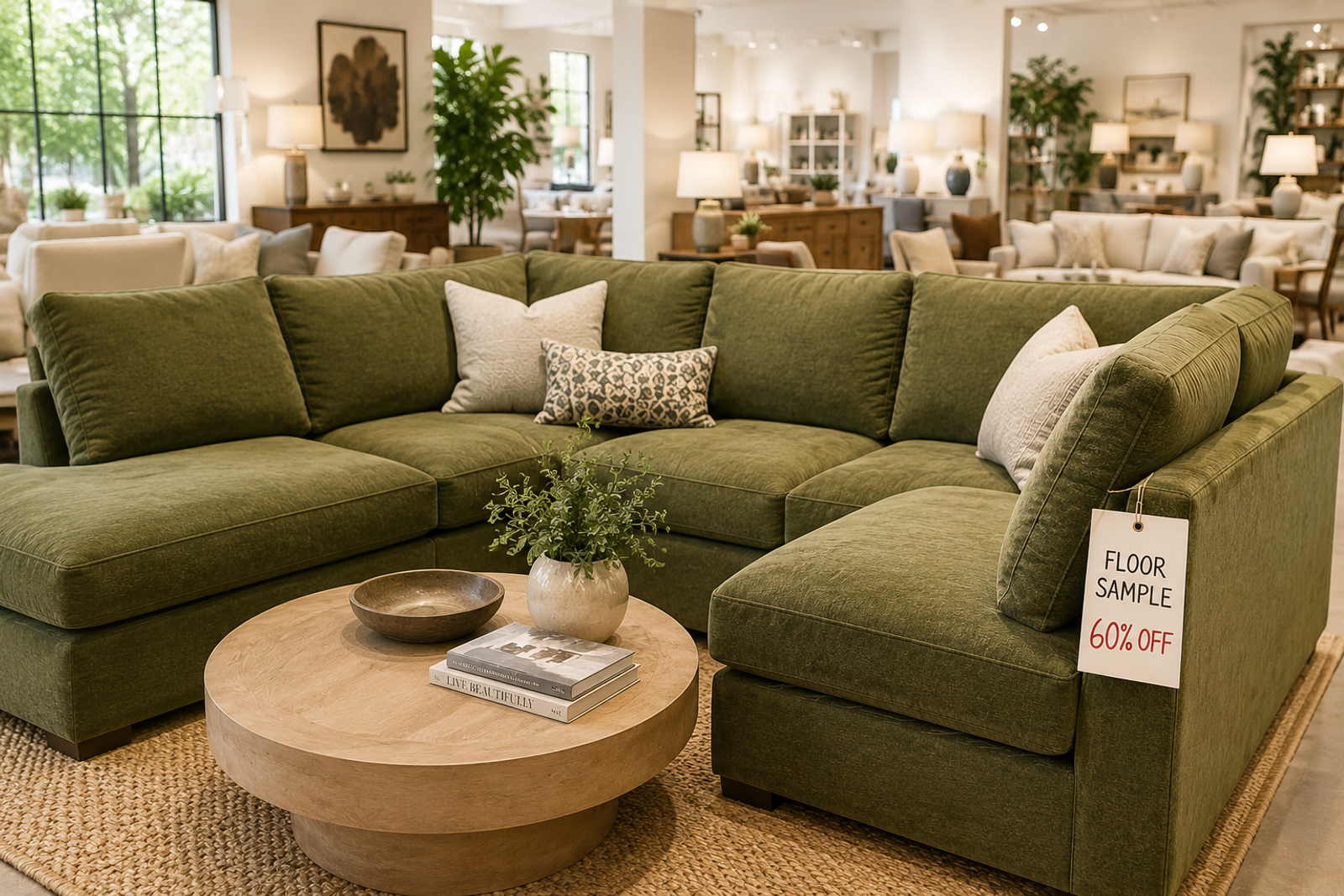
There is a sofa sitting in a showroom right now that nobody is looking at. It is structurally sound — hardwood frame, tight seams, well-finished legs. The fabric is excellent. But it was discontinued eight months ago, it is a shade of deep green that does not photograph well against the showroom's beige walls, and the sales floor has moved on to a new story about neutral textures and organic shapes. The sofa is priced at sixty percent of what it would have cost when it launched. And yet, most people walking past it today will not stop.
This is not unusual. It is, in fact, the basic operating condition of furniture retail. The best deals are not hidden by accident or buried in a warehouse — they are hiding in plain sight, in full view of anyone who walks through the door. What keeps most people from seeing them is not access. It is attention, psychology, and a shopping mindset calibrated to prefer easy over smart.
What a showroom is actually designed to do
Before understanding why good deals go unnoticed, it helps to understand what a showroom is engineered to accomplish. A well-designed retail floor is not a neutral display of available inventory. It is a persuasion environment. Light placement, vignette construction, traffic flow, and color palette are all deliberately arranged to tell a story — to make you feel the way a room could feel rather than to give you a systematic look at what is available.
This works brilliantly for new, coordinated collections. A freshly staged sectional in a warm gray, surrounded by a jute rug, a credenza, and a pair of lamps, reads as desirable and attainable. It converts. But that same retail machinery does essentially nothing for the floor sample that has been moved to a less favorable corner, or the overstock piece that is stored in back and only surfaced on request, or the discontinued item that sits in a clearance section with a handwritten tag and no context.
The showroom's storytelling apparatus ignores these items — not because they lack value, but because standard retail merchandising was never built to tell their story. That is the gap where genuine deals live.
"The most interesting thing about a clearance tag is not what it says about the product. It is what it says about how the product was positioned."
The real economics of a floor sample
A floor sample is not a damaged piece. It is a piece that has done its job. Retailers put furniture on the floor to serve a specific merchandising function: to anchor a room concept, demonstrate a product category, and help customers visualize. A sofa on the floor sells other sofas, rugs, tables, and lighting. Once it has fulfilled that role — or once the retailer needs the space to tell a different story — the floor sample becomes a problem of logistics, not of quality.
The markdown on a floor sample is compensation for the uncertainty of its history — a few years of people sitting on it, touching it, occasionally leaving fingerprints or minor surface scuffs. But what that markdown rarely accounts for is the quality of the piece itself, which in most cases is unchanged. A well-constructed sofa that spent three years on a showroom floor is still a well-constructed sofa. The discount is for the story, not for the structure.
Experienced buyers understand this instinctively. They know how to inspect a frame, check a cushion for integrity, examine a seam, and assess whether a piece will perform in a real home. They are not buying the pristine unboxing experience — they are buying the object. And the object is frequently excellent.
Why color and configuration create opportunity
Neutral sells. This is not a retail myth — it is a documented behavioral pattern that shapes inventory, pricing, and markdown cycles across the furniture industry. A cream or warm gray sofa can be mentally placed in more rooms, by more buyers, with less deliberation. It requires no commitment to a specific palette. It co-exists with future renovations. It resells more easily. That perceived universality makes it move faster, which means it almost never reaches the markdown floor.
Bolder choices behave differently. A sofa in deep teal, forest green, mustard, or dusty rose requires the right context — the right lighting, complementary walls, a buyer who understands that a strong anchor piece can make a room instead of complicating it. That narrower audience means slower sell-through. Slower sell-through means pressure to reduce price. That pressure is the buyer's friend, if the buyer has the confidence to act on it.
The same logic applies to configuration. An oversized sectional that does not fit a standard showroom vignette, an unusual chaise orientation, a piece built for a specific architectural purpose — these items can be spectacular in the right home and unsellable in the average one. Retailers who carry them eventually discount them not because the design failed, but because the audience for them is smaller than the audience for standard configurations. The right buyer, then, is not buying an inferior product. They are buying an undersold one.
Overstock, discontinuation, and the retailer's invisible pressure
Furniture is physically expensive to hold. A piece that occupies twelve square feet of showroom space, or that sits on a pallet in a warehouse, is costing the retailer in rent, handling, insurance, and working capital on every day it remains unsold. This is not a crisis — it is the ordinary background pressure of inventory management — but it shapes pricing in ways that most shoppers never consider.
When a product is discontinued, the retailer loses the ability to reorder it. That sounds like a problem until you consider what it means for the buyer: the price of that piece will only go one direction from here. There is no back-order, no new shipment, no comparable version arriving next season. The retailer needs to clear the unit, and the unit is one-of-a-kind in its availability. That combination of price pressure and genuine scarcity is unusual in consumer retail — and for the buyer who acts on it, it can represent exceptional value.
Customer-canceled orders tell a similar story. A piece that was built to specification, then canceled when a renovation stalled or a move fell through, arrives at the retailer already paid for and without a buyer. The retailer's incentive is quick conversion. The buyer's incentive is a piece that was often built to a higher specification than standard inventory — because it was originally ordered with intent.
"Retail discounts are often less about damage than about delay. The piece was never wrong — it just arrived at the wrong moment for someone else."
The size problem, and why it creates value
Large furniture sells slowly for reasons that have nothing to do with quality and everything to do with psychology. A sofa that is one hundred and twelve inches wide instead of ninety-six requires the buyer to have a specific room, a specific wall, and a degree of spatial confidence that most shoppers are not walking in with. It also demands delivery logistics that feel complicated — narrow hallways, freight elevators, disassembly, stairwells.
Retailers know this. A piece with an oversized footprint that has been on the floor for more than a season becomes a cost problem. Floor space is not idle — it is occupied by an item that is preventing something new from being told. The markdown on an oversize piece is frequently disproportionate to the value gap between that piece and its smaller counterpart. For the buyer with the right room and the ability to handle logistics independently, this is exactly where the most significant value-per-dollar can be found.
Local pickup matters enormously here. When a buyer can coordinate their own transport — or simply drive to a nearby retailer and arrange delivery on their own terms — the economics shift entirely. Furniture that would cost hundreds of dollars in freight to ship across the country can be loaded into a truck and moved for a fraction of that. The discount plus the logistics advantage can make an already strong deal genuinely exceptional.
What experienced buyers actually look for
The difference between a casual furniture shopper and an experienced one is not taste or budget. It is evaluation framework. The casual shopper asks: does this look the way I imagined? The experienced buyer asks: is this built well, priced fairly, and right for my space?
In practical terms, this means looking at frame construction before fabric color. It means pressing a cushion to assess density and spring quality, not just softness. It means checking whether a seam is tight and whether a leg joint is solid. It means reading a piece the way a craftsperson would, not the way a magazine would. Once you develop that eye, the showroom floor starts to look very different — and the clearance section starts to look far more interesting.
Experienced buyers also understand context pricing. A floor sample with a small surface mark and a forty percent discount is not a compromise — it is a different value proposition. They have internalized the idea that near-perfect condition plus meaningful savings routinely beats brand-new at full price when the underlying quality is equivalent. The imperfection is the price they pay for the discount, and they have made that calculation before walking in.
Why the best finds disappear before they go viral
One under appreciated feature of local furniture retail is its lack of network effects. A great deal at a national e-commerce retailer gets discovered once, shared online, and sold out within hours. A discontinued armchair in a local showroom gets noticed by whoever walks through the door — which, in any given week, is a fraction of a fraction of the potential audience.
This is a feature for the in-person shopper and a frustration for everyone else. The inventory that creates the most value does not flow through algorithmic recommendation engines. It does not surface on the first page of a search. It sits on a floor or in a back room, waiting for someone who came in looking for something else and had the presence of mind to stop and look.
Local browsing, then, is not just a shopping style — it is a sourcing strategy. The person who builds relationships with local retailers, who visits showrooms periodically rather than only when in immediate need, and who knows what questions to ask about incoming overstock and upcoming markdowns has a structural advantage over the person who shops purely online. They are playing a different game, with access to inventory that the digital world does not see.
The misfit piece that was always right for someone
There is a category of furniture that retailers quietly refer to as a “misfit piece” — the wrong piece in the wrong store. The size does not suit the local market. The color was bought as a trend that did not materialize. The configuration was ordered for a commercial project that changed scope. These pieces are not inferior to anything else in the showroom — they are simply mismatched to the market in which they landed.
For the right buyer, a misfit piece is the opposite of a compromise. It is a piece with full construction quality, reduced price, and the added virtue of being one of a kind in the real-world sense — not as a marketing designation, but because there is genuinely no other unit in the region. The buyer who finds it, evaluates it on its merits, and recognizes that it solves their room problem has found something that cannot be replicated at any price point by scrolling an e-commerce grid.
This is the part of furniture shopping that is genuinely pleasurable, if you allow it to be. Not the acquisition, exactly, but the discovery — the recognition that something others overlooked is actually exactly what you needed. It rewards patience, curiosity, and the willingness to engage with a room in person rather than through a screen.
The market rewards flexibility
The broader lesson from all of this is not complicated, but it is counterintuitive for a shopping culture built around convenience and instant clarity. The buyer who knows exactly what they want — the exact fabric, the exact finish, the latest configuration, the cleanest listing — is buying into the most competitive part of the market. They are competing with every other buyer who has the same shortlist, which means they are paying for certainty.
The buyer who can evaluate quality, adapt their preferences slightly, and act without requiring a perfect presentation is operating in a less crowded market.
They are not compromising — they are substituting flexibility for certainty, and the furniture retail system happens to pay very well for that trade.
The best furniture deals are hiding in plain sight because the logic of retail merchandising was never built to surface them. Floor samples served their purpose. Overstock accumulated from a bet that did not pay off. Discontinued items became one-offs through no fault of their own. Misfit pieces landed in the wrong market.
None of that is the piece's problem. And none of it should be yours — if you know how to look.
Related Articles
Your Store. Your Merchandise. Your Digital Outlet.
Give your store a digital outlet. See how FLRPL helps local retailers showcase products, share their branded storefront, and connect with nearby shoppers.


You Don't Need Everyone to See It
Local merchandise doesn't need everyone to see it. Explore why proximity, availability, timing, and relevance all matter in local retail discovery.

Not Every Drop Has to Be a Deal
A Drop doesn't require a markdown. See how retailers can use FLRPL to feature new arrivals, seasonal merchandise, distinctive products, deals and more.
Discover What's Waiting Nearby
Browse inventory from verified local retailers near you.