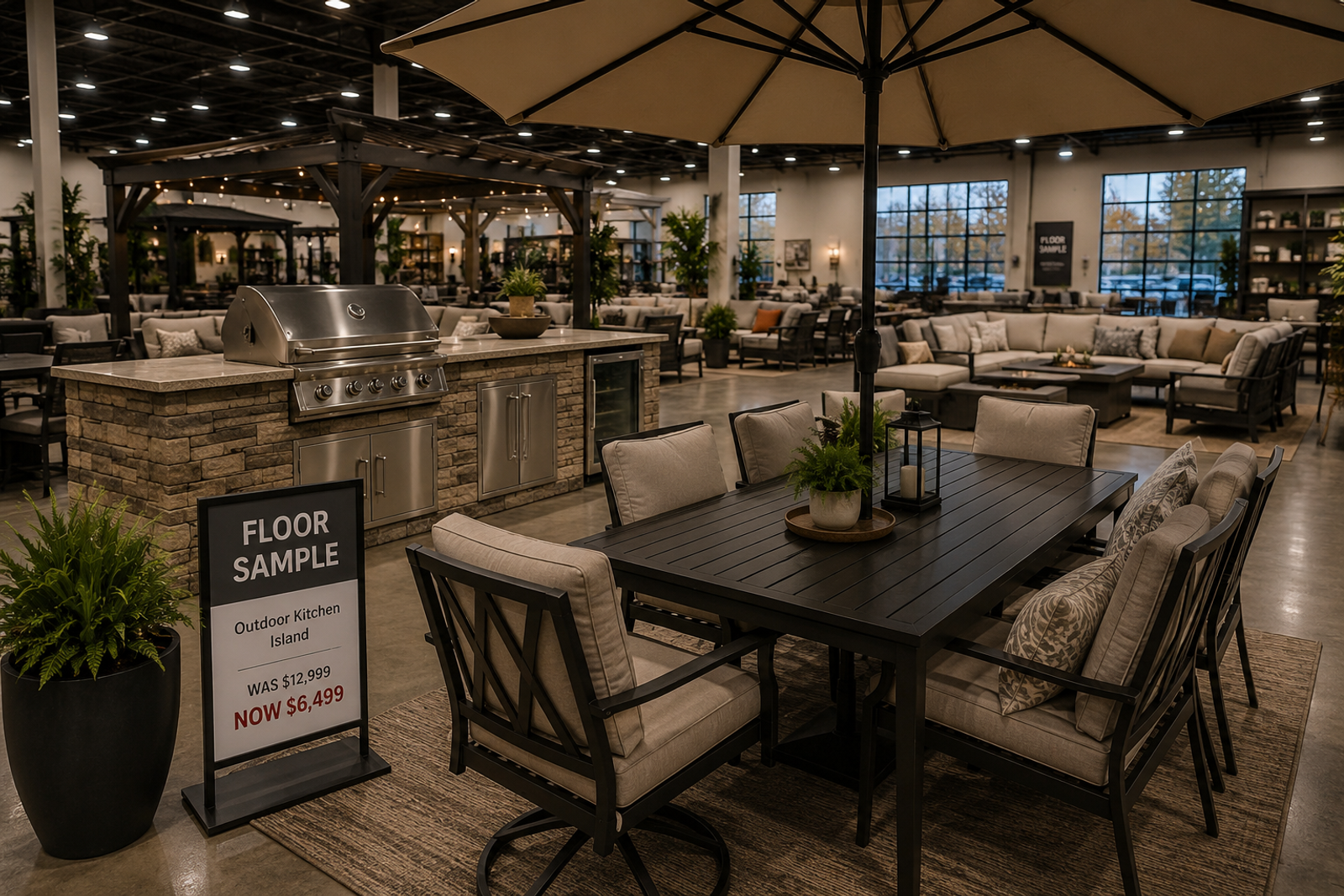
Why the Best Outdoor Furniture Deals Happen After Everyone Stops Looking
Outdoor furniture discounts often happen after peak buying season ends. Learn how weather, showroom inventory, floor samples, and retailer timing create hidden opportunities for informed buyers.

FLRPL Editorial Team
Author
Published in the FLRPL Journal | Buyer Education Series
TL;DR
- Outdoor furniture prices tend to drop most significantly after peak consumer demand, not during it — retailers shift from protecting margins to protecting floor space.
- The U.S. outdoor furniture and grills market is growing (~$14.6B projected by 2028), but growth doesn't prevent seasonal overhang — it just delays it.
- Weather is a hidden pricing variable: a cool spring, a rainy July, or an early fall can leave retailers with more inventory than their markdown calendars planned for.
- Oversized and trend-sensitive pieces — large sectionals, outdoor kitchens, pergolas, saunas, grills — carry the highest storage cost and become the most negotiable when demand softens.
- Local showroom inventory — floor samples, discontinued lines, display models — often gets discounted more aggressively than anything visible online, because it can't be neatly packaged into a digital storefront.
- Experienced buyers don't follow the season. They follow the retailer's urgency.
The Paradox Nobody Talks About
Here's something counterintuitive about buying outdoor furniture: the moment when everyone is most excited about patios is often the worst time to buy one.
Peak consumer inspiration arrives in April. Social feeds fill with styled outdoor rooms. Showrooms get replenished. Retailers hold firm on price because traffic is high, demand is real, and the season feels long. A retailer with a full showroom and a queue of motivated buyers has almost no reason to negotiate.
Fast forward to late July or August. The patio season hasn't ended — people are still sitting outside — but the buying impulse has. Most shoppers made their purchase weeks ago. The remaining inventory is now competing against something more powerful than a competitor's listing: it's competing against time.
That's when pricing gets interesting.
How Retailers Actually Think About Seasonal Inventory
Outdoor furniture is not like a television or a laptop. It doesn't hold its value through months of storage. A sectional that didn't sell in June becomes a liability in August — it's large, hard to move, and increasingly irrelevant to a shopper focused on fall planning.
Retailers who stock outdoor categories know this going in. They build their buying and pricing strategies around a concentrated selling window: roughly March through September, which accounts for nearly 60% of annual outdoor furniture purchases in the U.S. That concentration is both an opportunity and a risk. When the window opens cleanly — warm spring, stable consumer sentiment, strong foot traffic — inventory moves. When it doesn't, the math turns against them fast.
The real pressure is capital and space. A 12-foot pergola kit sitting in a corner of a showroom isn't just unsold product; it's tied-up cash, occupied square footage, and a piece that will require explanation when next year's lines arrive. For smaller regional retailers, that pressure is especially acute. They don't have the warehouse depth or the margin buffer to carry seasonal product indefinitely.
"The item doesn't get cheaper because it's worse. It gets cheaper because time is working against the seller."
Understanding this dynamic — not just knowing that markdowns exist, but knowing why they happen and when — is what separates informed buyers from everyone else.
Why Weather Rewrites the Markdown Calendar
Retailers plan seasonal inventory months in advance. Lead times on outdoor furniture, especially imported pieces, can stretch eight to sixteen weeks or longer. By the time a spring shipment arrives, the season is already underway — and whatever the weather decided to do in the intervening weeks has already shaped demand in ways no forecast could anticipate.
A cold, wet April doesn't just feel uncomfortable. It delays the psychological moment when consumers decide they want to invest in their outdoor space. That delay compresses the prime selling window, and if the season then runs warm and long, inventory may clear. But if summer arrives late and ends early, retailers can find themselves deep into September with product they planned to have sold by Independence Day.
Conversely, an early warm spell can pull demand forward so aggressively that the best inventory sells out before the average shopper has even thought about their patio. That's the other version of this problem — not overhang, but scarcity — and it's why showroom browsing in March can sometimes surface the widest selection before the predictable rush begins.
Regional Timing Isn't Uniform
Climate variation adds another layer of complexity. In northern markets — the upper Midwest, New England, the Pacific Northwest — the outdoor season is genuinely compressed. A cool spring followed by an early fall can reduce the primary selling window to ten or twelve weeks. That compression means markdown pressure often arrives earlier and moves faster than national retail calendars suggest.
In warmer southern and southwestern markets, demand stretches longer. Retailers in these regions may hold price further into fall because a consumer in Atlanta or Phoenix genuinely still has months of outdoor living ahead. But clearance still comes — it's just later.
The practical takeaway: the "right time to buy" isn't a national calendar event. It's a local market condition, and it's worth paying attention to how your specific region has been tracking weather-wise through the current season.
The Categories That Carry the Most Markdown Risk
Not all outdoor inventory discounts equally. The pieces that end up most negotiable are usually the ones that are hardest to store, hardest to ship, and hardest to explain to a customer once demand has moved on.
Large sectionals and modular seating are among the most discount-prone SKUs in the category. They occupy enormous floor space, require significant staff effort to rearrange, and don't photograph well once they've been on display. The moment a collection turns or a new line arrives, last season's sectional becomes a problem to solve, not a product to sell.
Outdoor kitchens and built-in grilling stations carry even more complexity. They're often display-only pieces that required professional installation just to show, and their very specificity — a particular size, finish, burner configuration — limits their resale pool. Once a model is discontinued, the floor model often becomes available at a fraction of its original price simply because the retailer has no inventory path for it.
Pergolas, gazebos, and shade structures are bulky, category-specific, and highly weather-influenced. A cool summer can leave significant pergola inventory unsold; a hot one can clear it out before retailers can reorder. The asymmetry makes these pieces interesting candidates for late-season negotiation.
Fire pits and outdoor heating straddle two seasons — they're often bought in late summer and fall as the evening temperature drops — which gives them a slightly longer sell-through window than pure spring-summer products. Still, oversized fire pit tables and built-in outdoor fireplaces carry enough storage cost to become negotiable once winter approaches.
Saunas occupy a niche that has grown meaningfully since 2020 but remains highly trend-sensitive. Barrel saunas and cabin-style units are large, expensive, and difficult to return or reposition. A display model that no longer fits a showroom's current aesthetic direction is often the first piece to get re-priced.
What Experienced Buyers Understand
There's a behavioral gap between how most people shop outdoor furniture and how people who consistently find the best deals do it.
Most consumers enter the category in spring, shop at the moment of highest inspiration, and compete with every other motivated buyer. Prices are firm. Selection is wide but moving fast. Retailers have leverage.
Experienced buyers invert this cycle. They've learned — sometimes through a single observation — that the shopper with the most patience often ends up with the best piece.
"The best patio deals arrive when the season stops feeling urgent and starts feeling expensive."
Here's what that looks like in practice: a buyer who waited until late August might walk into a local showroom and find a floor-sample sectional that retailed for $4,200 now priced at $1,800 — not because anything is wrong with it, but because the retailer needs the floor space back. The sectional is no longer earning its keep as a display piece. It has no online listing. It's too large to ship. Local pickup is the only path, and the buyer who shows up in person has almost no competition.
Experienced buyers also understand that imperfections on a floor sample aren't the same as defects. A small scuff on a frame, a slightly faded cushion from six months of showroom lighting, a missing hardware kit that can be ordered for eight dollars — these are the kinds of conditions that cause a retailer to reprice aggressively, but that have almost no practical impact on how the piece functions outdoors for the next decade.
The skill isn't patience alone. It's readiness. Knowing what you want, having measurements confirmed, being able to make a decision on the spot — these factors matter because the best floor sample inventory doesn't wait.
Why Showroom Displays Become Hidden Opportunities
The life cycle of a floor sample follows a predictable arc. A piece enters the showroom as a hero product — centered, well-lit, regularly cleaned, staffed with knowledgeable context. Over the following months, it does the hard work of selling product. Customers sit on it, ask about it, compare it to newer arrivals.
Then something shifts. A new collection comes in. The aesthetic trends slightly. A different colorway is now what customers want. The floor sample — which may still be in excellent condition — is suddenly holding space that a fresher piece needs.
At that point, the retailer has a decision to make: deep discount and move it, or carry it another quarter. For large, hard-to-store items, that second option is rarely attractive. The first option creates the opportunity.
This dynamic applies equally to discontinued lines. When a manufacturer discontinues a collection, retailers with remaining floor inventory often face the choice of holding it indefinitely (hoping to find the right buyer) or pricing it to move. Most experienced retail operations choose the latter. A well-built discontinued piece at 40–60% off is a legitimate value — especially for a buyer who cares about quality more than current collections.
Open-box and overstock inventory follows similar logic. A piece returned in good condition, a pallet ordered in excess of demand, a canceled order that arrived anyway — these situations all produce inventory that retailers need to clear through non-standard channels, often at prices that reflect urgency more than value.
The Psychology of Timing: Why Most Shoppers Get This Wrong
Consumer demand and retail pricing move in the same direction — but they peak at slightly different times. Consumer excitement peaks first. Retailer flexibility follows.
Most shoppers don't recognize this gap because they're inside it. They feel the urgency of the season and interpret a firm price as a fair price. They assume that the "real deals" already happened (holiday sales, Presidents Day promotions) and that what's left is priced correctly.
But pricing doesn't reflect quality. It reflects leverage. When a retailer has more motivated buyers than available inventory, prices stay firm. When the balance flips, prices move — and in seasonal categories with high storage costs, that balance often flips faster than consumers expect.
The window between "markdowns just started" and "best pieces already sold" can be narrow. This is the same dynamic behind why waiting often costs buyers the best opportunities once real markdowns begin. It rewards preparation. A buyer who knows exactly what they want, has inspected comparable pieces in person, and understands what a fair discount looks like on their specific category can make confident decisions quickly. Everyone else is reacting.
Local Pickup as a Strategic Advantage
There's a structural reason why some of the best outdoor furniture deals never appear online: the economics of moving a large piece don't support the overhead of a polished digital listing.
For a retailer trying to clear a bulky sectional, the calculation looks like this. Online listing means photography, copywriting, inventory management, return policy exposure, and often freight coordination for a piece that weighs several hundred pounds. White-glove delivery on an oversized item can cost $200–$500 or more. For oversized categories like pergolas, sectionals, grills, and outdoor kitchens, local pickup often becomes the most practical path for both buyer and retailer. That entire cost structure disappears the moment a buyer arrives in person, inspects the piece, and takes it home in a rented truck.
For the retailer, a lower sale price on a local pickup basis can net more margin than a higher-priced online transaction with full logistics overhead. For the buyer, local pickup opens access to inventory that simply doesn’t exist online — pieces that are too expensive to ship, too specific to photograph, or too far along in their markdown cycle to merit a digital sales effort. It’s the exact kind of overlooked inventory explored in Where Deals Actually Hide.
This is not a niche scenario. In a category defined by large, heavy, site-specific products, local pickup isn't a second-tier option. It's often where the real market lives.
A Closing Thought on Timing, Flexibility, and Local Retail
There's a version of furniture shopping that is purely reactive — driven by the calendar, the promotional email, the "limited time" banner. Most people shop that way, and most of the time, it produces average results.
Then there's a version of shopping that's structural. It recognizes that retail pricing isn't arbitrary; it follows predictable patterns shaped by inventory cost, weather, and the lifecycle of merchandise on a showroom floor. The consumer who understands those patterns doesn't need a sale to find value. They find it in the off-peak moment, the discontinued line, the floor sample that outlasted its original purpose.
Local retail is where that version of shopping lives. The deals that never make the homepage, the inventory that can't be photographed into a compelling listing, the piece that just needs the right buyer to walk through the door — that market is real, and it rewards exactly the kind of informed, flexible buyer who knows what they're looking at when they see it.
The season ends for most shoppers long before the deals do.
This article is part of the FLRPL Journal's Buyer Education Series. FLRPL is a digital outlet marketplace connecting local retailers with buyers looking for floor samples, overstock, and discontinued inventory.
Related Articles

Your Store. Your Merchandise. Your Digital Outlet.
Give your store a digital outlet. See how FLRPL helps local retailers showcase products, share their branded storefront, and connect with nearby shoppers.


You Don't Need Everyone to See It
Local merchandise doesn't need everyone to see it. Explore why proximity, availability, timing, and relevance all matter in local retail discovery.

Not Every Drop Has to Be a Deal
A Drop doesn't require a markdown. See how retailers can use FLRPL to feature new arrivals, seasonal merchandise, distinctive products, deals and more.
Discover What's Waiting Nearby
Browse inventory from verified local retailers near you.