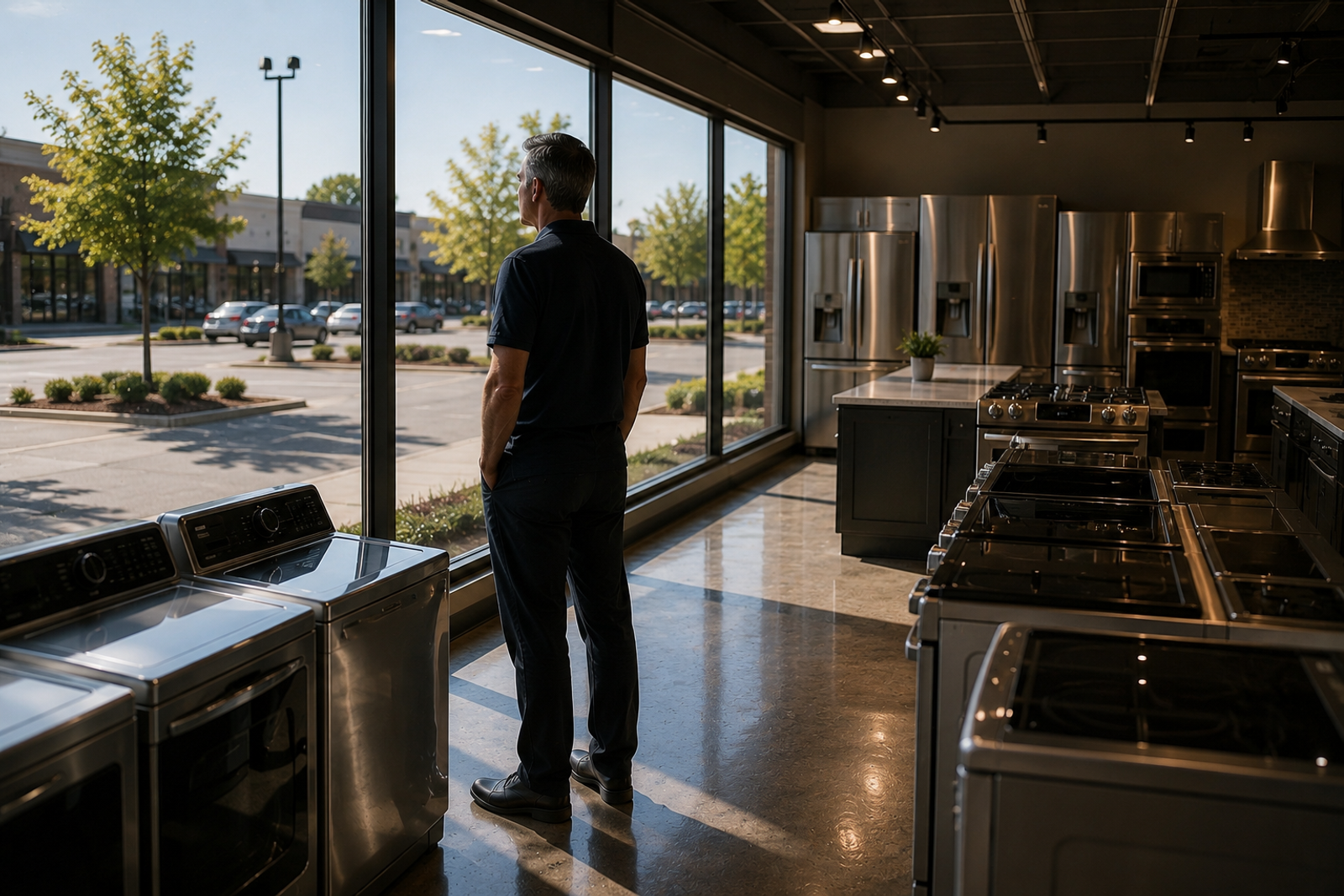
Retailers Don’t Lose Every Sale – to a Competitor
Independent retailers don’t lose every sale because of price or selection. Often, shoppers simply never discover the inventory in the first place. Learn why visibility has become the first competition in modern retail.

FLRPL Editorial Team
Author
TL;DR
- Modern retail competition begins before a shopper ever walks through the door — it begins the moment they open a search bar, a map app, or a social feed.
- Visibility precedes discovery. Discovery precedes consideration. Consideration precedes comparison. Comparison precedes purchase. Price only enters the equation after a product has already been found.
- Independent brick-and-mortar retailers often carry compelling inventory — floor samples, open-box merchandise, clearance items, one-of-a-kind pieces — that shoppers never encounter because it has no digital presence.
- National chains have structural advantages in search visibility, product feeds, and digital merchandising infrastructure that most independent retailers cannot match internally.
- Visibility is not a guarantee of sales. It is a condition for them. The goal is to ensure your inventory earns the right to compete.
The Store Was Ready. The Shopper Never Came.
On a Tuesday morning, before the doors opened, a lighting showroom on Long Island was at its best.
The floor was clean. Every fixture was lit — pendants casting warm pools of light across the center aisle, sconces arranged by finish along the far wall, a dozen chandeliers suspended at different heights from the ceiling overhead. A floor sample hung near the entrance, marked down to a price that would have stopped most shoppers in their tracks. The owner had positioned it deliberately. It was the kind of piece that sold itself, he figured — if someone saw it.
By noon, four people had come in. Two were contractors looking for something specific. One was returning a part. One browsed for ten minutes, thanked him, and left.
The floor sample was still there.
The owner was not doing anything wrong. The store looked beautiful. The pricing was honest. The inventory was real. But somewhere between that showroom and the shoppers who might have wanted exactly what he had, a gap had opened — quiet, invisible, and expensive.
This is not a story about one store. It is the operating condition for thousands of independent retailers right now, in every category from furniture to appliances to kitchen and bath. The stores are ready. The inventory is there. The discovery, increasingly, is not.
What Competition Actually Looks Like Now
For most of retail history, competition had a geography. Your competition was whoever was within reasonable driving distance, carrying similar merchandise, at a comparable price point. You competed on selection, on service, on relationships built over years of repeat business. If a shopper walked into your store, you had a real chance.
That geography still matters. But it now begins much earlier than the parking lot.
Today's shopper does not start their journey at the store. They start it at home, often the evening before — on a phone or a laptop, running searches, scanning maps, reading reviews, scrolling through images. By the time they arrive at a showroom, they have frequently already formed a consideration set. They know which two or three stores they plan to visit. They may already know which product they intend to look at. In some cases, they have already decided.
The stores that were not surfaced during that earlier process were never on the shortlist. They did not lose the comparison. They were never part of it.
This is the shift that changes everything: the competition is no longer only between retailers. It is between retailers and the systems that determine whether a shopper ever discovers them at all.
The Discovery Stack
Think of modern shopper behavior as moving through a layered discovery process before a purchase decision is made.
It starts with intent — a need, a question, an idea. The shopper wants to replace their dining room fixture. They need a new sectional. They are renovating a kitchen and want to understand what is available locally before they commit to anything online.
That intent flows into a search. Sometimes it is a Google query. Sometimes it is a Maps lookup — lighting showrooms near me, furniture stores open today. Sometimes it is a YouTube rabbit hole of design inspiration. Sometimes it is a social feed that surfaces something visually interesting in a sponsored post or a friend's story. Increasingly, it involves an AI-mediated path — asking a chatbot to suggest options, generate ideas, or summarize what is nearby.
Each of these channels is a filter. They determine which stores, which products, and which inventory enters the shopper's awareness. What does not pass through those filters simply does not exist to that shopper, regardless of how good it actually is.
Recent research on consumer behavior reflects how pronounced this shift has become. Searches for "who has [product] in stock" grew more than 8,000 percent in a single recent year — a number so large it initially sounds like a typo. It is not. It reflects a fundamental change in shopper expectation: people now believe that inventory availability should be knowable before they drive anywhere. They are not wrong to expect it. They are just ahead of where most independent retailers currently are.
Separately, roughly half of consumers have now purchased a product they discovered through social media, and more than a third have used an AI tool specifically to learn about or discover new products. The discovery stack is expanding, not contracting. Each new channel added is another place where a retailer's inventory can either appear — or not.
Why Valuable Inventory Stays Hidden
Here is the paradox at the center of this conversation: the inventory with the most potential to capture a shopper's attention is often the least visible online.
Floor samples. Open-box merchandise. Clearance items. Display models. Overstock. Discontinued products. One-of-a-kind pieces. This is the inventory that tends to carry the most immediate appeal — genuine discounts, often significant ones, on real products that are available right now, today, in a local showroom.
And yet it is precisely this inventory that most often goes unannounced. It sits behind a paper tag on a showroom floor. It lives in an owner's head, or on a handwritten back-room list. It is discoverable only by someone who already walked through the door.
Why Great Local Inventory Often Goes Unseen explored the structural reasons for this in detail. The short version: items like floor samples and overstock are operationally inconvenient to list online. They are one-offs. They do not fit neatly into a product catalog. They require individual photos, individual descriptions, individual pricing decisions. For a team of two or three people running a showroom, that work competes directly with serving the customers already in the store.
The result is a strange inversion. The inventory that deserves the most urgency — move this floor sample, clear this overstock, turn this capital back into cash — often receives the least promotional attention. It waits.
The Best Deals Never Make the Shortlist put it plainly: a deal cannot be discovered if it was never made discoverable. The shopper who would have driven twenty minutes for that marked-down chandelier never knew it existed. The retailer never knew they missed a sale. The floor sample waited another month.
The Structural Gap Independent Retailers Face
National chains do not win on price alone. In many categories, independent retailers can match or beat them. What national chains have — and what most independent retailers do not — is infrastructure for digital visibility.
A major furniture retailer or appliance chain has dedicated teams managing search optimization, product data feeds, Google Merchant Center integrations, local inventory advertising, and structured product data that makes their merchandise machine-readable across every platform that matters. When a shopper searches for a specific sofa or refrigerator model, that chain's inventory is positioned to appear. Their floor-level availability can surface in a Google Shopping result before the shopper has even decided where to go.
Independent retailers — even very good ones, with beautiful showrooms and deep product knowledge — often have none of that infrastructure. A website that has not been updated in two years. A Google Business Profile with hours that may or may not be accurate. An Instagram account that posts occasionally. A Facebook page that links back to the website.
The Sale Doesn't Start in the Showroom made this point directly: by the time a shopper visits, the decision has often already begun. If a retailer is absent from the early stages of that journey, they are not competing for the sale — they are waiting to see if a customer happens to arrive.
This is not a criticism. It is a description of a structural gap that exists for real operational reasons. Running a showroom is demanding work. Digital merchandising is its own discipline, and for most independent retailers it is genuinely a secondary concern when floor traffic is present and orders need to be fulfilled.
But the gap is real, and it compounds. Every month that passes without stronger digital presence is another month of shoppers forming consideration sets that do not include your store.
“Retailers don’t lose every sale to a competitor. Sometimes they lose it because the shopper never knew they existed.”
A Necessary Counterargument
Visibility is not enough. This should be said plainly.
A product that is discoverable but poorly priced will not sell. A store that shows up in search results but has weak reviews will lose shoppers before they arrive. A beautiful listing for an item that is no longer available destroys trust faster than no listing at all. And no amount of digital presence replaces the expertise, the service, and the relationship that a skilled independent retailer builds over years.
An Educated Buyer Is a Better Buyer made this case thoughtfully: when shoppers arrive informed, the conversation in the showroom can begin at a higher level. The retailer's knowledge becomes more valuable, not less, when the shopper has already done basic research. Visibility earns the appointment. The retailer earns the sale.
The argument here is not that visibility replaces the traditional qualities of great retail. It is that visibility must come first. A retailer cannot demonstrate expertise to a shopper who never walked in. A product cannot earn its price if it was never considered. The qualities that make an independent retailer worth visiting only matter once discovery has already occurred.
Why Most Shoppers Search the Wrong Places captures the other side of this: shoppers are searching, often actively, for exactly the kind of inventory that independent retailers carry. The disconnect is not a lack of demand. It is a failure of the path between demand and discovery to connect reliably.
"Local inventory is often not scarce. It is simply undiscovered."
What This Means in Practice
The lighting showroom owner on Long Island is not losing to a competitor with better chandeliers. He is losing to a gap in visibility — a gap between the inventory he has and the shoppers who would want it, if they only knew it was there.
His floor sample is real. The discount is genuine. The product is ready to leave the showroom today. What it lacks is the one thing that modern retail now requires before any other competition can begin: the ability to be found.
Floor Sample vs. Open-Box vs. Overstock and What Is a Floor Sample? both address the practical dimensions of this inventory — what it is, why it is priced the way it is, what a shopper should understand before pursuing it. The context matters. These are not inferior products. They are often exceptional values that simply lack a reliable path to the shopper who is looking for them.
The answer is not to abandon what makes independent retail meaningful: curation, expertise, the physical experience of a well-run showroom. The challenge is building stronger bridges between the inventory already inside the store and the shoppers already searching for it.
That means taking digital presence seriously — not as a marketing afterthought, but as a discovery infrastructure. It means treating a website, a Google Business Profile, and social media channels as active parts of the business, not static placeholders. It means recognizing that every item in the showroom — especially the floor samples, the clearance pieces, the one-of-a-kind finds — deserves a chance to be discovered.
Before any shopper compares your price to someone else’s, they first have to know you exist.
Before any of the traditional competition can begin—on price, selection, service, or relationships—a retailer must first compete for something more fundamental:
The chance to be considered at all.
“Before shoppers compare your price, they first have to find you.”
The Opportunity
Every day, independent retailers already have inventory waiting to be discovered.
Floor samples.
Open-box merchandise.
Clearance inventory.
Overstock.
Discontinued products.
One-of-a-kind finds.
Inventory already sitting on showroom floors.
FLRPL gives verified local retailers a dedicated platform to create visibility for inventory they already have, helping nearby shoppers discover what's available before they ever visit the store.
Visibility creates discovery.
Discovery creates opportunity.
FLRPL.
Your Digital Outlet.
Get Goods Gone.
Related Articles
Your Store. Your Merchandise. Your Digital Outlet.
Give your store a digital outlet. See how FLRPL helps local retailers showcase products, share their branded storefront, and connect with nearby shoppers.


You Don't Need Everyone to See It
Local merchandise doesn't need everyone to see it. Explore why proximity, availability, timing, and relevance all matter in local retail discovery.

Not Every Drop Has to Be a Deal
A Drop doesn't require a markdown. See how retailers can use FLRPL to feature new arrivals, seasonal merchandise, distinctive products, deals and more.
Discover What's Waiting Nearby
Browse inventory from verified local retailers near you.