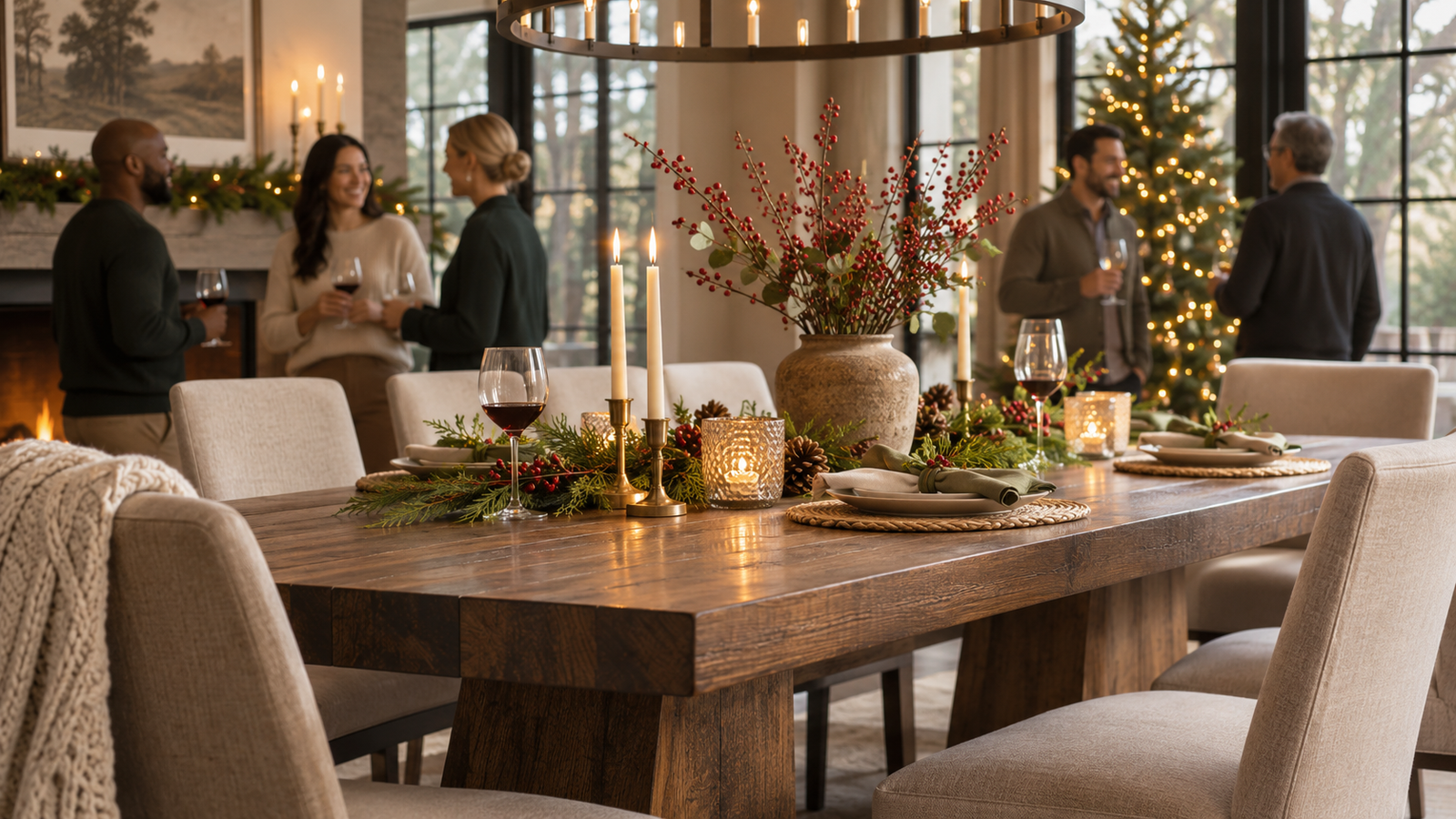
Company's Coming: What to Know Before Buying a Dining Table
Buying a dining table? Learn how to check seating comfort, room clearance, extension leaves, tabletop materials, and floor samples before you buy.

FLRPL Editorial Team
Author
TL;DR
- Look underneath the table. The apron—the frame beneath the tabletop—affects how comfortably your legs fit when you're seated.
- Don't rely entirely on advertised seating capacity. A table labeled for eight may comfortably accommodate only six, depending on its leg placement and the chairs you're using.
- Measure the room with guests in mind. You'll need space to pull out chairs, get up from the table, and move behind people who are seated.
- Test extension tables before buying. Make sure the leaves fit properly, the mechanism operates smoothly, and the table works in its fully extended position.
- Choose materials that suit your lifestyle. Solid wood, veneer, glass, stone, and other surfaces each have advantages and different care requirements.
- Consider floor samples and clearance merchandise. Local retailers may have attractive dining tables available, but inspect the actual piece and understand the terms of sale.
Thanksgiving is approaching, and the guest list keeps growing. The kids aren't so little anymore, a few extra relatives are coming for dinner, and suddenly the dining table that works perfectly well for six people needs to accommodate ten.
Maybe it's time for a bigger table. Or perhaps an extension table that gives you a little flexibility when company comes over.
You start shopping. There's a beautiful table in the showroom, the finish is just right, and the description says it seats eight. Perfect.
But does it really?
Can eight adults sit comfortably, or will someone end up with a table leg between their knees? Will the chairs fit underneath? When you add the extension leaf, will guests still be able to walk behind one another? And what happens when someone needs to get up just as you're carrying a hot platter to the table?
These are the details that rarely show up in product descriptions, yet they can make the difference between a dining table you love and one that becomes a source of frustration.
A dining table is more than a piece of furniture. It's where people gather, share meals, celebrate holidays, and spend time together. Choosing the right one involves more than finding a style you like and counting the chairs around it.
Here's what to know before you buy.
The Measurement Most People Overlook: What's Under the Table?
When shopping for a dining table, most people start with three measurements: length, width, and height.
That's reasonable. You need to know whether the table will fit the room.
But there's another measurement that deserves just as much attention, and it's one most shoppers never think to check.
The distance from the floor to the underside of the table.
Most traditional dining tables have what's called an apron. It's the frame running underneath the tabletop, often connecting the legs and providing structural support.
Some aprons are relatively shallow. Others are several inches deep, particularly on tables designed with substantial frames or extension mechanisms.
Why does that matter?
Because the apron takes up space where your thighs and knees need to go.
Two Tables, Same Height, Different Comfort
Here's an interesting example from Room & Board.
Its 72-by-36-inch Adams extension table and Parsons table are both listed at 29 inches high.
But their clearance beneath the apron is different.
The Adams has 25 inches from the floor to the underside of its apron. The Parsons provides 26.5 inches.
Now imagine using the same dining chair with an 18-inch seat height at both tables.
With the Adams, you'd have approximately 7 inches between the chair seat and apron. With the Parsons, you'd have 8.5 inches.
That extra inch and a half may not sound particularly important, but when you're seated for a long holiday meal, it can affect how easily you move your legs, shift position, or pull your chair closer.
Neither table is necessarily better. They're constructed differently, and people have different seating preferences.
The lesson is that two dining tables of identical height can feel surprisingly different once you're sitting at them.
Two tables can stand at exactly the same height and still offer very different levels of comfort once you're seated.
Most standard dining tables measure approximately 28 to 30 inches high, while dining chair seats commonly measure around 17 to 19 inches. Those dimensions provide a useful starting point, but they don't tell you everything about comfort.
And don't forget upholstered dining chairs. A thick seat cushion, particularly one that doesn't compress much, may put you closer to the underside of the table than expected.
Don't Forget the Chair Arms
Another common oversight involves dining chairs with arms.
An armchair may be perfectly comfortable when someone is sitting in it, yet refuse to slide underneath the table when it's empty.
The arms might hit the apron or underside of the tabletop.
That leaves chairs sticking farther out into the room, taking up space you may already need for walking.
Before purchasing, sit at the table using the actual chairs you intend to use. Pull yourself close enough to eat comfortably, check your knee and thigh clearance, and then push the empty chair underneath.
It's a simple test that can prevent an expensive mistake.
A Table That Seats Eight Doesn't Always Seat Eight Comfortably
One of the first questions shoppers ask about a dining table is, "How many people does it seat?"
Manufacturers generally provide a seating capacity, and many retailers display tables with the suggested number of chairs.
But there's an important distinction between fitting eight chairs around a table and comfortably seating eight adults.
Consider a rectangular table that's 72 inches long.
A common planning guideline is to allow approximately 24 inches of width per person, with more space desirable for generous place settings or larger chairs.
Using that measurement, three people could theoretically sit along each 72-inch side, with another person at either end.
That's eight.
Except the calculation assumes the entire length is usable.
Those Table Legs Can Get in the Way
Traditional tables often have legs positioned near the corners.
Those legs reduce the available space between them. Depending on their thickness and placement, they may interfere with the chairs closest to the ends.
It's possible to arrange three chairs along a side and discover that the people sitting in the outer positions have to straddle a table leg.
And if those chairs have arms or wider upholstered seats, the problem becomes even more noticeable.
This is why the distance between the table legs is often more useful than the overall length of the tabletop.
For example, Room & Board lists approximately 62 inches between the legs of its 72-inch Adams table, compared with approximately 69 inches on its 72-inch Parsons table.
Both tops are the same length, but the space available for chairs is different.
A table advertised as seating eight might be much more comfortable with six.
That doesn't make it a poor choice. It simply means you should understand how the table will function before relying on its advertised capacity.
What About Pedestal and Trestle Tables?
Different base designs offer different advantages.
A pedestal table eliminates traditional corner legs, which can make arranging chairs easier. But a large pedestal base may still interfere with people's feet.
Trestle tables, with substantial supports underneath, can offer generous space along their sides. However, people seated at the ends sometimes find those supports exactly where they want to put their legs.
Tables with legs set inward from the corners may provide more overhang at the ends, but they can also reduce usable space along the sides.
There's no single best design for everyone.
The most useful advice is also the simplest: Sit in every position you expect someone to use.
Don't just test the most comfortable chair in the middle.
Sit at the end. Sit beside a table leg. Pull the chairs close together and see how much elbow room everyone has.
It's particularly important when you expect a full table during Thanksgiving, Christmas, or other family gatherings.
Measure the Dining Room, Not Just the Table
Imagine finding a dining table that measures 84 inches long.
You've measured the dining room, and it fits perfectly.
There's space on every side, and the room looks terrific.
Then Thanksgiving arrives.
Someone pushes back a chair. Another person needs to walk behind them. Someone else is trying to reach the buffet, and suddenly the room feels considerably smaller.
This happens because people often measure a dining room with the chairs pushed neatly underneath the table.
But that's not how a dining room functions when it's being used.
How Much Space Should You Leave?
The National Kitchen & Bath Association's published planning guidance provides useful recommendations for space around dining areas.
For conventional seating arrangements, its pre-2023 guidelines suggest:
- 32 inches from the table edge to a wall or obstruction when nobody needs to pass behind a seated person.
- 36 inches when someone needs to squeeze or edge past.
- 44 inches when people need to walk behind someone who is seated.
These are professional planning recommendations, not universal building-code requirements.
Importantly, they're measured from the edge of the tabletop to the wall or obstruction, including the area occupied by the seated person.
They aren't additional walking space measured from the back of the chair.
In a busy dining room, even more space may be helpful, particularly when people are serving food or opening cabinet doors.
Watch Out for Buffets and Sideboards
Let's say your dining room is 12 feet wide, and you've found a table that's 40 inches wide.
With the table centered, you have approximately 52 inches between either edge and the walls.
That sounds generous.
Now add an 18-inch-deep buffet against one wall.
Without moving the table, you've reduced the available clearance on that side to 34 inches.
Suddenly, the space where someone needs to pull out a chair and another person needs to walk behind them isn't nearly as comfortable.
The table still fits the room. The problem is everything happening around it.
A dining table that fits perfectly with every chair tucked in may feel entirely different when the room is full of people.
When measuring, consider the actual furniture in the room, including sideboards, china cabinets, kitchen islands, and any doors that swing into the dining area.
And consider what happens when someone is seated.
If the dining room is a passage between the kitchen and another part of the house, you'll need more room to move than you might in a separate formal dining room.
For more on measuring furniture and the spaces it needs to occupy, see our FLRPL Journal guide, Will It Fit? The Complete Buyer's Guide to Measuring Before You Bring Home Furniture and Appliances.
Remember the Table When It's Extended
If you're buying an extension table, measure the room for its largest possible configuration.
A table that works beautifully at 72 inches may become difficult to navigate when extended to 96 or 108 inches.
You might gain two additional seats but lose the ability to walk comfortably around the ends.
One practical trick is to use painter's tape to mark the table's footprint on the floor.
Mark both the everyday size and the fully extended size. Then place chairs around those outlines and imagine people actually sitting in them.
It's much easier to discover a space problem before the table arrives.
Extension Tables: Convenience Comes Down to the Details
An extension table can be a great solution for households that entertain occasionally but don't want a large dining table occupying the room every day.
You enjoy a smaller table for ordinary meals and expand it when family and friends visit.
But not all extension tables work the same way.
And some are considerably easier to use than others.
Understanding the Different Types of Leaves
The traditional center-leaf table opens in the middle, allowing one or more additional sections to be inserted.
These leaves may be stored separately, often in a closet or another suitable location.
A self-storing leaf stays within the table itself, eliminating the need to find somewhere else to keep it.
A butterfly leaf folds into the table, usually on hinges, and opens when you extend the top.
Other tables have extensions that pull out from one or both ends, while drop-leaf tables have hinged sections that fold downward when they aren't needed.
Each arrangement has advantages.
Self-storing leaves are convenient because everything stays together. Traditional removable leaves can offer flexibility in how much extra length you add. Drop-leaf tables can work well in smaller spaces.
But the feature worth paying attention to isn't simply the type of extension.
It's how easily the table operates and how securely it performs when fully opened.
Always Open the Table Before Buying
If you're shopping in a showroom, ask the salesperson to demonstrate the extension mechanism.
Then try it yourself.
Does the table open smoothly? Are the leaves easy to insert? Do they align with the main tabletop? Does everything lock into place securely?
Some tables have mechanisms designed to move both halves together smoothly. Others require you to pull the sections apart individually.
Neither arrangement is automatically better, but the mechanism should function properly.
Also check whether the table legs move when the table expands.
On some designs, the legs move outward with the top. Others keep the base stationary, and larger tables may need an additional supporting leg.
The important question is whether all the new seating positions remain usable.
A table that gains two feet in length doesn't necessarily gain equally comfortable seating for two more people.
Check the Leaves Themselves
Make sure all the leaves are included and that they fit the table properly.
Check the finish as well.
A leaf stored away from sunlight may look slightly different from the tabletop that's been exposed in a showroom for years.
With solid wood, seasonal changes in humidity can also affect how adjoining sections fit. Small changes may be normal, but a table that's difficult to open, won't close properly, or has badly misaligned leaves deserves closer attention.
If you're considering a floor sample or discontinued table, this becomes particularly important.
And don't forget to ask where the leaves will be stored if they're not self-storing. A large extension leaf isn't particularly convenient if you have nowhere suitable to keep it.
Choosing a Tabletop That Works for Your Household
Dining tables come in a tremendous variety of materials, from traditional solid wood to glass, stone, laminate, and engineered surfaces.
It's easy to become focused on appearance, but construction and maintenance matter too.
A beautiful table that requires constant attention may not be ideal for a busy household.
Solid Wood Versus Wood Veneer
Many shoppers instinctively assume solid wood is always the better choice.
Not necessarily.
Solid hardwood has a natural character and can often be repaired or refinished, depending on its construction and finish. But wood responds to changes in humidity, and its natural movement has to be accommodated in the furniture's design.
A well-made wood-veneer table uses a thin layer of genuine wood over a stable underlying material, such as plywood or MDF.
That's different from a printed imitation-wood surface.
Veneer construction can provide excellent stability and allows manufacturers to achieve designs that may be more difficult with solid wood.
Its limitation is that the wood surface is thin, so refinishing options may be more restricted.
The better question isn't simply whether a table is solid wood.
It's whether the materials and construction are appropriate for the design and the way you intend to use it.
Other Tabletop Materials
Glass tables can give a room an open, airy feeling and are easy to wipe clean. However, scratches, fingerprints, and damaged edges can be concerns.
Marble offers a distinctive natural appearance, but many marble surfaces are susceptible to staining and etching from acidic substances.
Engineered quartz generally provides good resistance to everyday stains and scratches, although the resins used in quartz surfaces can be sensitive to heat.
Laminate is often practical and easy to maintain, but hot cookware and water entering damaged seams can cause problems.
Ceramic and sintered-stone surfaces can offer impressive resistance to everyday wear, though their performance varies by product and edge construction.
The Room & Board tabletop material guide offers a useful overview of several common materials and their care requirements.
No material is perfect for every household.
If you entertain frequently, have young children, or use the dining table for homework and everyday activities, consider how much maintenance you're comfortable with before choosing a surface.
Protecting Your Table When Company Comes Over
Thanksgiving dinner can be surprisingly demanding on a dining table.
Hot serving dishes come out of the oven. Cold drinks leave condensation. Wine and gravy get spilled, and heavy platters are moved around as everyone reaches for another helping.
A tabletop that looks beautiful in a showroom may require a little protection during a busy holiday meal.
Heat and Moisture Are Two Things to Watch
One of the simplest precautions is to use insulated trivets or hot pads beneath serving dishes.
Even surfaces marketed as durable may have restrictions on direct heat exposure, so follow the manufacturer's instructions for your particular table.
And remember, a tablecloth isn't necessarily heat protection.
It may help protect against some scratches or spills, but hot serving dishes still need proper insulation, and liquids can soak through fabric.
Coasters help protect against condensation from glasses and pitchers. Spills should be cleaned promptly using methods appropriate for the finish.
Avoid dragging rough-bottomed serving dishes, ceramic decorations, or centerpieces across the table. Even a durable finish can be scratched by an abrasive object.
Don't Assume Every Wood Table Needs Oil or Wax
Wood furniture finishes vary considerably.
Some manufacturers recommend periodic treatment of particular oil-and-wax finishes. Others specifically advise against using furniture polish, wax, or solvents.
For example, Copeland Furniture's care instructions recommend mild cleaning methods for its finished furniture and caution against using certain products.
There's no universal wood-care treatment that's appropriate for every table.
Ask the retailer for the manufacturer's care instructions and follow them.
A few simple precautions can help preserve a dining table's appearance long after the holiday decorations are put away.
For additional seasonal preparation ideas, see Getting Your Home Ready for the Holidays? Start Here.
Floor Samples and Clearance Tables: Worth a Look
When shopping for a dining table, don't overlook the merchandise already sitting on local showroom floors.
Furniture retailers periodically discount floor samples, discontinued styles, open-box pieces, and overstock to make room for new collections.
These can represent worthwhile buying opportunities, particularly when you're searching for a table without a lengthy special-order process.
But it's important to understand what you're buying.
A discontinued table isn't necessarily damaged. It may simply be a style, size, or finish the manufacturer no longer produces.
Overstock may be unused merchandise that a retailer needs to clear.
A floor sample is different because it's the actual piece that has been displayed in the showroom.
The important thing is to evaluate the condition and price of the specific table rather than making assumptions based on the clearance designation.
What Should You Inspect?
Start with the tabletop.
Look at the surface from different angles, paying attention to scratches, dents, finish wear, and damaged corners or edges.
Then look underneath.
Check the legs and supporting structure for looseness or visible damage. Make sure the table feels stable, and ask about any noticeable wobble.
If it's an extension table, open it completely.
Don't assume everything works simply because the table looks attractive when closed.
Confirm that all leaves, supports, and hardware are present. Check their condition, fit, and finish.
Also ask about the terms of sale.
Some retailers sell floor samples on a final-sale basis, and certain manufacturer warranties may exclude merchandise sold as-is.
Understand the return policy, warranty coverage, delivery arrangements, and whether replacement parts are available.
Our article What Is a Floor Sample? The Smart Shopper's Guide to Showroom Deals explores these considerations in more detail.
There's Value in Seeing the Actual Merchandise
One advantage of shopping locally is the opportunity to inspect the piece you're considering.
You can sit at the table, look underneath it, operate the extension, examine the finish, and see how it works with actual dining chairs.
Those are things that can be difficult to judge from product photographs alone.
A photograph can show you what a dining table looks like. Sitting at it and testing how it works tells you whether it's the right table for your home.
FLRPL helps verified local retailers feature selected floor samples, clearance inventory, discontinued merchandise, and other available pieces through their digital outlets.
Shoppers can discover these items, review information about what's available, and contact the retailer directly.
The retailer remains responsible for the sale, including pricing, condition, delivery, and applicable warranty terms.
For someone trying to find a dining table before the holidays, discovering merchandise already available at nearby stores may be a useful place to start.
Buying Before the Holidays? Check Availability Carefully
If you're hoping to have a new dining table in place before Thanksgiving or Christmas, don't assume that "in stock" automatically means ready for immediate delivery.
The table may be in the showroom, in a local warehouse, or at a distribution center somewhere else.
Ask where the actual merchandise is located and whether the complete table, including its leaves and hardware, is available.
Also confirm whether delivery includes assembly.
Some tables arrive with the base and top separated, and others require more involved setup.
Before purchasing, make sure the largest components can be carried through your doors, hallways, stairways, and any tight turns.
And get the expected delivery schedule in writing, particularly when you're working toward a specific holiday.
Sometimes the better choice is to use an extension leaf you already own, temporarily add a second table, or wait until you've found the right piece.
A dining table should work for years, not just for one holiday dinner.
Seven Things to Check Before You Buy
Before making a decision, take a few minutes to review these practical details:
- Check the apron clearance. Sit at the table and make sure your thighs and knees have adequate room.
- Measure between the table legs. Confirm your chairs fit comfortably, including at the ends.
- Test the actual seating capacity. Don't rely solely on the number of seats advertised.
- Measure the room with chairs pulled out. Allow space for guests to move and for people to pass behind them.
- Operate every extension. Make sure all leaves are present, fit correctly, and work smoothly.
- Understand the tabletop material and finish. Know how to protect and maintain the surface.
- Confirm the purchase details. Check delivery, assembly, return policies, warranties, and available replacement parts.
A Table Worth Gathering Around
It's easy to admire a dining table when it's empty.
The real test comes when it's full.
When everyone has a comfortable place to sit, knees clear the apron, chairs move freely, and there's still room to pass the gravy.
A good dining table should accommodate the people gathered around it without making everyone think about the furniture itself.
And when the holiday is over, it should be just as comfortable for breakfast, homework, or a quiet dinner on an ordinary Tuesday.
The best dining table isn't necessarily the one that seats the most people. It's the one that works for the people gathered around it.
The Opportunity
Every day, independent retailers already have inventory waiting to be discovered.
Floor samples.
Open-box merchandise.
Clearance inventory.
Overstock.
Discontinued products.
One-of-a-kind finds.
Inventory already sitting on showroom floors.
That's why FLRPL exists.
FLRPL helps verified local retailers create visibility for inventory they already have, making it easier for nearby shoppers to discover what's available before they ever visit the store.
FLRPL.
Your Digital Outlet for Local Inventory.
Visibility creates discovery.
Related Articles
Buying a Bathroom Vanity? What Most Shoppers Overlook
Buying a bathroom vanity? Learn what to check before buying, from plumbing and cabinet construction to countertops, sinks, storage, and floor samples.

Is a Sleeper Sofa Worth It? What to Know Before You Buy
Learn what to look for when buying a sleeper sofa, from mattress comfort and opening mechanisms to room dimensions, durability, and showroom testing.

When Do the Best Holiday Deals Actually Start?
Wondering whether to buy now or wait for Black Friday? Learn how to compare holiday deals, evaluate discounts, and find worthwhile local merchandise.
Discover What's Waiting Nearby
Browse inventory from verified local retailers near you.