Buying a Bathroom Vanity? What Most Shoppers Overlook
Buying a bathroom vanity? Learn what to check before buying, from plumbing and cabinet construction to countertops, sinks, storage, and floor samples.

FLRPL Editorial Team
Author
TL;DR
- Measure the finished unit, not just the cabinet. Countertop overhangs, backsplashes, and opening doors and drawers all take up space that a cabinet-width measurement misses.
- Photograph and measure your plumbing before you shop. Record the drain and shutoff-valve heights from the finished floor and their distance from the side wall. They often decide which vanities will work without plumbing changes.
- A drawer-heavy vanity has to make room for the drain. Top drawers, shelves, and interior supports can occupy exactly the space the sink trap needs. U-shaped drawers help only when they match your plumbing.
- Check the wet zones, not just the finish. Water damage usually starts at toe kicks, bottom edges, plumbing cutouts, and unsealed edges. A beautiful finish doesn't tell you what's beneath it.
- Countertops, sinks, and faucets need to work together. Compare surface materials for durability and maintenance, confirm sink compatibility, and make sure your faucet matches the countertop's hole configuration.
- Inspect the exact piece and get the terms in writing. With a floor sample, open-box, or discontinued vanity, confirm what's included, what condition it's in, and what the return and warranty terms are.
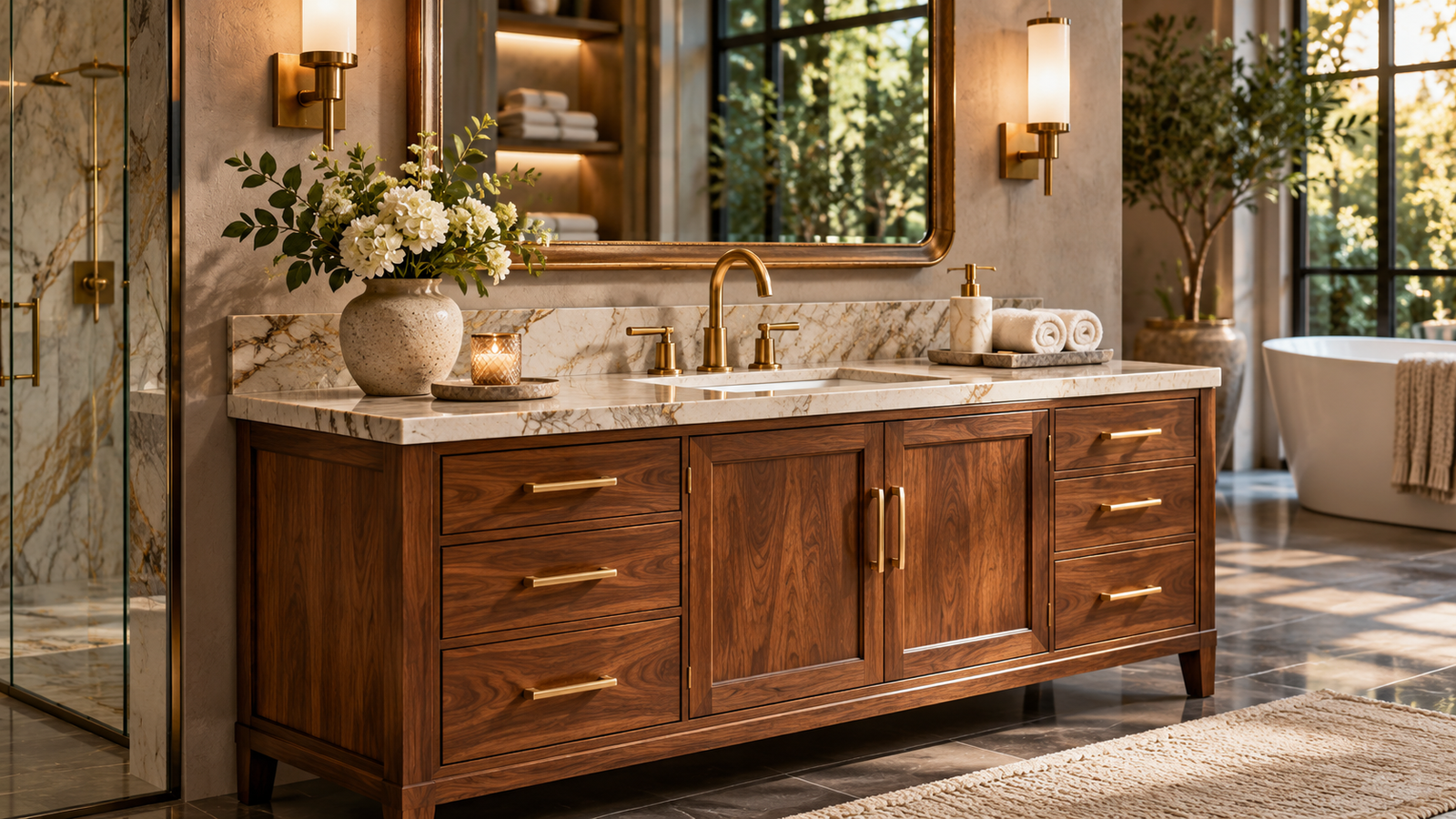
Imagine a homeowner walking through a kitchen-and-bath showroom and stopping at a 36-inch furniture-style vanity in a warm walnut finish, topped with a creamy quartz counter and a neat undermount sink. The wall at home is 40 inches wide, so the measurements seem to work. The vanity comes home, the old cabinet comes out, and the problems appear one at a time. The new top drawer sits exactly where the drain pipe comes out of the wall. The countertop extends farther into the room than the old one did, and the bathroom door now catches its corner. The faucet they bought separately needs a different hole pattern from the one drilled in the top. Nothing about the vanity was defective. It was simply the wrong vanity for that bathroom.
That scenario is hypothetical, but each of those problems is entirely possible when a vanity is purchased without considering the room and plumbing behind it. A vanity can look perfect in the showroom, fit the wall, and still be completely wrong for the room it's going into. The reasons are rarely about style. They're about the details the showroom display can't show you: what sits behind your current cabinet, how the finished unit occupies the floor, what the cabinet is made of under the finish, and whether the sink, top, and faucet were designed to work together. This guide walks through each of them.
Measure More Than the Cabinet
Vanity specifications don't always describe the same dimensions. Some identify the cabinet itself, while others describe the complete unit with its countertop. Before buying, make sure you know which measurements you're looking at. Seller sizing guides commonly list vanity widths from about 24 to 72 inches, cabinet depths of roughly 18 to 21 inches, and heights of about 30 to 36 inches. These are product conventions, not standards. Depending on the design, the countertop may extend beyond the cabinet, adding to the finished unit's overall dimensions. One cabinetmaker's sizing guide describes a 21-inch-deep cabinet paired with a top that measures about 22 to 23 inches once its front overhang is included. Side overhangs, a backsplash, and side splashes add more. A vanity squeezed between two walls needs the countertop's full width to fit, not just the box's.
Clearances that matter after installation
A vanity that fits the wall can still crowd the room. Every inch of depth comes out of the floor space in front of the sink, which is often the same space you need to reach a toilet, step out of a shower, or swing the bathroom door. Doors and drawers need room too: a drawer that extends into the toilet's path or a shower door that can't clear an open cabinet door are easy to miss until installation.
Model codes set some minimums. Section P2705.1 of the 2024 International Residential Code, a model code that many U.S. jurisdictions adopt with their own amendments, calls for at least 21 inches of clear space in front of a lavatory to any wall, fixture, or door, and at least 15 inches from the lavatory's centerline to a side wall or partition. Local adoption and amendments vary, so confirm what applies where you live. Professional planning guidelines generally recommend more generous spacing than code minimums. The National Kitchen & Bath Association released a fifth edition of its planning guidelines in 2026, and a designer or the current edition is the right place to check its recommendations.
In practice, the most useful test is physical. Tape the full countertop footprint on the floor, including overhangs, open the bathroom and shower doors against it, and stand where you'd brush your teeth to see whether you can still move comfortably. Our guide Will It Fit? covers measuring doorways and delivery paths as well, which matters for a large vanity with a stone top.
Height and mounting style
Sources disagree slightly on where "standard" ends, but standard-height vanities generally run about 30 to 34 inches and comfort-height models about 34 to 36 inches. Neither is right for every household: comfort height often suits taller adults, while a lower vanity may work better for children. A freestanding or furniture-style vanity rests on the floor, on legs or a toe kick. A wall-mounted, or floating, vanity leaves the floor open, which makes cleaning easier, but it needs solid support inside the wall and leaves less room to hide plumbing.
The Plumbing Problem Nobody Sees in the Showroom
In a showroom, a vanity sits against a clean wall with no pipes behind it. In your bathroom, a drain pipe and two water-supply valves are already set in fixed positions. Whether a new vanity works without changes often depends on whether its interior leaves room for them.
A vanity may fit the wall perfectly and still fail to accommodate the plumbing behind it.
Why furniture-style vanities are more sensitive
A traditional sink base is essentially an open box behind a pair of doors, with a back panel that can usually be notched around the plumbing and plenty of room for the sink trap, the curved section of drain pipe under the basin. In furniture-style vanities with stacked drawers, the drawer boxes, shelves, and internal supports compete for the same space as the trap, supply lines, and valve handles. One cabinet manufacturer's plumbing layout guide points out that a drawer has to clear the plumbing not only when it's closed, but also while it's moving and when it's removed for service, and the cabinet has to leave room for someone to reach in and disconnect the fittings later.
U-shaped drawers, which wrap around the trap with storage on both sides, are a clever solution, but only if the notch lines up with your actual plumbing. Drains aren't always centered, and a hardware maker's guidance recommends recording the drain outlet position, trap shape, and supply pipes before choosing a pull-out. An open-back cabinet or a design with a door section beneath the sink may fit more layouts.
Measure it before you shop
Before visiting a showroom, open your current vanity and photograph the plumbing. Measure the height of the drain's center and the shutoff valves from the finished floor, meaning the top of the tile, not the subfloor, and their distance from a side wall. One seller's guide gives common drain heights of roughly 16 to 20 inches above the finished floor, with supply valves a few inches higher and to each side, but those are typical installations, not rules.
Bring those numbers and photos with you, and ask the retailer for the vanity's plumbing cutout dimensions. If the drain falls within the cabinet's open back or cutout and the valves sit clear of the drawers, the vanity will likely fit without moving pipes. If not, the plumbing may need to be adjusted or relocated, adding cost and complexity. Talk to a licensed plumber before you buy, not after the old vanity is gone.
What's the Vanity Cabinet Actually Made Of?
A bathroom is one of the harshest environments in the house for cabinetry. Humidity, splashes, standing water, and cleaning products test a cabinet's construction every day, and the material names on a product tag tell only part of the story.
The common materials
Solid wood is typically used for face frames, doors, and drawer fronts. It's strong and repairable, but it expands and contracts with humidity, which is why it's less often used for large cabinet panels. Plywood, made from thin wood layers glued in alternating directions, generally resists irreversible swelling and holds screws better than particleboard, though it still absorbs moisture and its raw edges need sealing. MDF (medium-density fiberboard) provides a smooth, stable surface that's excellent for painted doors, but if water reaches its core, it can swell and won't fully recover. Particleboard, made from bonded wood particles, is the most economical substrate and is usually covered with laminate or vinyl wrap. Several sellers' guides note that it tends to fail first at cut edges and around hinge screws once water gets in. Wood veneer and laminated finishes describe the surface layer, not the core beneath it, and a convincing wood-grain face can cover any of these substrates.
None of these is automatically right or wrong. A properly constructed and protected engineered-wood cabinet can perform well in a bathroom, while even plywood remains vulnerable when water reaches exposed or poorly sealed areas. What matters most is how the material is used, finished, and protected, especially at the edges and openings where water actually reaches it.
The most revealing parts of a bathroom vanity may be the ones you rarely see: the edges, plumbing cutouts, and cabinet base.
Where to look in the showroom
Water damage tends to show up first in predictable places: the toe kick and the bottom of the cabinet where floor splashes land, the edges of plumbing cutouts in the back panel, and any exposed edge where the protective coating stops. Look at those areas closely. An unfinished edge can also tell you what the cabinet is made of. Visible layers indicate plywood, a uniform brown edge suggests MDF, and a coarse, chip-like texture points to particleboard.
Then test the hardware. Open and close every door and drawer, watching for sagging hinges, drawers that drift sideways, and soft-close mechanisms that slam or stall. Check that joints are tight and the cabinet doesn't rack when you press a corner. Ask whether the hardware is stainless or coated, since corroded hinges and unsealed seams are common early failure points in a humid room.
Choosing the Right Vanity Countertop
The countertop is where shoppers most often choose by appearance alone. Every material involves tradeoffs, and resistance to stains, scratches, chemicals, and heat are separate qualities. A surface that shrugs off makeup spills may still be vulnerable to a hot curling iron.
Natural stone: granite and marble
Granite is hard and handles most everyday stains well when sealed, though it needs periodic resealing, and its edges and sink cutout should be checked for chips. Marble is chosen for its appearance, but it stains more readily. Marble is particularly sensitive to acidic substances, which can leave dull marks known as etching, as a stone fabricator's homeowner guide explains. Sealing can help reduce the risk of staining, but it does not prevent acid etching. Buyers who prefer a consistently pristine surface should understand that distinction before choosing marble for a frequently used bathroom.
Engineered quartz
Quartz, made from crushed quartz bound with resin, is nonporous and low-maintenance, and it resists most everyday staining. Heat is its stated limit. Caesarstone's care guidance warns against placing hot items directly on its surfaces and notes that sudden temperature changes can cause damage that can't be reversed. Some retail guides describe quartz as heat-resistant, but the manufacturer's instructions for the specific product should take precedence.
Laminate, solid surface, and cultured marble
Laminate is practical and economical. Formica is a brand, not a material, and laminates are sold under various names. The weak point is seams and edges: Formica's care guidance warns that water near seams can penetrate and swell the substrate underneath. Solid-surface materials, including acrylic-based products such as Corian, often come with an integrated sink. Minor scratches can usually be sanded out, but Corian's care guide still calls for trivets under hot items. Cultured marble is a molded, gel-coated top, usually with an integrated basin. One cabinetmaker's care sheet warns against acetone-based nail polish remover, bleach, abrasive cleaners, and hair-coloring products. Sources disagree on scratch repair, but a fair summary is that minor dulling may be polishable, while deep scratches through the gel coat may not be.
That variation matters. Formica actually recommends acetone for removing tough stains from its own laminate, while cultured marble care sheets warn against it. Chemical resistance is product-specific, not a general rule.
Also seen in showrooms
Sintered and ultracompact surfaces such as Dekton have hard, stain-resistant faces, but manufacturers including Cosentino note that edges are the most vulnerable to chipping. Porcelain and vitreous china, common in integrated tops and sinks, resist stains well, but Kohler advises against steel wool and abrasive pads. Wood tops add warmth but must be carefully sealed, especially around the sink cutout. Glass is mostly a sink or decorative choice and can't be repaired if it chips.
Whatever you choose, a heat mat for styling tools is a sensible habit. The manufacturer cautions found in the research address hot cookware rather than curling irons specifically, but the same logic applies. Before buying, ask for the care sheet for that exact top and read it with your household's routine in mind.
Sinks, Faucets, and the Details That Need to Match
The sink, countertop, and faucet aren't independent choices. Each one constrains the others.
Four sink styles
An undermount sink is mounted beneath the countertop, so there's no rim to catch debris and the counter wipes straight into the basin. It requires a precisely cut opening and a countertop system designed to support an undermount installation, commonly stone, quartz, or solid surface, and the seal between sink and top needs attention over the years. A drop-in or self-rimming sink rests on the counter, its rim hiding the cutout. It's simpler to install, but the rim collects grime. A vessel sink sits on top of the counter and needs only a drain hole, but it needs a faucet positioned appropriately above the basin, often a taller deck-mounted or wall-mounted model, and its base can trap residue. An integrated sink is molded as one piece with the top, typical of cultured marble and solid-surface tops. There's no seam to clean, but if the basin cracks or is badly damaged, you'll usually need to replace the entire top, not just the sink.
Faucet holes aren't interchangeable
Countertops are usually drilled for one of three faucet configurations. A single-hole faucet needs one opening. A centerset faucet combines the spout and handles on one base designed for holes 4 inches apart. A widespread faucet has separate handles and typically fits holes spaced about 8 to 16 inches apart. A single-hole faucet can sometimes cover a 4-inch hole pattern with a deck plate. However, a centerset faucet won't fit an 8-inch widespread pattern, and a typical 4-inch deck plate won't cover those widely spaced holes. Check the hole spacing before falling for a faucet.
What's actually included
A showroom display often looks complete, with faucet, drain, backsplash, and mirror in place, but packaged vanities vary widely in what's included. Ask in writing exactly which components, from faucet to mounting hardware, come with the purchase.
Storage That Actually Works
Usable storage matters more than the number of drawer fronts. A top drawer that looks full-depth may be shallow or notched once it clears the plumbing, so look inside the cabinet and ask how much of each drawer is actually usable. Deep drawers organize bottles, hair tools, and cleaning supplies better than cabinet doors, which tend to leave items stacked and hard to reach. Doors are more forgiving of irregular plumbing, though, and adjustable shelves make the space behind them more useful.
A double vanity can seem like the obvious choice for two people, but two sinks take up counter space that might otherwise hold toiletries, split the interior storage, and need enough separation for two people to use them at once. On a 60-inch vanity, a single sink with generous counter space may serve a couple better than two crowded basins. Model codes also set minimum distances between lavatory centerlines, so confirm the spacing for your layout.
Finally, consider cleaning. Furniture-style vanities on legs and wall-mounted vanities leave the floor visible and easier to mop, while toe-kick bases close off that space but collect splashes along their bottom edge.
Shopping Floor Samples and Clearance Vanities
A vanity already sitting in a local showroom can be a good find. Each category means something different. A floor sample has been on display and may show minor wear from handling. An open-box unit has been unpacked, sometimes returned, and needs a careful check that every component is present. A discontinued design may be perfectly functional, simply a style or finish the retailer no longer carries. Overstock is usually new inventory the store has too much of. Clearance pricing doesn't mean a vanity is damaged. For a closer look at how these merchandise categories differ, see our guide, Floor Sample vs. Open-Box vs. Overstock: What's the Difference?
What it does mean is that the exact piece deserves a close look. Check cabinet corners and edges for chips and wear, and the countertop for chips or hairline cracks, especially around the sink cutout, faucet holes, and the drain area of an integrated basin. Test every drawer and door, and look at the back panel, plumbing openings, toe kick, and bottom rail for signs of swelling. Confirm which accessories are included, and ask whether replacement parts are still available for discontinued models.
A floor sample's real advantage isn't the tag. It's the chance to inspect the exact vanity you'd be taking home.
Terms vary by retailer and by item. Some retailers, Room & Board among them, sell floor samples as final sale; others treat them differently, and warranty coverage on open-box or display merchandise isn't guaranteed. Get the return, warranty, and delivery terms for the specific piece in writing before you commit. Our guide What Is a Floor Sample? covers the questions to ask.
FLRPL helps verified local retailers feature selected inventory, so nearby shoppers can discover a specific vanity and contact the store directly. Seeing the actual cabinet, countertop, construction, and included components in person is the real benefit. Each retailer sets its own pricing, condition disclosures, warranty, and delivery terms, so confirm those with the store.
Before You Buy: The Final Checklist
- Finished dimensions: Do you know the overall width, depth, and height of the cabinet with its countertop, overhangs, and backsplash?
- Room clearance: Have you taped the footprint and confirmed that doors, drawers, the toilet, and the shower all have room to work?
- Plumbing alignment: Do your drain and valve positions, measured from the finished floor, fall within the cabinet's open back or cutout and clear of the drawers?
- Drawer and door operation: Have you opened every drawer fully and tested the hinges, glides, and soft-close hardware?
- Materials and water protection: Are edges, cutouts, and the toe kick sealed, and does the cabinet show any signs of swelling?
- Countertop, sink, and faucet compatibility: Does the sink style suit the top, and does your faucet match the drilled hole spacing?
- Inclusions and terms: Do you have in writing what's included, what the warranty covers, whether the sale is final, and how delivery works?
A Vanity That Works on Monday Morning
Return to the homeowner in the showroom. The walnut finish and quartz top were never the problem. They chose by what the display could show, while the decision depended on what it couldn't: the drain behind the old cabinet, the door that swings past the countertop's corner, the hole pattern in the top. A good vanity purchase isn't about finding the most beautiful cabinet. It's about choosing one that fits the room, works with the plumbing already in the wall, stores what you actually use, holds up to daily water and cleaning, and goes in without unpleasant surprises.
Fall in love in the showroom if you like, but make the decision with a tape measure, a photo of your plumbing, and the drawer pulled all the way open.
The Opportunity
Every day, independent retailers already have inventory waiting to be discovered.
Floor samples.
Open-box merchandise.
Clearance inventory.
Overstock.
Discontinued products.
One-of-a-kind finds.
Inventory already sitting on showroom floors.
That's why FLRPL exists.
FLRPL helps verified local retailers create visibility for inventory they already have, making it easier for nearby shoppers to discover what's available before they ever visit the store.
FLRPL.
Your Digital Outlet for Local Inventory.
Visibility creates discovery.
Related Articles

Company's Coming: What to Know Before Buying a Dining Table
Buying a dining table? Learn how to check seating comfort, room clearance, extension leaves, tabletop materials, and floor samples before you buy.


Is a Sleeper Sofa Worth It? What to Know Before You Buy
Learn what to look for when buying a sleeper sofa, from mattress comfort and opening mechanisms to room dimensions, durability, and showroom testing.

When Do the Best Holiday Deals Actually Start?
Wondering whether to buy now or wait for Black Friday? Learn how to compare holiday deals, evaluate discounts, and find worthwhile local merchandise.
Discover What's Waiting Nearby
Browse inventory from verified local retailers near you.