
The Inventory Was Never the Problem
Slow-moving floor samples, overstock, and discontinued inventory are not always unwanted. Sometimes the right shopper simply never had an opportunity to discover them.

FLRPL Editorial Team
Author
TL;DR
- Slow-moving inventory often gets blamed on the product itself — wrong style, wrong price, weak demand — when the real issue may be that it never reached the shopper who wanted it.
- Floor samples, discontinued runs, open-box units, and overstock are a normal byproduct of running a physical store, not evidence of bad buying decisions.
- A product can be fully in stock and still have no digital footprint — no listing, no photo, no way for a nearby search to find it.
- Publishing one-off, constantly changing inventory is operationally hard, which is why so much of it stays invisible even at well-run stores.
- Visibility doesn't invent demand from nothing — it connects demand that already exists to supply that already exists.
- The useful question isn't "what's wrong with this item?" It's "has the right buyer ever had a real chance to find it?"
The Rug That Was Never Really For Sale
There is a one-of-a-kind rug displayed near the back of an independent flooring showroom on Long Island. It's a discontinued pattern — the mill stopped weaving it two years ago — in a size that's hard to find and priced well below what it would have cost new. The owner knows exactly what it is, where it came from, and roughly what it's worth. If a customer walked in and asked for that size, that color palette, and that price range, she could walk them straight to it in under a minute.
But nobody walks in and asks for it, because nobody outside the store knows it exists.
Somewhere within a few miles, there's very likely a homeowner searching for almost exactly that rug right now — measuring a room, comparing options on a laptop, narrowing down a size and a budget. That search and that rug are two halves of the same transaction. They just never meet. The rug sits in a showroom. The search happens somewhere else entirely, on a screen the rug has no presence on.
This is the quiet tension running underneath a lot of independent retail: the merchandise isn't failing to compete. It's failing to show up in the comparison at all.
The Default Diagnosis
When something doesn't sell, the instinct is to interrogate the product. Wrong pattern. Wrong price point. Bought too much. Should have discounted sooner. It's a reasonable instinct — retail is unforgiving, and margin discipline matters. But it's also an incomplete diagnosis, because it assumes the product had a fair chance to be seen by the person who wanted it, and simply failed to convert.
For some slow-moving inventory, that assumption may not hold. The product was never actually presented to a shopper who was looking for it. It sat in a showroom that a fraction of the local market walks through in a given month, described only in the memory of whichever staff member happened to notice it. The verdict "shoppers didn't want it" and the reality "shoppers never encountered it" produce the exact same outcome on a P&L — an unsold item taking up floor space — which is precisely why they're so easy to confuse.
The Inventory Is Rarely the Whole Story
Floor samples. Open-box units. Discontinued runs. Cancelled special orders. Display pieces. Overstock from a shipment that ran heavy. Customer returns that are functionally new. None of this is exotic — it's the ordinary residue of operating a physical store. A furniture showroom rotates its floor sets every season. An appliance dealer ends up with display units that were plugged in, tested, and never used. A lighting showroom retires a fixture line the moment the manufacturer discontinues it, regardless of whether the fixture itself is still beautiful. A bike shop has last year's frame color sitting in the back because the new one just arrived.
None of that is a sign the retailer bought poorly. It's the predictable cost of keeping a showroom current. What varies enormously from store to store isn't how much of this inventory exists — it's how much of it ever becomes visible to anyone outside the building.
Slow-moving inventory is not always unwanted inventory. Sometimes it is simply undiscovered inventory.
Available Is Not the Same as Discoverable
A product can be completely real, fully in stock, accurately priced, and sitting six feet from the front door — and still have no meaningful digital existence. No dedicated listing. No current photo. No description a search engine can index. No signal anywhere that says: this specific item, in this condition, at this price, is available at this address, today.
That distinction — available versus discoverable — is easy to overlook because it feels like it shouldn't matter. The product is right there. But a shopper can't walk into a store they don't know has what they're looking for. Being physically present in a building and being present in the search a shopper is actually running are two separate conditions, and only one of them determines whether that shopper ever finds out the item exists.
A product can exist on the showroom floor and still be absent from the market.
As explored in Why Great Local Inventory Often Goes Unseen, merchandise can clear every traditional retail bar and still fail the one that determines whether it gets found.
Why This Inventory Is So Hard to Publish
None of this happens because retailers are careless or behind the times. Publishing this specific category of inventory is genuinely difficult, in a way that standard catalog merchandise isn't.
A one-off item — a single floor sample, a single returned unit, a single remaining roll of a discontinued flooring pattern — has to be individually photographed, measured, described, condition-noted, and priced. It has to be tied to a specific location, kept current while it's available, and pulled down the moment it sells. Multiply that by dozens of items rotating through a showroom in a given month, on top of running the floor, helping customers, and managing the rest of the business, and it's easy to see why so much of this inventory never makes it online at all. It isn't a catalog SKU that gets uploaded once and left alone. It's a moving target, and keeping up with it is its own part-time job.
That operational reality is worth sitting with, because it reframes the problem. This isn't a story about retailers who don't understand marketing. It's a story about inventory that, by its nature, resists the tools built for standardized product catalogs.
What the Platforms Already Know
It's worth noting that Google itself has built infrastructure specifically around this gap. Local inventory ads and free local listings exist because a retailer's own website often doesn't reflect what's actually sitting on the sales floor — so Google built a separate path for that information to reach a nearby shopper's search, independent of the store's website. The existence of that infrastructure is itself a signal: a major discovery platform decided this problem was common and valuable enough to build dedicated tooling around it.
Google has reported stronger store-visit and online-conversion performance when retailers pair local inventory visibility with standard Shopping campaigns. The precise results will vary by retailer, category, and campaign, but the underlying point is useful: making local availability visible can change shopper behavior before a store visit occurs.
When the Inventory Really Is the Problem
None of this is an argument that visibility fixes everything. Sometimes slow-moving inventory really is the problem. Obsolete merchandise doesn't become desirable because more people see it. An unrealistic price doesn't become fair because it's better photographed. If the assortment doesn't match local taste, or the condition is genuinely poor, or the listing itself is inaccurate, exposure just means more people confirm they don't want it, faster.
That distinction matters, and it's worth a retailer sitting with honestly: is this a merchandising problem or a discoverability problem? A merchandising problem means the item was offered to the market and the market said no. A discoverability problem means the item was never actually offered to the market in any form a shopper could find. As explored in Retailers Don't Lose Every Sale to a Competitor, a lot of what looks like lost demand is really demand that went looking somewhere else because the retailer's own inventory never entered the search.
Sorting those two categories honestly is more useful than treating every slow mover the same way. One calls for a markdown or a different buying strategy next season. The other calls for a different question entirely.
The Question Worth Asking
The reframe is simple, even if it's easy to skip past: instead of asking what's wrong with this item, ask has the right buyer ever had a real opportunity to find it. Those are different questions with different answers, and conflating them leads a lot of genuinely good, fairly priced merchandise into a markdown cycle it never needed.
Better visibility does not manufacture a buyer who does not exist. It creates a path between an existing product and a shopper who may already be looking for it. As explored in The Best Deals Never Make the Shortlist, the product must first enter consideration. And as The Sale Doesn’t Start in the Showroom explains, that consideration often begins long before a shopper visits the store.
The rug near the back of the showroom is not necessarily waiting for demand to appear. Somewhere nearby, the right buyer may already be searching. The open question is whether that search and that rug ever have a chance to meet.
For a closer explanation of how these inventory categories differ, see Floor Sample vs. Open-Box vs. Overstock.
The Opportunity
Every day, independent retailers already have inventory waiting to be discovered.
Floor samples.
Open-box merchandise.
Clearance inventory.
Overstock.
Discontinued products.
One-of-a-kind finds.
Inventory already sitting on showroom floors.
FLRPL gives verified local retailers a dedicated platform to create visibility for inventory they already have, helping nearby shoppers discover what’s available before they ever visit the store.
Visibility creates discovery.
Discovery creates opportunity.
FLRPL.
Your Digital Outlet.
Get Goods Gone.
Related Articles
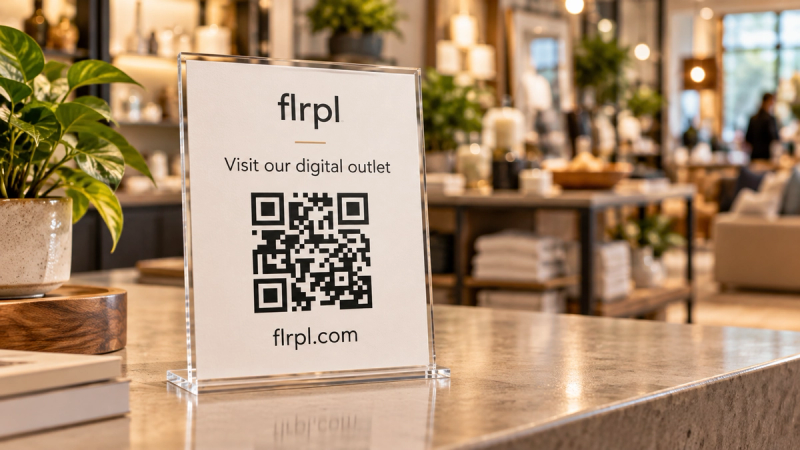
Your Store. Your Merchandise. Your Digital Outlet.
Give your store a digital outlet. See how FLRPL helps local retailers showcase products, share their branded storefront, and connect with nearby shoppers.


You Don't Need Everyone to See It
Local merchandise doesn't need everyone to see it. Explore why proximity, availability, timing, and relevance all matter in local retail discovery.

Not Every Drop Has to Be a Deal
A Drop doesn't require a markdown. See how retailers can use FLRPL to feature new arrivals, seasonal merchandise, distinctive products, deals and more.
Discover What's Waiting Nearby
Browse inventory from verified local retailers near you.