
You Don't Need Everyone to See It
Local merchandise doesn't need everyone to see it. Explore why proximity, availability, timing, and relevance all matter in local retail discovery.

FLRPL Editorial Team
Author
TL;DR
- A piece of local merchandise doesn't need the whole internet's attention to create a meaningful opportunity for discovery.
- Reach and relevance aren't the same thing. A large audience and the right audience can be two different groups entirely.
- For physical merchandise, location isn't a detail — it affects whether someone can actually inspect, ask about, or pick up the product.
- Before anyone makes a trip, they're often weighing whether the trip is worth it. Availability and convenience are part of that math.
- FLRPL doesn't claim to know who the right shopper is. It creates another opportunity for selected merchandise to be discovered by people nearby.
You Don't Need Everyone
One dining table. One showroom. One location.
It doesn't need the attention of the entire internet to create an opportunity for discovery. It needs to be seen by someone who's in the market for a dining table, lives or works close enough to go look at it, and is shopping while it's actually sitting there.
That's a narrower description than "more visibility" usually implies. It's also a more honest one. A floor-sample sofa, an open-box appliance, a distinctive rug — these are physical objects that exist in one specific place. Their relevance to any given shopper depends not just on what they are, but on where they are and whether that location makes sense for that person.
Reach and Relevance Aren't the Same Thing
It's tempting to assume that more exposure is always better — more views, more impressions, more people seeing a listing.
Physical local merchandise works differently, and it's worth being precise about why, rather than just asserting that smaller is somehow better. A dining table sitting in a showroom can, in principle, be seen by somebody on the other side of the country. That exposure isn't worthless — but it isn't the same thing as being seen by somebody who could reasonably go look at it, experience it in person, and potentially take it home. Raw audience size and audience relevance are not the same measurement. One describes how many people saw something. The other describes how many of them were actually in a position to do anything about it.
For local retail, proximity can be part of relevance.
Timing, need, and convenience matter too, but proximity is meaningful because the product in question is a physical thing sitting in a physical place.
Where the Product Is Matters
For a piece of furniture, an appliance, or a grill sitting in a local store, location isn't metadata tucked into a listing. It's part of what determines whether a shopper can actually do something with the information. Can they go see it this weekend? Can they ask a question in person? Can they pick it up themselves, or does delivery make sense from where they are? None of that is answerable without knowing where the product physically is, relative to where the shopper physically is.
That's a different kind of visibility than a retailer's name being generally known. Knowing that a furniture store exists somewhere in the area is useful. Knowing that a specific store nearby has a specific dining table available right now is a different, more actionable piece of information — one that gives a shopper a reason to consider that particular store, at that particular moment, for that particular reason.
We Built FLRPL for the Merchandise Already There goes into why that distinction — knowing a store exists versus knowing what it has — sits at the center of FLRPL's purpose.
Before Someone Makes the Trip
Most people weigh, at least briefly, whether a trip to a physical store is worth making. Is what I'm looking for actually there? Is the store reasonably convenient? Is there something worth going to see?
That weighing shows up in consumer research, too. In a 2026 McKinsey and ICSC survey of 3,004 U.S. consumers, 37% of respondents ranked being able to reliably find what they were looking for among their top three reasons for choosing a retailer. Convenient location was another leading factor, selected by 33%. Together, those findings reinforce something fairly intuitive about physical retail: availability and convenience both factor into the decision.
Neither finding proves that any one shopper will make any one trip. But together they describe a reasonable, common-sense calculation — one that's especially intuitive for furniture, appliances, lighting, rugs, grills, and other goods people generally want to see or touch before buying. A local Drop can add useful information to that calculation: here's what's available, and here's where it is.
What's available matters. So does whether getting to it makes sense.
Sometimes They Know What They Want. Sometimes They Don't.
Not every shopper arrives the same way. Some already know exactly what they're after — they need a refrigerator, and they're checking which nearby stores have one in stock. That's closer to certainty than discovery: a specific need, met by a specific answer.
Others aren't looking for anything in particular when a specific piece catches their eye — a dining table they weren't searching for, but would genuinely like to see in person. That's closer to discovery than certainty.
FLRPL doesn't depend on every shopper approaching merchandise the same way. A Drop can give the first shopper information about something specific that's available locally. For the second, it can simply create another opportunity to come across something they weren't necessarily searching for. Both are forms of relevance, even though they start from different places.
The Right Set of Eyes
You don't need every set of eyes. You need the right set of eyes.
That doesn't mean FLRPL identifies the perfect buyer, predicts intent, or guarantees a match between merchandise and shoppers. The idea is much simpler: a person may be more relevant to a given piece of local merchandise when they're nearby, when the timing lines up, and when the product is something they'd actually want to see or own. FLRPL creates an opportunity for that kind of discovery among nearby shoppers. It doesn't guarantee who will see a Drop, visit a store, or buy anything at all.
Local by Design
FLRPL's local orientation isn't an afterthought or a limitation to work around — it follows directly from what the platform is built to represent. Every Drop is a real, physical item, sitting inside a real, local store. That starting point makes locality part of the premise, not a feature layered on top of it.
That doesn't make local discovery the only model worth building, or inherently superior to broader approaches. It simply fits what FLRPL is built around: real merchandise, in real stores, and another opportunity for people nearby to discover it.
Not Every Drop Has to Be a Deal explores the other half of that premise — what a retailer chooses to feature in the first place, and why.
The Opportunity
Every day, independent retailers already have inventory waiting to be discovered.
Floor samples.
Open-box merchandise.
Clearance inventory.
Overstock.
Discontinued products.
One-of-a-kind finds.
Inventory already sitting on showroom floors.
That's why FLRPL exists.
FLRPL helps verified local retailers create visibility for inventory they already have, making it easier for nearby shoppers to discover what's available before they ever visit the store.
FLRPL.
Your Digital Outlet for Local Inventory.
Visibility creates discovery.
Related Articles

Not Every Drop Has to Be a Deal
A Drop doesn't require a markdown. See how retailers can use FLRPL to feature new arrivals, seasonal merchandise, distinctive products, deals and more.

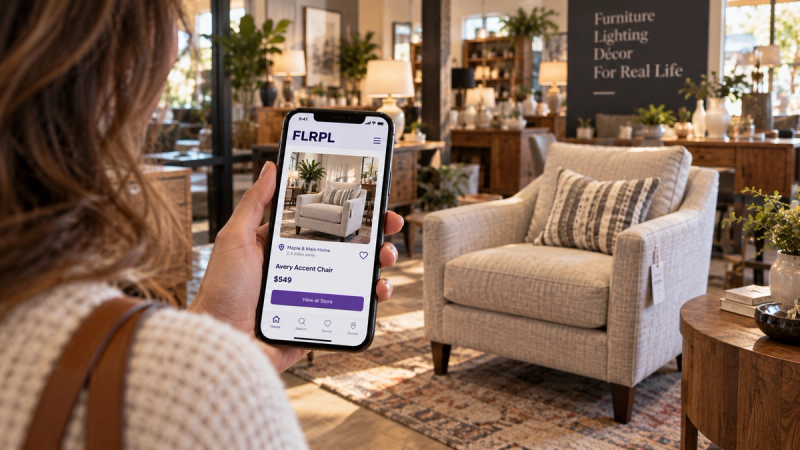
We Built FLRPL for the Merchandise Already There
Discover why we built FLRPL and how it gives local retailers another way to feature selected merchandise, reach nearby shoppers, and introduce people to their stores.
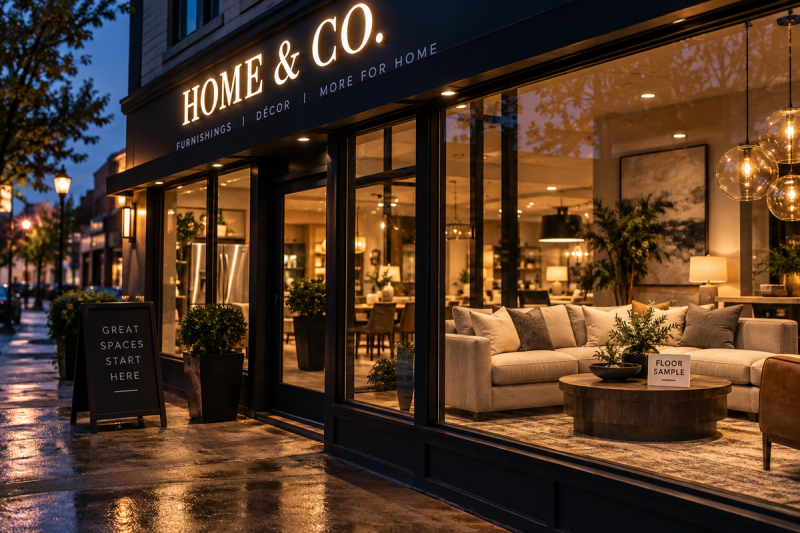
Your Storefront Starts Before the Front Door
Shoppers often research before visiting a store. See how product-level visibility can help local inventory become discoverable before they reach the front door.
Discover What's Waiting Nearby
Browse inventory from verified local retailers near you.