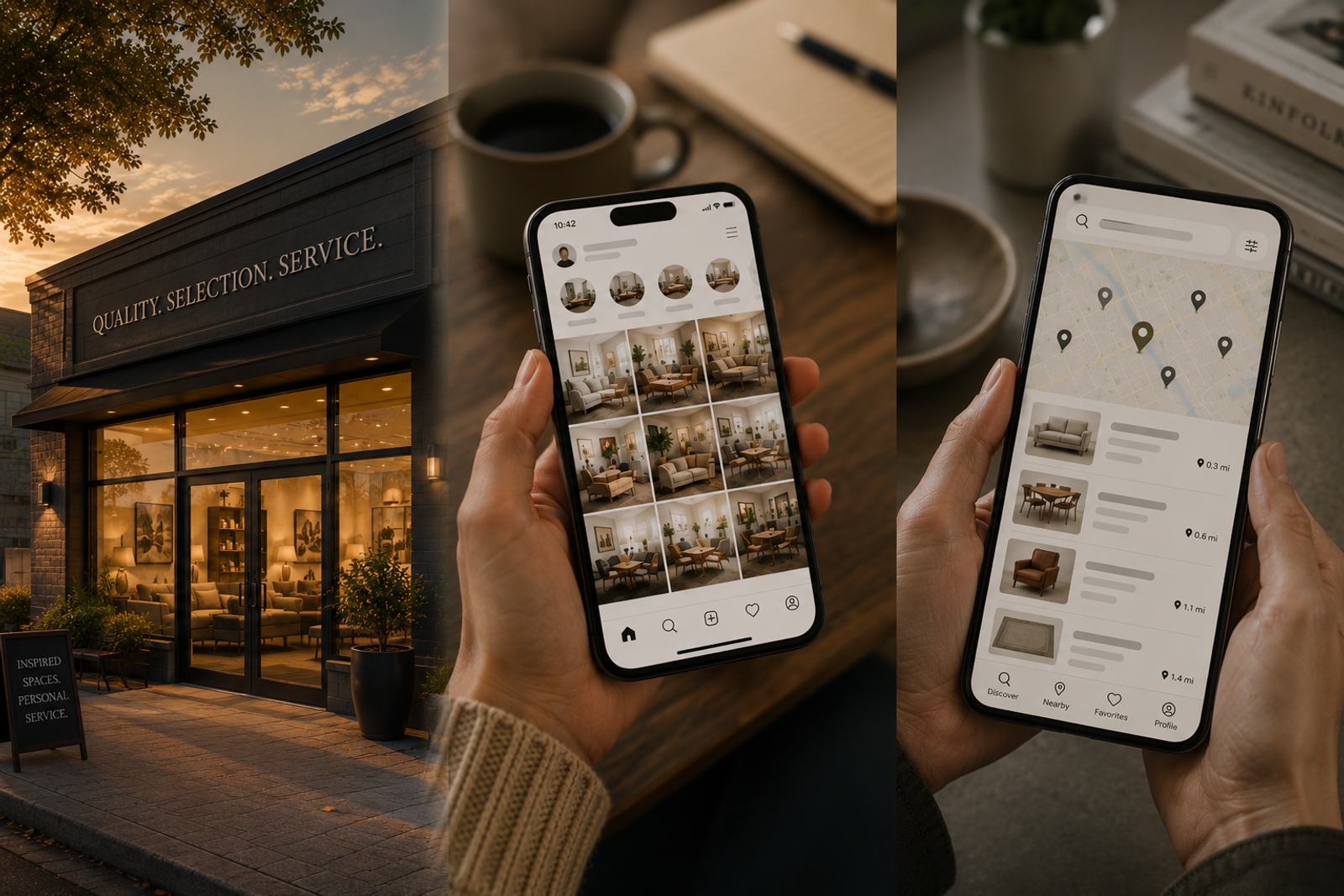
Your Website Isn't Your Discovery Strategy
Your website builds your brand. Social media builds your audience. But product discovery happens somewhere else. Learn why independent retailers need all three.

FLRPL Editorial Team
Author
TL;DR
- A retailer's website is not a discovery engine — it was never designed to be one. It is a brand headquarters: the place shoppers go after they have already found you.
- Social media is a relationship channel. It builds community and engagement with people who already know you exist.
- Product discovery — the moment a nearby shopper decides where to go — happens primarily through search, local search, maps, shopping surfaces, and increasingly AI-mediated queries.
- Shoppers today search by product, not by store. They are not typing your business name into Google. They are typing what they want, and letting the results tell them where to get it.
- The most compelling showroom inventory — floor samples, open-box merchandise, overstock, one-of-a-kind pieces — is often the least visible in the channels where discovery actually happens.
- The mistake isn't investing in a website. The mistake isn't posting on social media. The mistake is expecting either one to solve a problem they were never built to solve.
- Independent retailers don't need one digital channel doing everything. They need three — each doing the specific job it was designed for.
Having a Digital Presence and Having a Discovery Strategy Are Not the Same Thing
Walk into almost any independent retailer today and you will likely find a professionally built website.
A real one. Not a placeholder — a thoughtfully designed site with product galleries, a services page, store hours, customer testimonials, and a contact form that actually works. The photography is good. The brand looks credible. If a shopper landed on it, they would almost certainly trust what they saw.
The same retailer probably has social media. An Instagram account updated regularly with showroom photography and new arrivals. A Facebook page that posts a few times a week. Modest but genuine engagement — existing customers asking questions, leaving comments, occasionally tagging a friend.
And yet, despite all of it, shoppers who eventually find their way into the showroom often say some version of the same thing:
"I had no idea you were here."
The website was not the problem. The social channels were not the problem. Each was doing exactly what it was designed to do. The problem was what was missing — a layer of digital presence built specifically for the moment when a nearby stranger is searching for something the retailer already has.
It's a layer of retail visibility that has often been overlooked—not because it isn't important, but because most retailers have never had a dedicated way to create it.
What a Website Actually Does
There is a temptation, particularly among retailers who have invested in building a good website, to expect it to do too many things at once. That expectation is understandable. A website is the most controlled, most permanent, most fully owned piece of digital real estate a business has. Of course it should work hard.
It does. Just not in the way most retailers expect.
A retailer's website is, at its core, a headquarters. It is where shoppers go when they already know a business exists and want to learn more — who you are, where you are, what services you offer, what past customers have said, how to reach you. It communicates trust. It supports conversion. When a shopper has already narrowed their list and is deciding whether to visit or call, the website is what closes that gap.
The website is where that decision gets confirmed. It is not where it gets made.
Google's own local shopping infrastructure reflects this understanding. When Google built tools to help retailers surface in-store inventory through search, it acknowledged something important: if a retailer's website does not contain inventory information for their physical store, Google can show that in-store inventory using a Google-hosted page instead. In other words, Google knows most retail websites are not built as real-time inventory lookup tools — so it built the infrastructure to compensate.
That is not a criticism of retailer websites. It is a recognition that a website was designed for depth, not currency. It communicates permanence — your brand, your story, your reputation. Constantly changing showroom inventory is, by nature, the opposite of permanent. A floor sample available today and gone next week. A clearance item that won't last the month. An open-box appliance priced to move in the next thirty days.
Expecting a website to surface that kind of fluid, time-sensitive inventory to shoppers who do not yet know the business exists is asking it to perform a job it was never designed for.
As we explored in The Sale Doesn't Start in the Showroom, by the time a shopper arrives, the decision of where to go has often already begun. The website confirms it. It does not start it.
"A website tells shoppers who you are. Discovery tells shoppers what you have."
What Social Media Actually Does
If the website is headquarters, social media is the ongoing conversation happening around it.
Facebook, Instagram, and their counterparts are genuinely effective at one specific thing: maintaining relationships with people who already know you. An engaged following means your existing customers see your projects, your new arrivals, your promotions. A well-run Facebook page keeps your business present in the peripheral awareness of people who connected with you years ago.
That is valuable. It is not discovery.
Social feeds are built around existing connections. The algorithm surfaces content to people who have already signaled interest — by following, liking, engaging. The shopper who has never heard of your store, sitting at home wondering where to find open-box flooring nearby, is not in your audience. They are not following you. They will not see your posts — not because your content is weak, but because the channel was designed to communicate with people who already know you exist, not to reach those who don't.
This is not a flaw in social media. It is a feature. These platforms are excellent at community, storytelling, and keeping customers close. But the shopper with active purchase intent — searching for something specific, available locally, right now — is not starting that search on Instagram.
As we observed in Why Most Shoppers Search the Wrong Places, the disconnect is rarely a lack of demand. The demand is real. The gap is between where the demand lives and where most retailers have placed their visibility.
Where Discovery Actually Happens
Most independent retailers have a website and at least one social channel. Most feel that this represents a reasonable digital presence. Measured against what was expected fifteen years ago, it does.
But the way shoppers find products has changed in ways that this combination of channels does not fully address — and the shift is more significant than it might appear.
Searches for "who has [product] in stock" grew more than 8,000 percent in a single recent year. Not 80 percent. Not 800 percent. Eight thousand. That is not a trend line. That is a behavioral shift. Shoppers now expect to know whether a product is available locally before they leave the house.
Here is the reason it matters so much: people don't search for stores. They search for products.
A shopper does not wake up thinking, I should check XYZ Flooring today. They think, I need waterproof vinyl flooring. Then they search. The results — in Google, in Maps, in shopping surfaces, in AI-generated recommendations — tell them where to go. Retailers visible in those results get considered. Retailers who are not simply do not exist to that shopper, regardless of how good the inventory actually is.
Google Maps has become, in Google's own words, a tool people use "to explore something they're interested in," not merely to navigate to a place they have already chosen. Local search is how a significant share of purchase decisions begin. Shopping surfaces and local inventory listings exist because Google recognized that the question "where can I find this nearby?" was being asked millions of times daily — and most retailers were not equipped to answer it.
The shopper forming their shortlist is doing it in search results, in map applications, and increasingly through AI-mediated queries. If a retailer's inventory is not visible in those channels, the shortlist gets built without them — and as we've written in The Best Deals Never Make the Shortlist, a product cannot be considered if it was never encountered.
"The shopper rarely starts with your homepage. They start with a question."
Once you stop asking one digital channel to do every job, the modern retail landscape becomes much easier to understand. Each channel exists because it solves a different problem. When they work together, they reinforce one another rather than compete.
The Three Layers of Retail Visibility
Once this distinction becomes clear, a framework emerges — not as a marketing model, but as a practical description of what each digital channel is actually responsible for.
Layer One: Your Website Builds your brand. It is your headquarters. Your story. Your credibility. When a shopper finds you and wants to know if you are worth visiting, this is where they go.
Layer Two: Your Social Channels Build your audience. They maintain relationships with customers who already know you, tell the ongoing story of your business, and keep your brand present in the lives of people who have chosen to follow you.
Layer Three: Your Discovery Platform Makes your inventory findable. This is where strangers become customers. It is where a nearby shopper — searching by product, not by store — has a chance to find what you carry before they ever visit.
None of these layers replaces the others. A retailer without a website lacks credibility. A retailer without a social presence loses ongoing connection with their audience. A retailer without a discovery layer is far less likely to appear at the moment nearby shoppers are deciding where to go.
The mistake is not investing in a website. The mistake is not posting on social media. The mistake is expecting either one to solve a problem they were never built to solve.
Think of it this way. Your website is where shoppers go when they already know your name. Your social media is where your community stays connected to your business. Discovery is where strangers become customers. Each channel supports a different stage of the shopper's journey. Remove one, and the system becomes incomplete. Expect one to do all three jobs, and you will almost always be disappointed.
"Retailers don't need one digital channel doing everything. They need each channel doing the job it was built to do."
The Inventory That Disappears
The discovery gap is costly for all independent retailers. For those carrying certain types of inventory, it is especially so.
Floor samples. Open-box merchandise. Overstock. Discontinued products. One-of-a-kind pieces that arrived without a twin and will leave the same way. This is inventory with genuine urgency — real discounts, available now, in a local showroom, ready for a buyer willing to come see them.
It is also the inventory most structurally difficult to represent online. As we've written in Why Great Local Inventory Often Goes Unseen, items like floor samples and overstock are operationally inconvenient to list digitally. They are one-offs. They don't fit neatly into a product catalog. Each requires its own photo, its own description, its own pricing decision — work that, for a small team managing a busy showroom, competes directly with serving the customers already inside.
The result is a strange inversion. The inventory with the most urgency — move this floor sample, clear this overstock, recover that capital — receives the least promotion. It waits behind a handwritten tag on a showroom floor, discoverable only by someone who already walked through the door.
For everyone else, it does not exist.
This is not a website failure. A website was never designed to surface a single floor sample to a nearby shopper who has never heard of the store. It is not a social media failure either. Instagram was not built for real-time local inventory lookup. It is a discovery-layer failure — the absence of a channel designed specifically to make that item findable at the moment someone is actively looking for it.
As we explored in Floor Sample vs. Open-Box vs. Overstock and What Is a Floor Sample?, these are not inferior products. They are often exceptional values — the kind that would move quickly if the right nearby shopper knew they existed.
"The most valuable inventory in the showroom is often the least visible online."
When a Website Is Enough
Intellectual honesty requires acknowledging the cases where this framework does not fully apply.
For certain business models, the website is both headquarters and primary discovery environment — and that combination works well. Luxury brands with limited, intentionally curated assortments often control the entire shopper journey from first encounter through purchase. Their inventory does not change week to week. Their audience is defined. The website is the product universe, and discovery happens through the brand itself.
Highly specialized manufacturers and direct-to-consumer brands occupy a similar position. When a shopper is searching for a narrow product category and the brand is known within it, the website becomes the destination rather than a stop on a longer journey.
For these retailers, the three-layer framework is less urgent.
But for the majority of independent brick-and-mortar retailers — furniture showrooms, appliance dealers, flooring stores, lighting showrooms, kitchen and bath studios — carrying broad assortments, frequently changing inventory, and a mix of standard merchandise and one-of-a-kind finds, the website alone cannot cover the full ground the modern shopper journey now requires.
Why We Built FLRPL
We did not build FLRPL to replace retailer websites. A good website is doing exactly what it should be doing.
We did not build it to replace Facebook or Instagram. Those channels serve real purposes for the retailers who use them well.
We built it to address the space between them — the moment when a nearby shopper is actively searching for something a local retailer already has, but does not yet know where to find it. The floor sample that deserves more than a handwritten tag. The open-box appliance at a price that would move it in days if the right shopper knew it existed. The one-of-a-kind piece sitting in a showroom, waiting for someone who is, right now, searching for exactly that thing.
As we've argued in Retailers Don't Lose Every Sale to a Competitor and The Inventory Was Never the Problem, the inventory itself is rarely the issue. The gap is between what retailers have and whether nearby shoppers can find it. And as An Educated Buyer Is a Better Buyer observed, shoppers who arrive already informed are better customers — more prepared, more decisive, more ready to act. Giving them a way to find the inventory before they visit is not a threat to the in-store experience. It is a way of earning the appointment.
Every digital channel has a purpose.
Your website builds your brand.
Your social channels build your audience.
Your discovery platform creates visibility for inventory.
Visibility creates discovery.
Discovery creates opportunity.
The Opportunity
Every day, independent retailers already have inventory waiting to be discovered.
Floor samples.
Open-box merchandise.
Clearance inventory.
Overstock.
Discontinued products.
One-of-a-kind finds.
Inventory already sitting on showroom floors.
That's why FLRPL exists.
FLRPL helps verified local retailers create visibility for inventory they already have, making it easier for nearby shoppers to discover what's available before they ever visit the store.
FLRPL
Your Digital Outlet for Local Inventory.
Visibility creates discovery.
Related Articles
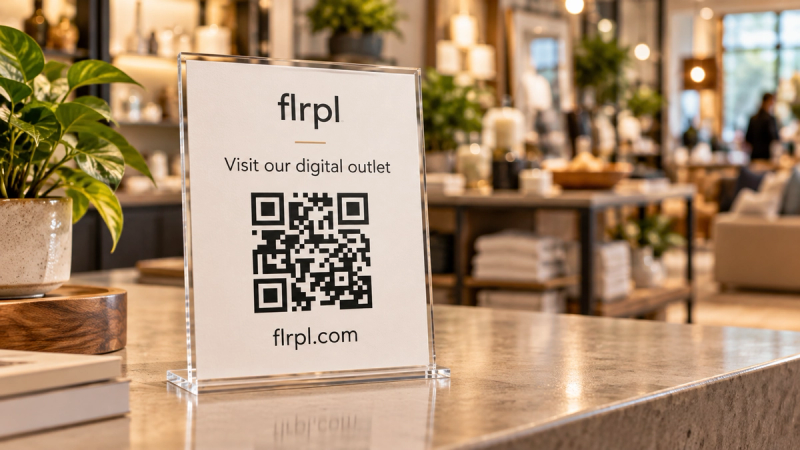
Your Store. Your Merchandise. Your Digital Outlet.
Give your store a digital outlet. See how FLRPL helps local retailers showcase products, share their branded storefront, and connect with nearby shoppers.


You Don't Need Everyone to See It
Local merchandise doesn't need everyone to see it. Explore why proximity, availability, timing, and relevance all matter in local retail discovery.

Not Every Drop Has to Be a Deal
A Drop doesn't require a markdown. See how retailers can use FLRPL to feature new arrivals, seasonal merchandise, distinctive products, deals and more.
Discover What's Waiting Nearby
Browse inventory from verified local retailers near you.