The Showroom Can Be Discovered Before the Visit
A physical showroom holds more than its storefront can communicate. See how product-level discovery can make local inventory visible before a shopper visits.

FLRPL Editorial Team
Author
TL;DR
- A showroom's inventory doesn't stop existing when the store closes for the night — but historically, it's also been invisible to anyone who hasn't yet walked through the door.
- There's a meaningful difference between store-level discovery ("there's a furniture store near me") and product-level discovery ("there's a specific walnut dining table, in this condition, at this price, at a store near me"). They answer different questions.
- Product-level discovery creates a different path into local retail. Instead of requiring a shopper to find the store first and then discover what's inside, a specific piece of inventory can become the starting point — connecting the shopper back to the local retailer that has it.
- Nonstandard inventory — floor samples, open-box units, clearance, discontinued items, one-of-a-kind pieces — is especially well suited to this kind of specific representation, because each item may really only exist once, in one place, in one condition.
- None of this makes the physical showroom less important. Most consumers still rely on stores to actually buy things, and research shows people move fluidly between digital and physical channels rather than choosing one over the other.
- The whole idea depends on honesty. A digital representation of a physical item is only useful if it's accurate — about price, condition, and whether the thing is actually still there.
- FLRPL is built around this premise: helping verified local retailers make real, physical inventory more discoverable before a shopper ever arrives.
After Hours
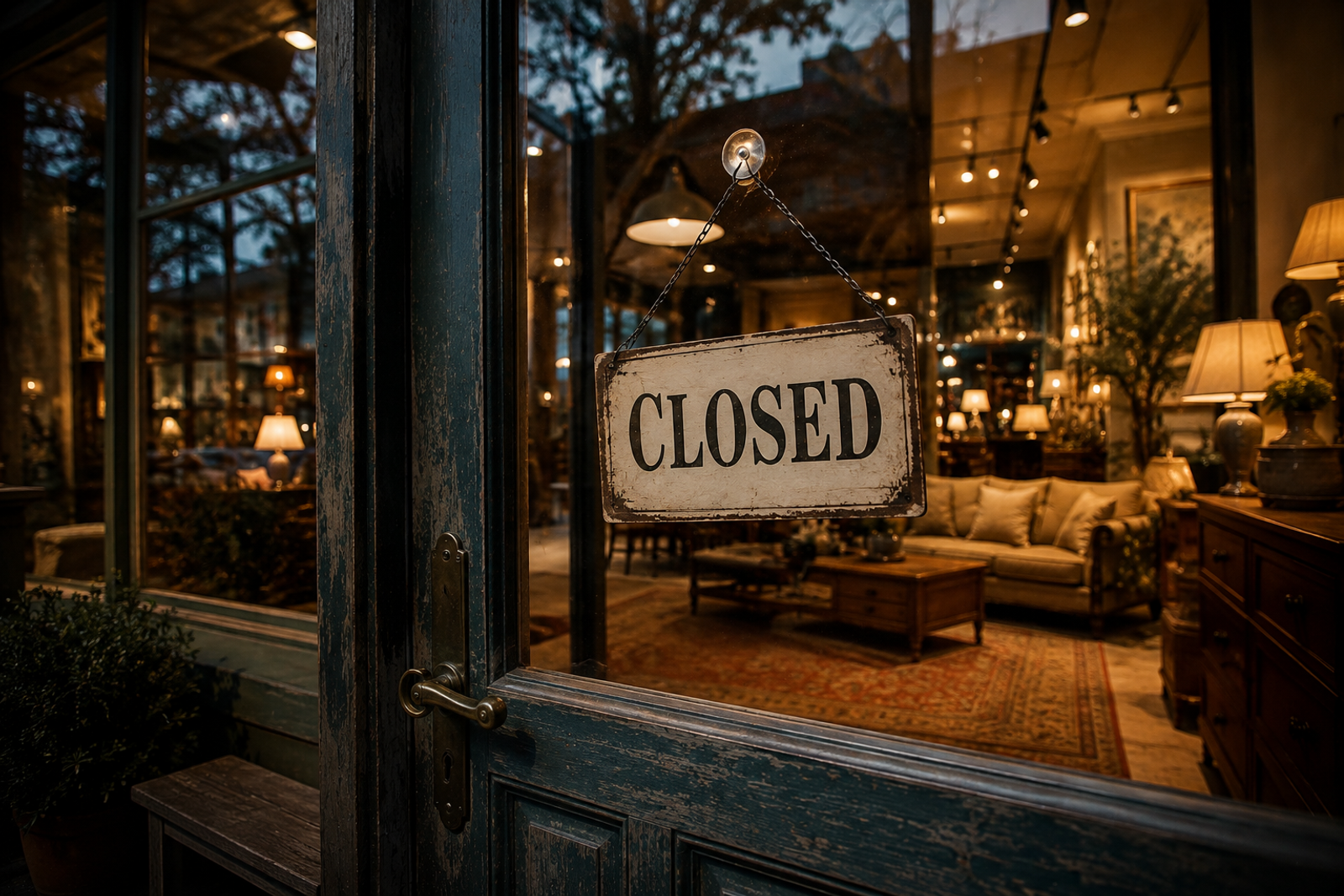
It's a little past ten at night, and a furniture showroom on a street you know is dark.
The sign is off. The doors are locked. Nobody's inside.
But the inventory is.
A walnut dining table sits under the showroom lights that have since been switched off. There's a floor-model refrigerator with a small dent. A bathroom vanity in a finish the manufacturer discontinued last spring. A rug that came in slightly imperfect and got marked down instead of returned. A patio set. A pendant light. An open-box espresso machine, complete except for the original wrapping.
None of it has gone anywhere. It's exactly where the retailer put it — priced, displayed, and waiting.
Somewhere nearby, at roughly the same hour, someone is on their phone searching for almost exactly one of those things. Maybe it's the vanity. Maybe it's the rug. They don't know the showroom exists, or if they do, they have no way of knowing what's actually inside it tonight.
That's not a failure of the retailer. It's just how physical retail has generally worked. What's on the floor is knowable to the people who walk in, and largely unknowable to everyone who hasn't yet.
The question worth sitting with is a simple one: what if that didn't have to be true? Not "what if the store went digital" — it doesn't need to, and shouldn't have to become something else to be found. What if the actual, physical inventory already sitting on the floor could start being discovered before the shopper ever walked in?
What a Storefront Can't Tell You
A showroom has always contained more information than its storefront can communicate.
A retailer's name and address answer one question: where is this business?
That's useful. It's also incomplete.
Knowing a furniture store exists three miles away doesn't tell a shopper whether that store happens to have the thing they're actually looking for tonight. A storefront, a sign, even a well-built website homepage — these communicate that a retailer exists and roughly what kind of retailer it is. But they don't necessarily tell a shopper what's physically inside that particular store, right now, today.
This is where it's worth separating two ideas that get flattened together far too often.
Store-level discovery sounds like: there's a furniture store near me.
Product-level discovery sounds like: there's a specific walnut floor-sample dining table, in this condition and at this price, at a furniture retailer nearby.
These aren't competing propositions. They're not even really doing the same job. A store listing tells a shopper where you are and who you are. Product-level information can help explain why, specifically, this retailer might matter to what they need right now — not in general, but this week, with this particular piece of merchandise sitting on the floor.
“One gives orientation. The other gives a reason.”
The Product-to-Store Connection
Connecting a specific product to a specific physical store isn't a new idea. Local retail discovery increasingly happens at the product level, allowing shoppers to encounter merchandise in connection with the place where it actually exists.
That distinction matters.
A shopper doesn't necessarily have to begin by knowing the retailer's name. Discovery can begin with the product itself — what it is, where it is, what condition it's in, and what it costs — and lead back to the store that has it.
Where things become more interesting is with inventory that doesn't fit neatly into a standardized product feed: a single floor sample, an open-box item, a discontinued piece, a clearance item, or something genuinely one-of-a-kind.
Those products aren't simply another SKU sitting across dozens of locations. They're specific physical objects sitting somewhere right now.
Which is exactly where things get interesting.
The Thing About a Floor Sample
A regular catalog item is, in a sense, disposable in its specificity. If a retailer sells the same sofa in the same condition at ten locations, one clean manufacturer photo and one model number can reasonably stand in for all ten. The listing doesn't need to know which exact unit a shopper will eventually take home.
“The inventory is still physical. What changes is that it can become digitally discoverable.”
A floor sample doesn't work that way. It's one physical object, in one specific condition, sitting in one specific store, at one specific price, for as long as it happens to still be there. The finish might be slightly different from what's in the catalog. There might be a scuff on the leg nobody's hidden, because nobody needs to. The price reflects that it's already been sat in, walked past, and marked down accordingly.
The same is true of open-box merchandise, clearance goods, overstock, discontinued items, and anything that's genuinely one-of-a-kind. A generic description doesn't capture what actually makes the item what it is. It's not "a sofa." It's this sofa, in this condition, at this retailer, for this price, and possibly not for long.
That specificity matters. The more particular and non-repeatable an item is, the less a generic listing can tell a shopper about what is actually available at that store. An honest, item-level representation can tell a much more complete story.
Retailers already understand this instinctively. It's why floor samples get their own signs inside the store. The opportunity is to give that sign a life outside the building.
The Showroom Still Does the Job Nothing Else Can
None of this is an argument that the physical store matters less. If anything, it's closer to the opposite.
PwC's research on retail technology trends describes a shopping journey where people browse, ask questions, comparison shop, and buy across a genuine mix of digital and physical channels — and even with all that digital activity woven in, more than half of consumers, 54%, still go to a store to make the final purchase. IBM's global consumer research puts the number even higher: 73% of the consumers it surveyed said they rely on physical stores to actually buy goods.
Taken together, these aren't findings about digital channels beating physical ones. They describe something closer to a loop — discovery, research, comparison, a visit, a conversation with someone who knows the product, and eventually a decision that often still happens on the floor.
That's because the showroom does things a listing simply can't. It's where a shopper can see the actual scale of a dining table, run a hand across a finish, notice how a rug's fibers catch the light, or ask someone who's sold the same vanity forty times what tends to go wrong with the installation. No photograph substitutes for that, and nothing about product-level discovery is trying to.
What's changed isn't the value of the visit. It's when the visit might start.
ICSC, citing Klarna's Shopping Pulse research, reported that 84% of U.S. shoppers said they sometimes or often research online before heading into a store, with 40% saying they do this often. That's a statement about behavior that already exists broadly, not a claim that shoppers are combing local inventory listings at scale. But it does support the more modest, more defensible point at the center of this piece: for a large share of shoppers, the trip to the showroom has already been preceded by something — a search, a comparison, a moment of research — well before they arrive.
The sale doesn't start in the showroom — but the showroom is still very often where it finishes.
A Digital Window Should Reflect What's Really There
The value of product-level discovery comes from specificity.
A floor sample isn't just a dining table. It's a particular dining table, sitting in a particular showroom, in a particular condition, at a particular price.
The same is true of an open-box appliance, a discontinued vanity, a clearance rug, or a one-of-a-kind piece of furniture. What makes these products interesting is precisely what makes them different from standardized inventory: the details matter.
“The more specific the item, the more useful its story can become.”
That's why a Drop on FLRPL is designed to represent the actual merchandise a retailer has available — with the information a nearby shopper would want to know before deciding whether to take a closer look.
The product remains in the showroom. The retailer remains the source. FLRPL simply gives that physical inventory another place to be seen and understood.
For retailers, that creates an opportunity to show shoppers more than a storefront ever could: not simply what kind of store this is, but what's actually here.
That is what turns a physical piece of inventory into something discoverable before the visit.
Where FLRPL Fits
This is the idea FLRPL is built around.
The inventory isn't hypothetical. The retailer already bought it, already priced it, already put it out on the floor. Nothing about that changes. What FLRPL adds is another way for selected pieces of that real, physical inventory to become discoverable to nearby shoppers before they've set foot in the store.
On FLRPL, an individual listing is called a Drop — a digital representation of an actual item that physically exists at a local retailer. Or, put more plainly: a digital window into merchandise that's sitting inside a store right now, represented with the specificity that physical inventory requires.
Your inventory can become part of your marketing without becoming something separate from the store itself. FLRPL isn't trying to build a parallel universe of "digital inventory" that competes with the physical version. It's designed to make the physical version — the floor sample, the open-box unit, the piece that's one of one — more discoverable to someone who hasn't walked in yet.
This isn't meant to replace anything a retailer is already doing. Not the website, not search, not social media, not the relationships built over years with regular customers. It's meant to sit alongside those, as one more possible way for a shopper to first encounter the store — not through the name on the sign, but through something specific sitting inside it.
We've written before about how a retailer doesn't need to abandon the paths shoppers already use to find them in order to add one more. This is the natural next step in that idea: if a product can be the entrance, then the products already sitting inside a showroom — right now, tonight, under the lights that just went off — can start making that introduction before anyone walks through the door.
The Showroom Doesn't Have to Wait
Sometimes the product gets found first. When that happens, the shopper may not have started by looking for a particular retailer at all. They were looking for a particular thing — and discovered the retailer along with it.
That's a small shift, but it changes where a showroom's story can begin.
It can begin with a walnut table. A floor-model refrigerator. A discontinued vanity. A one-of-a-kind rug.
Great local inventory has always been capable of going unseen, simply because the shopper hasn't encountered it yet.
The showroom doesn't have to wait for someone to walk through the door before its inventory has a chance to be discovered.
The lights can be off. The doors can be locked. The inventory is still there.
And now, it can have another way to be found.
The Opportunity
Every day, independent retailers already have inventory waiting to be discovered.
Floor samples.
Open-box merchandise.
Clearance inventory.
Overstock.
Discontinued products.
One-of-a-kind finds.
Inventory already sitting on showroom floors.
That's why FLRPL exists.
FLRPL helps verified local retailers create visibility for inventory they already have, making it easier for nearby shoppers to discover what's available before they ever visit the store.
FLRPL.
Your Digital Outlet for Local Inventory.
Visibility creates discovery.
Related Articles
Your Store. Your Merchandise. Your Digital Outlet.
Give your store a digital outlet. See how FLRPL helps local retailers showcase products, share their branded storefront, and connect with nearby shoppers.


You Don't Need Everyone to See It
Local merchandise doesn't need everyone to see it. Explore why proximity, availability, timing, and relevance all matter in local retail discovery.

Not Every Drop Has to Be a Deal
A Drop doesn't require a markdown. See how retailers can use FLRPL to feature new arrivals, seasonal merchandise, distinctive products, deals and more.
Discover What's Waiting Nearby
Browse inventory from verified local retailers near you.