
Sometimes the Product Gets Found First
Shoppers don't always start with a store name. Sometimes they start with a product. Discover how product visibility can introduce nearby shoppers to local retailers they may never have found otherwise.

FLRPL Editorial Team
Author
TL;DR
- Shoppers may begin with a product, need, category, or price point rather than a retailer name. In those journeys, the retailer can be what gets discovered second.
- When a specific item is made discoverable with accurate information — what it is, what it costs, where it is, whether it is available — the store behind it becomes part of the answer to the shopper's original question: Where can I find this?
- A visit prompted by one product may lead to browsing, comparison, substitution, or a different purchase entirely. The item that earns the visit does not have to be the item that ultimately creates the value.
- Floor samples, open-box merchandise, overstock, and one-of-a-kind items carry distinctive combinations of product, condition, price, and availability that can create additional relevant encounters — but only if that information is accurate and reachable.
- Stale listings, mispriced inventory, and misrepresented condition do not create opportunity. They create distrust. Accuracy is a prerequisite.
- AI and conversational search are expanding the number of question-first and product-first discovery journeys, making structured, accurate inventory information increasingly important — but not guaranteeing that any retailer's inventory will be surfaced automatically.
- Discovery creates another possible path into retailer awareness. What happens after that still has to be earned.
The Lamp They Had Never Heard Of
Imagine a shopper who has been looking for a specific type of floor lamp — warm-toned, adjustable, not too large — for several weeks. She had checked two stores she already knew. Neither had what she wanted.
One evening she searched online with more specificity than usual, including a price range and a location qualifier. A result appeared for a lamp at a lighting showroom she had never encountered. She had not been looking for the showroom. She had been looking for the lamp. The store was simply the place that had it.
She noted the address, drove over the following Saturday, and found the lamp — along with a showroom she would describe to a friend that afternoon as one of the nicest she had ever been in.
The lamp was what got found. The retailer was what got discovered next.
That sequence — product first, retailer second — is the subject of this article. It is not a new phenomenon. But it is one that is increasingly shaped by digital infrastructure, and one that independent retailers can influence more deliberately than most currently do.
The Shopper Who Doesn't Start With Your Name
Most retailers think about discovery from the inside out. They have a store. They want shoppers to find it. The natural instinct is to invest in the store's brand, its name, its reputation — to make the retailer itself more visible.
That logic is sound. It is also incomplete.
A meaningful share of shoppers begin from the outside in. They start with a need, a product category, a price point, or a specific availability question. They are not thinking about which retailer to visit. They are thinking about what they want. The retailer enters their awareness only after the product does.
Google's local inventory infrastructure is built around exactly this sequence. Its stated purpose is to surface specific in-stock products and store information to nearby shoppers at the moment they search — connecting product intent with a physical location. When a result shows a shopper what a product is, what it costs, and which nearby store has it, the retailer becomes part of the answer to the shopper's original question: Where can I find this?
That is not a small thing. It is a form of introduction that does not depend on the shopper already knowing the retailer's name. The product creates the reason for the encounter; the store becomes part of the answer.
As we argued in Every Product Deserves a Chance to Be Found, a product that cannot be found cannot be considered — and a product that cannot be considered cannot create any of the downstream outcomes that follow. The sequence begins with discovery. The retailer's opportunity depends on whether that first step occurs.
"Sometimes the product is what gets discovered first. The retailer is what gets discovered next."
The Retailer Becomes Part of the Answer
There is a mechanism worth understanding here, because it shapes how independent retailers should think about what a product listing actually accomplishes.
When a shopper searches for a specific item — a particular appliance, a floor lamp in a certain style, a sectional within a price range — the results that appear are not simply links to websites. Increasingly, they are product-level answers: what the item is, what it costs, where it is available, and how far away that location is. The shopper's question was about the product. The answer includes the retailer as a necessary component of that answer.
Google's store-specific product pages are designed precisely around this: when a shopper clicks on a local inventory result, they are taken to a page that communicates the product, the price, the availability, and — critically — which specific store carries it. The store is not incidental. It is part of the information the shopper needed.
This matters especially for retailers whose names are not yet widely recognized in their market. A national chain benefits from decades of brand awareness — a shopper may visit without needing a specific product to prompt the trip. An independent retailer, by contrast, may need to earn that first encounter through something more specific. As we explored in The Sale Doesn't Start in the Showroom, the decision of where to go is increasingly made before the shopper leaves home. A product listing that makes the store legible — that answers "where can I find this?" — can create that first encounter where none existed before.
For independent retailers, this does not mean replacing search, Maps, a website, or any of the digital tools they already use. Those channels serve important purposes. The opportunity is to make more of the actual merchandise inside the store discoverable as well — particularly the floor samples, open-box goods, clearance inventory, discontinued products, and one-of-a-kind pieces that may never have a meaningful digital presence of their own. The store may already be online. The individual opportunity sitting on its floor may not be.
To be precise: this is an editorial inference supported by how local discovery systems work, not a universally measured consumer sequence. Not every listing introduces a new customer. Not every encounter creates a visit. The claim is narrower and more careful than that: a discoverable product creates another possible path through which a shopper may encounter a retailer they had not previously considered.
One Product Can Create a Reason to Visit
The question that follows is practical: can a specific product listing actually bring someone through the door?
The directional evidence suggests yes — but with important qualifications about what the evidence shows and what it does not.
Google's merchant documentation states that retailers using local inventory ads alongside standard Shopping ads notice, on average, a 21 percent increase in store visits and a 9 percent increase in online conversions for products available in store. That figure comes from Google's own aggregate platform reporting; the methodology, sample, and geography are not publicly detailed, and it should not be treated as a universal benchmark for every independent retailer.
What the evidence does support — carefully — is this: when a shopper can confirm that a nearby store has something relevant, a store visit becomes more plausible. Google's earlier local search research found that one in four people who avoided stores did so partly because they did not know whether a product was in stock. Removing that uncertainty — making the answer to "does this store have it?" findable before the trip — can reduce a friction point that otherwise prevents the visit from happening at all.
That is the claim. Not that inventory listings drive traffic. That inventory information can make a visit more worth considering.
"When a shopper can confirm that a nearby store has something relevant, a visit becomes more plausible."
The Item That Earns the Visit Does Not Have to Be the Item That Creates the Value
Here is where the argument becomes genuinely interesting for independent retailers — and where the opportunity extends beyond the single transaction.
A shopper who enters a store in search of a specific item does not necessarily leave having purchased only that item, or even that item at all. Retail behavior research, primarily from grocery and mass-merchant contexts, consistently finds that initial shopping intent and final purchase outcome can differ. Unplanned purchases occur. Substitutions happen. Shoppers encounter things they had not considered and decide they want them. The context of being inside a store — the merchandise, the presentation, the conversation with staff, the physical experience of a well-run showroom — creates possibilities that a search result cannot.
This should be stated with appropriate restraint. The research on unplanned buying comes substantially from grocery and shopping-trip contexts, and its specific findings should not be transferred directly to furniture showrooms, lighting stores, or specialty retail. Browsing and add-on purchases depend heavily on shopping mission, category, price point, time available, and the shopper's disposition. Not every person who enters a store for one reason will leave having bought something else.
But the broader behavioral possibility is real and familiar to anyone who has spent time in retail: the shopper who comes in for the floor sample lamp and leaves having also ordered a pair of sconces. The couple who walked in to see one piece of furniture and spent two hours in the showroom. The customer who could not find exactly what they wanted, but spoke with a knowledgeable salesperson and discovered an alternative they liked more.
As we wrote in The Sale Is Only One Possible Outcome, the value of a visit is not limited to the immediate transaction. Familiarity, consideration, trust, and the foundation of a future relationship are all possible outcomes of an encounter that began with a single discoverable product.
The item that earns the visit does not have to be the item that ultimately earns the sale.
“The item that earns the visit does not have to be the item that ultimately creates the value.”
Why This Can Matter More for Independent Retailers
National chains do not primarily need product discovery to introduce themselves to shoppers. Their names are already known. Their locations are already familiar. A shopper who needs a refrigerator knows, before searching, that certain large retailers carry refrigerators.
Independent retailers face a different starting point. Lower brand awareness, a narrower geographic footprint, and limited marketing budgets mean that many nearby shoppers simply do not know a particular store exists. That is not a failure of the store. It is a structural condition of operating at independent scale in a market where larger competitors have spent decades building name recognition.
This is where product-led discovery can become particularly relevant for independent retail. A retailer cannot demonstrate its expertise until a shopper encounters it. It cannot show its service, its curation, its distinctive assortment, or the quality of its showroom until someone walks through the door. And for a shopper who has never heard of the store, a specific, findable product can provide a concrete reason to walk through that door.
A 2023 consumer study found that 54 percent of shoppers said whether a retailer carried local brands that mattered to them influenced their store choice. Independent retailers — with their often distinctive, locally curated, or category-specific assortments — can offer exactly this kind of differentiation. But differentiation creates value only when the shopper has a way to encounter it.
American Express's research on independent business discovery found that younger consumers in particular often discover new independent stores through walking around their neighborhoods and through social media — routes that are inherently serendipitous and geographically limited. Digital product discovery creates an additional, more intentional path: a shopper who was not walking past the store, who was not already following it on social media, but who was searching for something the store happens to have. That distinction is part of why, as we explored in Your Website Isn't Your Discovery Strategy, different digital channels serve different roles in the shopper journey.
As we argued in Why Great Local Inventory Often Goes Unseen, the constraint for most independent retailers is rarely the quality of what they carry. It is the narrowness of the path between the inventory and the shoppers who would want it.
"A retailer cannot demonstrate its expertise until someone has a reason to encounter it. Discovery creates that reason."
The Inventory That Can Become the Doorway
Floor samples. Open-box merchandise. Clearance inventory. Overstock. Discontinued products. One-of-a-kind pieces.
These categories make the idea of product-led discovery especially tangible. These items carry distinctive combinations of attributes: a specific product, in a specific condition, at a specific price, available at a specific location, for a limited window. That combination is harder to find anywhere else. A shopper searching for an open-box appliance at a particular price point, or a floor sample sectional in a specific fabric, is conducting a search that most standard inventory channels cannot answer well. The matching problem is precise enough that when a result does surface, it can feel unusually relevant.
As we explored in The Best Deals Never Make the Shortlist, compelling local inventory cannot enter a shopper's consideration if the shopper never encounters it in the first place.
That relevance can make a visit more worth considering. Not guaranteed. More worth considering.
One caution worth stating plainly: accuracy is not optional in this context. A listing for inventory that is no longer available, at a price that has changed, or in a condition that was better described than actual, does not create opportunity. It creates a disappointed shopper standing in a store wondering why they drove there. For unique, transient inventory especially, stale or inaccurate information can reverse whatever goodwill the initial discovery generated. As we've noted throughout this series, the path from discovery to a store visit depends on the shopper believing the information is reliable. That belief is earned by accuracy, and it is lost quickly when accuracy lapses.
AI Is Creating More Question-First Journeys
The discovery landscape is shifting in ways that reinforce the relevance of product-led pathways — though not without important qualifications.
Salesforce's 2025 research found that 39 percent of consumers, and more than half of Gen Z respondents, were already using AI tools for product discovery. McKinsey's 2026 consumer research reported that 28 percent of Gen Z shoppers said they were using generative AI tools for shopping, while 60 percent said they regularly used AI Overviews within traditional search. Conversational and AI-assisted discovery tends to be question-first and product-first by nature: a shopper asks what they want, and the system attempts to surface relevant answers.
For retailers with discoverable, accurately described local inventory, this creates another possible path through which a product search could surface their store as a relevant answer.
What it does not create is any guarantee. Whether a specific retailer's inventory appears in an AI-assisted discovery result depends on many factors — the quality and structure of the product data, the platform through which the AI is operating, geographic signals, commercial relationships, and the specifics of what the shopper asked. Making inventory digitally accessible and accurately described can improve its potential to participate in these discovery channels, but it is not sufficient on its own. It is not sufficient on its own, and the article would be dishonest to suggest otherwise.
What the research does support is that the number of product-first and question-first discovery pathways is expanding. A shopper who begins with a question rather than a store name is precisely the shopper that discoverable local inventory has the most potential to reach.
What Discovery Still Cannot Do
This is worth stating directly, because the argument is more credible when its limits are acknowledged.
Visibility can fail to create meaningful opportunity in several circumstances. If the price is wrong, the shopper will find the product and move on. If the store is too far away or its hours are inconvenient, the discovery may produce no visit. If reviews or reputation signals raise doubt, the shopper may encounter the listing and choose to look elsewhere. If the inventory listing is inaccurate — condition misrepresented, price outdated, product no longer available — the discovery actively damages trust rather than building it.
Some shoppers are simply transactional. They want the fastest acceptable result, and a local independent retailer competing against a same-day delivery option may not win that comparison regardless of how well the inventory is presented.
There is also a less obvious risk: discovery systems can foreground the product while minimizing the retailer. A marketplace or AI interface may surface a product clearly while presenting the store behind it as secondary information. If a retailer's name, location, images, and differentiators are weak or inconsistent, even a well-discovered product may not successfully introduce the store behind it.
Visibility does not equal traffic. Traffic does not equal sales.
Discovery creates another opportunity to enter consideration. Everything after that still has to be earned — through the merchandise, the price, the experience, the staff, and whatever happens when the shopper walks through the door.
"Discovery gives the retailer an opportunity. What happens after that still has to be earned."
Why This Matters to FLRPL
FLRPL is built around a simple idea: sometimes a shopper will discover the product before they discover the retailer.
By giving verified local retailers a dedicated discovery channel for inventory they already have — floor samples, open-box merchandise, clearance, overstock, discontinued products, and one-of-a-kind finds — FLRPL is designed to create another possible path between a nearby shopper's intent and the store that may already have the answer.
As we argued in The Inventory Was Never the Problem and Retailers Don't Lose Every Sale to a Competitor, the inventory is often not the constraint. What is often missing is the path that makes the inventory findable to the right shopper at the right moment.
What happens after discovery depends on the merchandise, the price, the retailer, the shopper, the service, and the timing. The platform does not control those variables. It creates another opportunity for the encounter to happen.
Sometimes the encounter may lead to the sale of the original item. Sometimes it may lead to another product, a conversation, a store visit, or simply a retailer entering the shopper's consideration for the first time.
The product gets found. The retailer gets discovered.
That is the opportunity.
The Opportunity
Every day, independent retailers already have inventory waiting to be discovered.
Floor samples.
Open-box merchandise.
Clearance inventory.
Overstock.
Discontinued products.
One-of-a-kind finds.
Inventory already sitting on showroom floors.
That's why FLRPL exists.
FLRPL helps verified local retailers create visibility for inventory they already have, making it easier for nearby shoppers to discover what's available before they ever visit the store.
FLRPL.
Your Digital Outlet for Local Inventory.
Visibility creates discovery.
Related Articles
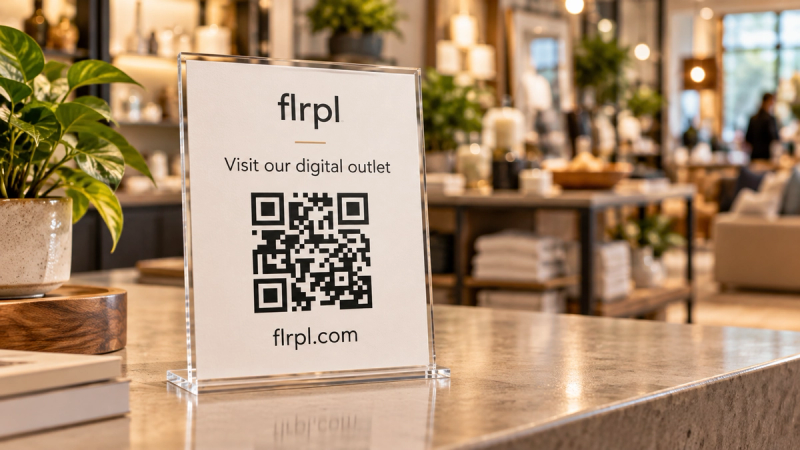
Your Store. Your Merchandise. Your Digital Outlet.
Give your store a digital outlet. See how FLRPL helps local retailers showcase products, share their branded storefront, and connect with nearby shoppers.


You Don't Need Everyone to See It
Local merchandise doesn't need everyone to see it. Explore why proximity, availability, timing, and relevance all matter in local retail discovery.

Not Every Drop Has to Be a Deal
A Drop doesn't require a markdown. See how retailers can use FLRPL to feature new arrivals, seasonal merchandise, distinctive products, deals and more.
Discover What's Waiting Nearby
Browse inventory from verified local retailers near you.