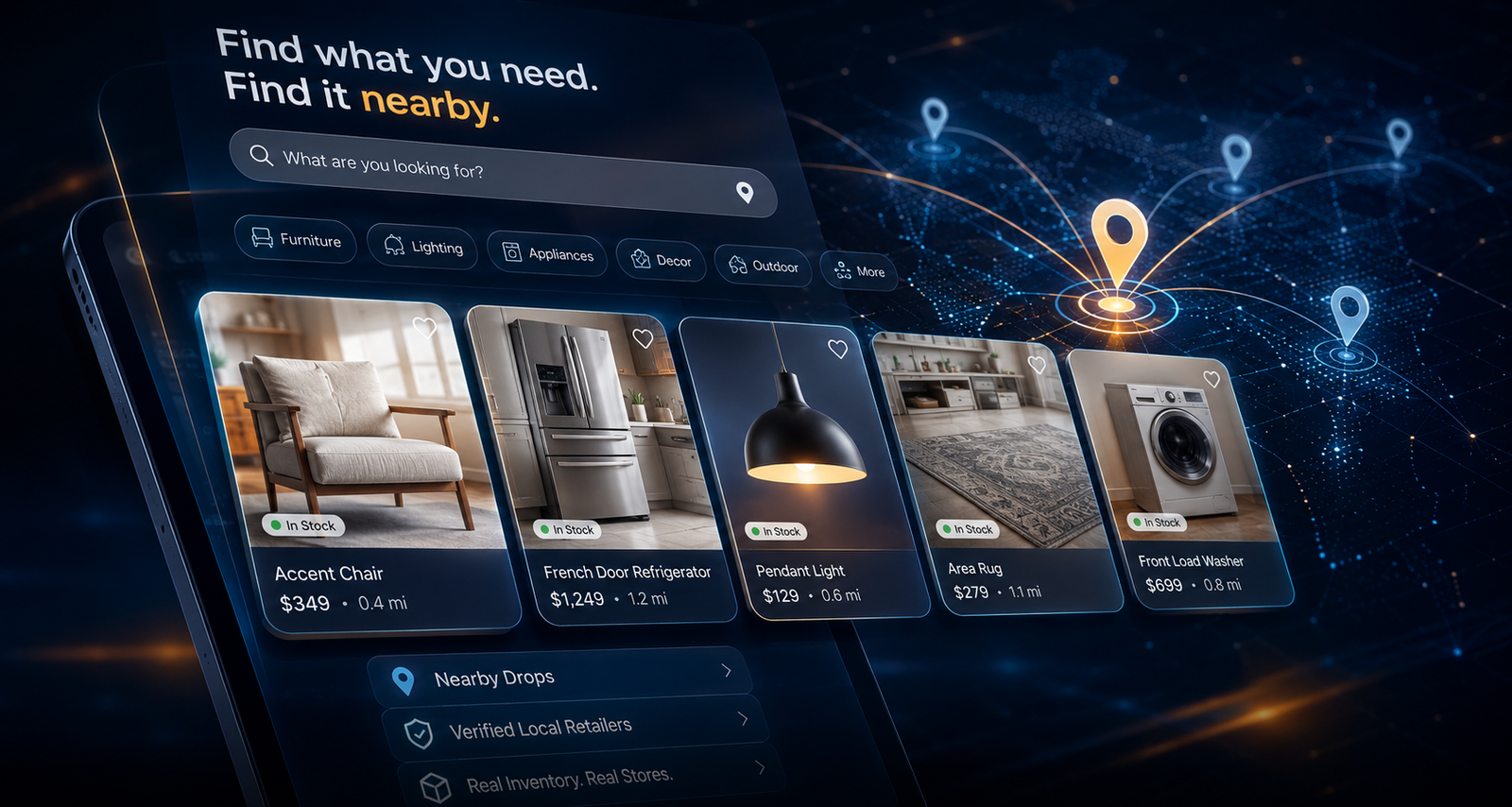
Give Shoppers Another Way to Find You
Shoppers discover retailers in different ways. See how product-level discovery gives local inventory another path to be found—without replacing the channels retailers already use.

FLRPL Editorial Team
Author
TL;DR
- Shoppers don't all discover retailers the same way — some start with a store, others start with a search, a recommendation, or a specific product.
- Physical and digital discovery coexist. One doesn't replace the other.
- Store-level discovery answers "here's our store." Product-level discovery answers "here's something we have that fits what you need right now."
- FLRPL adds an inventory-led discovery path. It doesn't ask retailers to give up their website, search presence, social media, or storefront.
- Local availability is part of how shoppers decide whether a visit is worth it.
- Another relevant path means another possible opportunity to be encountered — not a promise of traffic or sales.
- The Drop can be the shopper's introduction to a retailer they've never heard of.
Two shoppers are looking for the same store, and neither of them knows it yet.
The first has been there before. She remembers the name, opens Maps, and drives straight there. For her, the store is the starting point. Everything else — the drive, the parking lot, the front door — follows from already knowing where she's headed.
The second has never heard of the place. He's not looking for a store at all. He's looking for a specific floor-model dishwasher, in stainless, under a certain price, available this week. He doesn't type a retailer's name into anything, because he doesn't have one. He types what he needs.
If the second shopper's search happens to surface the exact appliance sitting on that store's floor, he may end up walking through the same front door as the first shopper — without ever having heard of the store until the moment the product introduced him to it.
Same destination. Different doors.
That distinction is worth sitting with, because it's easy to assume every shopper arrives the same way: they hear about you, they look you up, they come in. Plenty do. But plenty of retail discovery doesn't start with a retailer's name at all. It starts with a need, a category, a price point, or a specific item — and the retailer may become part of the answer.
There Is No Single Front Door Anymore
Retail discovery used to be described as a funnel: awareness, consideration, purchase, in that order, moving one direction. That model was never fully accurate, and it's even less accurate now.
PwC's research on retail behavior describes something closer to a loop than a funnel. Shoppers often browse first in stores, then look to family and friends for recommendations, then go online for more research at search engines, digital marketplaces, brand sites, and social media. There isn't a single lane. There's a shopper moving between physical and digital touchpoints, sometimes in one sitting, sometimes over days, picking up information wherever it's useful.
The physical store hasn't disappeared from that journey. It remains part of a shopping process that increasingly moves between physical and digital environments. The point isn't that digital has replaced physical, or that any one channel has “won.” Shoppers assemble their own path from whatever sources are useful to them.
“Not every shopper uses the same door.”
Different Channels Do Different Jobs
It's tempting to treat every discovery channel as a smaller version of the same thing — different shelves in the same store. They're not. A storefront does something a website can't. A website does something search can't. None of them do what the others do, and none of them need to.
The storefront creates physical presence: something to walk past, walk into, touch. The website gives shoppers a controlled place to understand the retailer — its assortment, credibility, services, location, and story. Search and maps help someone locate options they don't yet have a preference among. Social media builds familiarity and engagement over time. Word of mouth builds trust before a shopper ever interacts with the business directly.
Your Website Isn't Your Discovery Strategy made the case that a website is built to serve people who already know to look for it — it's a destination, not a discovery engine on its own. Product-level discovery works from the opposite direction. It doesn't wait for someone to arrive already interested in a specific retailer. It starts with the thing itself.
Store-level discovery says: here is our store, here's what we're about, here's why you should remember us.
Product-level discovery says something narrower and, for a certain kind of shopper, more useful: here is something we actually have, right now, that might be what you're looking for.
Store-level discovery says, "Here we are." Product-level discovery can say, "We have what you're looking for."
Neither replaces the other. They're built to answer different questions.
What Product-Level Discovery Adds
A shopper doesn't always begin with a store in mind. Sometimes they begin with a category, a condition, a size, a color, a brand, a price ceiling, or simply "I need this today, near me." Sometimes the Product Gets Found First made that case directly — that the item itself can be the thing a shopper encounters before they know anything about who's selling it.
This article picks up where that one leaves off. If the product can make the introduction, the next question is why that matters enough to build around. The answer is that a retailer's other channels are mostly organized around the retailer's identity — the name, the brand, the story. Product-level discovery is organized around what is actually available. That gives the retailer a chance to become relevant to someone who may never have thought to search for the retailer by name.
Another Door, Not a Replacement
A retailer already has a front door. The website can be another. Search can be another. Social media, word of mouth, a marketplace listing — each is its own possible entrance into awareness. Product-level discovery adds one more: an entrance built around the specific, actual inventory sitting inside the store right now.
That's worth qualifying carefully, because the metaphor can run away from itself. Not every door gets equal traffic. Not every shopper walks through every door, or even knows it's there. Adding an entrance doesn't hand a retailer a new customer — it hands them another place where a customer might show up.
“Another door is not automatically another customer. It is another possible entrance.”
The value of the idea isn't that it guarantees anything. It's that a retailer doesn't have to bet everything on a single path being discovered. If a shopper never finds the website, never sees the social post, never hears the recommendation — there can still be another way in, built around the product itself.
Why Local Inventory Makes This Different
Not all inventory benefits equally from this kind of discovery, and it shouldn't be described as if it does. Product-level discovery becomes particularly relevant when the merchandise itself is specific enough that generic store promotion doesn't fully describe it: floor samples, open-box units, clearance, overstock, discontinued goods, one-off pieces, showroom inventory that will never appear the same way twice.
Why Great Local Inventory Often Goes Unseen laid out the underlying problem — that this kind of inventory is often exactly the merchandise a retailer struggles to market well, because it doesn't fit neatly into a catalog or a recurring campaign. A floor sample sofa isn't "the sofa," it's the one sofa, in that condition, at that price, available until it isn't.
That combination — product, condition, price, location, and availability, all attached to one real item — answers a question that a homepage or a general ad usually can't: does anyone near me have this exact thing? It doesn't guarantee a sale. But it can provide a more precise answer than most store-level marketing is built to give.
Pre-Visit Certainty Matters
Before any of that inventory gets a chance to matter, a shopper has to decide whether visiting is worth their time. Research on that decision is consistent: shoppers increasingly try to answer it before they leave the house.
ICSC, citing Klarna's Shopping Pulse research, reports that 84% of U.S. shoppers sometimes or often research online before going in-store. Google's research on local retail behavior finds something more specific: 50% of surveyed consumers checked product inventory before going to a store.
The Sale Doesn't Start in the Showroom made this point in more depth — that by the time a shopper physically arrives, a lot of the deciding has already happened somewhere else. Knowing that a product actually exists, at a real price, in real condition, before making the trip is part of what makes the trip feel worth making at all. That's not a marketing insight so much as a practical one: uncertainty is friction, and reducing it is useful regardless of which channel does the reducing.
Where FLRPL Fits
This is the part of the idea FLRPL was built around.
FLRPL gives verified brick-and-mortar retailers another place to make inventory they already have discoverable — real items, not catalog placeholders. A retailer builds a Drop around an actual product: what it is, its condition, MSRP alongside the FLRPL price, where it is, and whether it's still available.
The shopper doesn't have to begin with the retailer's name. They can begin with what they're looking for.
“On FLRPL, the store does not always have to be the shopper's starting point. The Drop can be.”
Your Inventory Can Become Part of Your Marketing argued that inventory itself — not just the promotional material built around it — can have discovery value. FLRPL puts that idea into practice: a discovery environment built around the products themselves, not simply the promotion of the store carrying them.
FLRPL is designed to add a discovery path that begins with what the retailer actually has.
And importantly, that path is additive. FLRPL was not built to ask retailers to abandon the channels they already use. Their website matters. Their search presence matters. Social media, advertising, customer relationships, and the physical storefront all have a role.
FLRPL was built to add another one.
A discovery path organized around specific, locally available inventory — giving the product itself an opportunity to introduce the retailer to a shopper who may not have started by looking for that retailer at all.
Why Accuracy Matters
An additional discovery path is only as good as the information behind it. If a Drop shows a product that's already sold, a price that's stale, or a condition that doesn't match reality, the shopper who finds it isn't gaining anything — they're walking into a disappointment the listing created.
That means the details actually matter: current availability, accurate pricing, an honest description of condition, photography that shows the real item, and clear identification of which retailer and location it's coming from. A listing that isn't kept current can undo the opportunity it was meant to create. This isn't a minor operational note — it's the difference between a discovery path that works and one that quietly erodes trust every time it doesn't.
AI Is Adding More Doors
The list of ways a shopper can start their search keeps growing, and AI tools are the newest addition to it. Recent research from IBM and NRF found that 72% of surveyed consumers still shop in stores, while 45% turn to AI for help during their buying journeys, and 41% specifically use AI to research products.
That's worth noting for one reason in particular: new discovery methods are being added to existing ones, not necessarily replacing them. AI is simply one more place a shopper's question might start. Retail discovery keeps gaining entry points — it doesn't consolidate down to fewer of them.
Another Door Does Not Mean Another Customer
None of this should be overstated. Another discovery path doesn't guarantee attention. Attention doesn't guarantee consideration. Consideration doesn't guarantee a visit, and a visit doesn't guarantee a sale. The Sale Is Only One Possible Outcome made that distinction plain, and it holds here too: opportunity and outcome are not the same thing, and treating them as interchangeable is how a good idea turns into an overpromise.
The Best Deals Never Make the Shortlist described inventory that's genuinely worth a shopper's attention but never gets the chance to be considered in the first place, simply because nobody sees it. That's the actual gap product-level discovery is meant to close — not the sale itself, but the chance to be seen at all.
Another door is not automatically another customer. It's another possible entrance — one door among several, none of them guaranteed, all of them worth having.
The Opportunity
Every day, independent retailers already have inventory waiting to be discovered.
Floor samples.
Open-box merchandise.
Clearance inventory.
Overstock.
Discontinued products.
One-of-a-kind finds.
Inventory already sitting on showroom floors.
That's why FLRPL exists.
FLRPL helps verified local retailers create visibility for inventory they already have, making it easier for nearby shoppers to discover what's available before they ever visit the store.
FLRPL.
Your Digital Outlet for Local Inventory.
Visibility creates discovery.
Related Articles
Your Store. Your Merchandise. Your Digital Outlet.
Give your store a digital outlet. See how FLRPL helps local retailers showcase products, share their branded storefront, and connect with nearby shoppers.


You Don't Need Everyone to See It
Local merchandise doesn't need everyone to see it. Explore why proximity, availability, timing, and relevance all matter in local retail discovery.

Not Every Drop Has to Be a Deal
A Drop doesn't require a markdown. See how retailers can use FLRPL to feature new arrivals, seasonal merchandise, distinctive products, deals and more.
Discover What's Waiting Nearby
Browse inventory from verified local retailers near you.